

Notification Service Alternatives

7 Best Resend Alternatives for Developers in 2026

Yashika Mehta
May 28, 2026
TABLE OF CONTENTS

Last Updated: May 2026

Resend's free tier sends 3,000 emails a month, but it caps you at 100 emails per day, and the Pro plan jumps to $20/month for 50,000. For teams that outgrow that ceiling, send high transactional volume, or need deliverability tooling Resend doesn't ship yet, the question becomes which Resend alternative fits the way you actually send email. The short answer: Postmark and Amazon SES cover the two ends of the spectrum, with SendGrid, Mailgun, MailerSend, Loops, and SMTP2GO filling the middle on price, scale, and feature depth.

Resend earned its following with the best developer experience in the category: React Email components, an idempotent send API, and a dashboard that works on day one. Most teams looking for an alternative aren't unhappy with the DX. They're hitting one of four walls: per-email cost at scale, deliverability operations on shared pools, the daily send cap on free and lower tiers, or the need for marketing and lifecycle features alongside transactional sends.

This guide compares 7 Resend alternatives. Each one wins on at least one of those dimensions. Pricing was verified in May 2026 from every vendor's public pricing page.

Why Teams Look for a Resend Alternative in 2026

Resend is a strong default for modern JavaScript teams. Most switches come down to one of five reasons.

  • The daily send cap. The free tier is limited to 100 emails per day and 3,000 per month, per Resend's pricing page. Bursty transactional traffic (password resets after an outage, a sign-up spike) can hit the daily wall even when the monthly allowance has room.
  • Per-email cost at scale. Resend Pro is $20/month for 50,000 and $35/month for 100,000. That is competitive, but Amazon SES at $0.10 per 1,000 is an order of magnitude cheaper once volume climbs into the millions.
  • Deliverability operations. Resend manages shared-pool reputation, but teams that need granular suppression handling, managed IP warmup, or inbox-placement analytics often want a vendor with deeper deliverability tooling.
  • Marketing and lifecycle features. Resend added Broadcasts and Audiences, but it is transactional-first. Teams that want drag-drop campaigns, automation journeys, or contact-based marketing look elsewhere.
  • Production maturity at the top end. Resend is young. Some teams sending business-critical mail at high volume still prefer an incumbent with a longer track record and a larger support organization.

If none of these is a pain point and you live on the Next.js or React stack, Resend is hard to beat. The list below is for teams who have hit one of those five walls.

How We Evaluated These Alternatives

Every tool below was assessed on six dimensions:

  1. Developer experience. SDK quality, docs, webhook event model, idempotency, framework fit.
  2. Free tier and entry pricing. Daily caps, monthly allowance, first paid tier.
  3. Cost at scale. Per-1,000 economics as volume climbs into the hundreds of thousands.
  4. Deliverability operations. Managed IP warmup, suppression handling, shared-pool reputation, inbox placement analytics.
  5. Template and marketing tooling. Editor, versioning, variables, automation, segmentation.
  6. Pricing transparency. Verified May 2026 from each vendor's public pricing page.

Which Resend Alternative Fits Your Team?

Pricing verified May 2026 from each vendor's public pricing page.

Tool Best for Free tier Entry paid plan Strength vs Resend
Postmark Transactional reliability 100/mo $15/mo (10K) Speed-to-inbox, support
Amazon SES Cost at scale 3K/mo (first year) $0.10 per 1K Cheapest at volume
SendGrid Scale + marketing 100/day trial $19.95/mo (50K) One vendor for both
Mailgun Deliverability tooling 100/day trial $15/mo (10K) Logs, validation, routing
MailerSend Cheap + drag-drop UI 500/mo $5.60/mo (5K) Lowest entry price
Loops Lifecycle + transactional 1K contacts / 4K sends Quote-based Marketing automation
SMTP2GO Managed SMTP relay 1K/mo $10/mo (10K) SMTP-first, legacy apps

1. Postmark

Postmark is the closest peer to Resend on transactional focus, and the one teams switch to when speed-to-inbox and support quality matter more than the React-native authoring story. Where Resend is transactional-first with a modern editor, Postmark is transactional-only with a long reputation for fast delivery and separate Message Streams for transactional versus broadcast traffic.

Key features:

  • Message Streams that isolate transactional from broadcast traffic
  • 45-day log retention by default
  • Inbound email parsing with webhooks
  • Template versioning with draft and live states
  • Detailed bounce and spam webhook payloads

Pricing: Free tier 100 emails/month. Basic from $15/month for 10,000 emails; Pro $16.50/month and Platform $18/month, all starting at 10,000. Overage runs from $1.20 to $1.80 per 1,000 depending on tier. Postmark pricing, verified May 2026.

Ratings: G2 profile (listed under ActiveCampaign Postmark).

Pros: Strong transactional deliverability, clean dashboard out of the box, fast and well-regarded support.

Cons: Transactional-only, so no marketing automation; per-1,000 cost is higher than SES at scale; no in-app or push channels.

Best for: Teams that want rock-solid transactional delivery and responsive support over modern authoring tooling.

Visit Postmark

2. Amazon SES

Amazon SES is the cheapest credible alternative on this list at $0.10 per 1,000 outbound emails. It is the opposite of Resend on philosophy: SES gives you SMTP and a sender reputation and leaves the dashboard, templates, suppression UI, and warmup playbook for you to build. Teams move from Resend to SES when volume is high enough that engineering hours cost less than the per-email savings, and they already have AWS infrastructure.

Key features:

  • Pay-as-you-go pricing with no subscription or minimum
  • SMTP and HTTP API access
  • Configuration sets for event publishing via SNS
  • Managed and standard dedicated IP options
  • Virtual Deliverability Manager add-on for engagement analytics

Pricing: No subscription. $0.10 per 1,000 outbound emails, pay-as-you-go. New AWS accounts get 3,000 message charges free per month for the first 12 months. Dedicated IPs from $15/month (managed) or $24.95/month (standard). Amazon SES pricing, verified May 2026.

Ratings: G2 profile.

Pros: Cheapest sending at scale by a wide margin, deep AWS integration, proven infrastructure reliability.

Cons: No native dashboard, templates, or marketing features; new accounts start in a sandbox with a 200/day cap until production access is approved; you operate deliverability yourself.

Best for: High-volume senders already on AWS who have the engineering bandwidth to operate email infrastructure. See our full Amazon SES alternatives breakdown if SES itself is the thing you're escaping.

Visit Amazon SES

3. SendGrid

SendGrid, now part of Twilio, is the alternative teams shortlist when they want one vendor for transactional and marketing email under a single bill. Compared with Resend, the draw is breadth: automated IP warmup, a Marketing Campaigns product, and the largest third-party integration library in the category.

Key features:

  • Email API and Marketing Campaigns on one platform
  • Event Webhook with delivery, bounce, click, open, and spam events
  • Automated IP warmup for new dedicated IPs
  • Email Validation API for list hygiene
  • Dynamic templates with Handlebars

Pricing: Free trial of 100 emails/day for 60 days (no longer a permanent free tier). Essentials from $19.95/month for 50,000 emails. Pro from $89.95/month for 100,000 and up to 2.5M. SendGrid pricing, verified May 2026.

Ratings: G2 profile.

Pros: Largest integration library in the category, automated IP warmup, combined transactional and marketing in one account.

Cons: No permanent free tier since the 2025 trial change, support quality complaints common on lower tiers, dashboard feels dated against newer entrants.

Best for: Teams that want one vendor for transactional and marketing, or that already run on Twilio. Our SendGrid alternatives guide covers the reverse migration.

Visit SendGrid

4. Mailgun

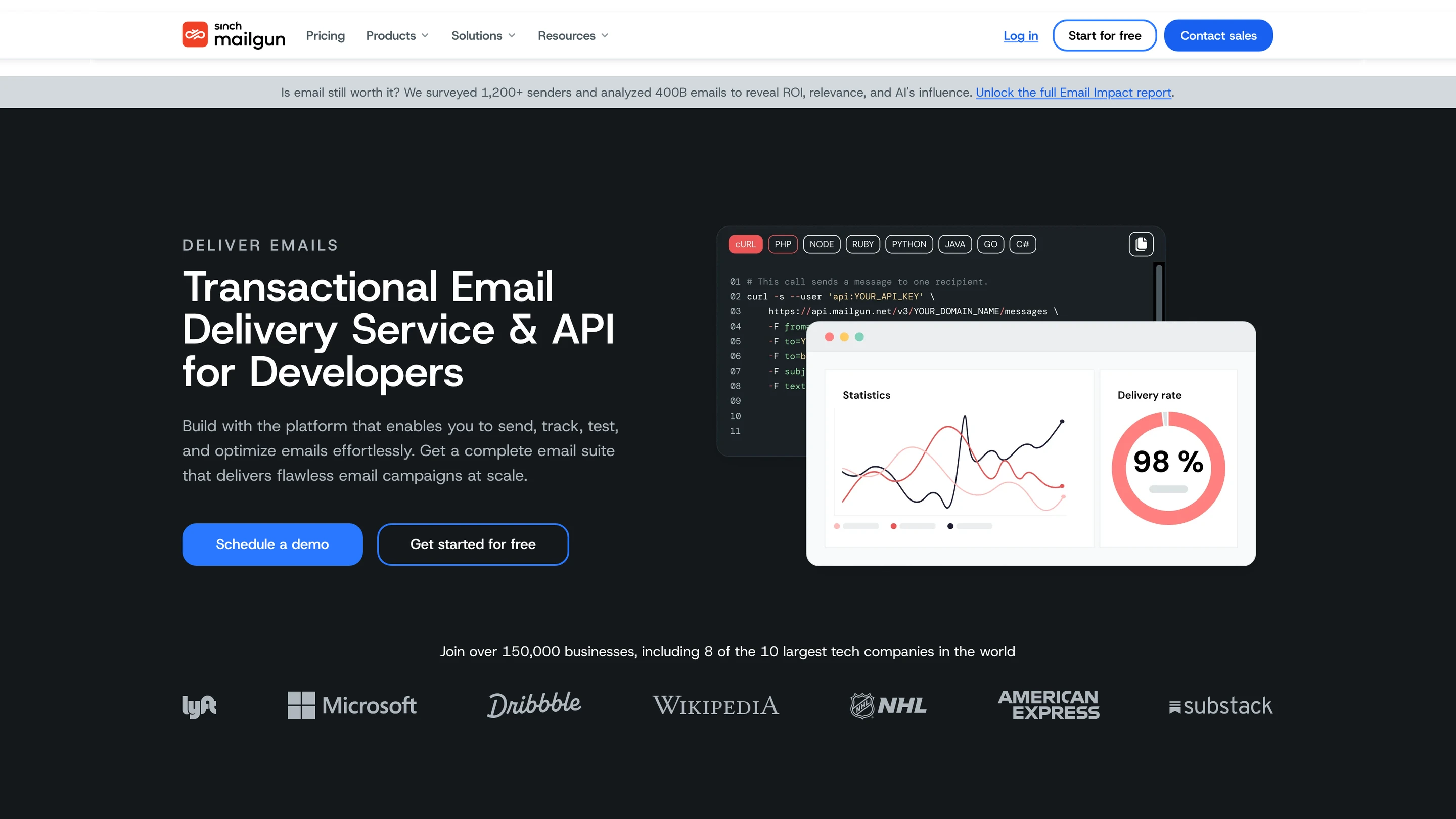
Mailgun is the Resend alternative for teams that want deliverability tooling and programmatic control with a real dashboard. Logs, analytics, inbound parsing, email validation, and routing all ship out of the box, which makes it a fit when email is a core system component rather than a side feature.

Key features:

  • Email API and SMTP with the same feature surface
  • Inbound routing with webhooks
  • Real-time logs and analytics
  • Email validation API
  • Dedicated IPs and IP pools

Pricing: No permanent free tier (100 emails/day trial). Basic from $15/month for 10,000. Foundation $35/month for 50,000. Scale $90/month for 100,000. Overage from $1.10 to $1.80 per 1,000. Mailgun pricing, verified May 2026.

Ratings: G2 profile.

Pros: Strong deliverability tooling, API and SMTP parity, mature inbound parsing and validation.

Cons: No permanent free tier, log retention short on entry tier, support quality complaints common.

Best for: Teams that treat email as core infrastructure and want validation, routing, and analytics in one API. See our Mailgun alternatives guide for the comparison set.

Visit Mailgun

5. MailerSend

MailerSend is the lowest-entry-price alternative on this list and the one to pick when non-developers need to touch templates. It pairs an affordable transactional API with a drag-drop editor, sitting between bare-metal SES and the marketing-first ESPs.

Key features:

  • Drag-drop and HTML template editors in the same UI
  • API, SMTP, and SDKs for Node, PHP, Python, Go, Ruby, Laravel
  • Inbound routing with parsing
  • Multi-user roles for separating marketing and engineering access
  • Email verification credits on most plans

Pricing: Free tier 500 emails/month plus 10 verification credits. Hobby at $5.60/month for 5,000 emails. Starter and Professional cover 50,000 with overage at $0.90 per 1,000. MailerSend pricing, verified May 2026.

Ratings: G2 profile.

Pros: Lowest paid entry price on this list, clean editor non-developers can use, multi-tenant roles built in.

Cons: Smaller deliverability operations team than the incumbents, advanced analytics are weaker, daily sending caps apply on lower tiers.

Best for: SMB and product teams that need an affordable API plus a real UI for marketing and design teammates.

Visit MailerSend

6. Loops

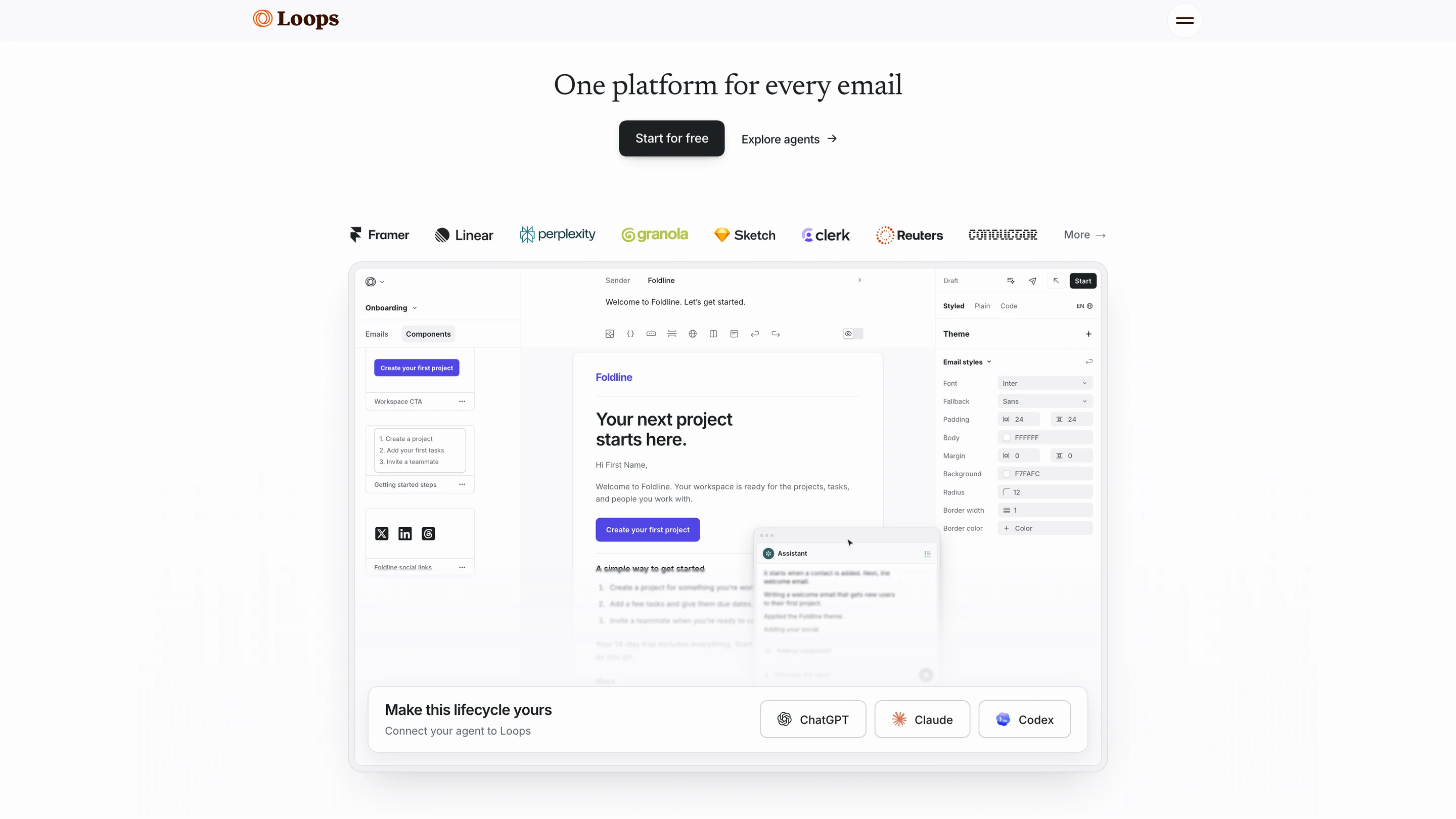
Loops is the alternative for teams that liked Resend's modern feel but want lifecycle marketing in the same tool. It targets SaaS companies, combining transactional sends with a campaign and automation builder and a non-technical-friendly editor. Transactional email is included at no extra charge, which is unusual in the marketing-first tier.

Key features:

  • Transactional email API alongside marketing campaigns
  • Visual loops (automation) builder for lifecycle emails
  • Contact properties and event-based triggers
  • Modern editor aimed at SaaS teams
  • No charge for team seats or send volume on paid plans

Pricing: Free plan up to 1,000 subscribed contacts and 4,000 sends/month, all features included. Paid plans remove the contact cap and Loops branding; pricing is by subscribed-contact count and quoted on request. Transactional sending is included at no additional charge. Loops pricing, verified May 2026.

Pros: Lifecycle marketing and transactional in one modern tool, transactional included free, SaaS-focused editor.

Cons: Paid pricing is quote-based rather than published, contact-based model can cost more than send-based pricing for transactional-heavy use, younger and smaller than the incumbents.

Best for: SaaS teams that want lifecycle marketing plus transactional in one modern platform rather than a pure send API.

Visit Loops

7. SMTP2GO

SMTP2GO is a managed SMTP relay, the alternative for teams whose easiest integration is plain SMTP rather than an HTTP API: WordPress sites, legacy applications, or anything where adding an SDK is more work than pointing at a relay. The pitch versus Resend is no SDK requirement, no warmup, and a real dashboard.

Key features:

  • SMTP relay with global points-of-presence
  • HTTP API with the same feature surface as SMTP
  • Real-time analytics dashboard
  • Dedicated IPs and subaccounts
  • Spam and bounce reporting

Pricing: Free tier 1,000 emails/month with a 200/day cap. Starter at $10/month for 10,000. Professional at $75/month for 100,000. Premier custom for 3M+. SMTP2GO pricing, verified May 2026.

Ratings: G2 profile.

Pros: Cheap 100,000-email tier at $75/month, no warmup or sandbox, strong reliability reputation.

Cons: Less developer-modern (no React Email or component authoring), analytics simpler than Postmark or SendGrid, marketing features minimal.

Best for: WordPress sites, legacy apps, and teams that want a managed SMTP relay with a usable dashboard.

Visit SMTP2GO

How to Choose the Right Resend Alternative

The shortlist depends on which Resend limitation actually hurts.

  • If you need rock-solid transactional delivery and support: Postmark.
  • If per-email cost at scale is the issue: Amazon SES, or SMTP2GO for a managed middle ground.
  • If you want transactional and marketing under one vendor: SendGrid or Loops.
  • If deliverability tooling is the gap: Mailgun for logs, validation, and routing.
  • If price is the deciding factor: MailerSend at $5.60/month for 5,000, or SMTP2GO at $10/month for 10,000.
  • If non-developers need to author emails: MailerSend or Loops for the drag-drop editor.

One thing worth checking before you commit: how each vendor reports inbox placement. Inbox placement problems often surface days after the send, and the depth of that reporting varies widely across these tools.

Or: Keep Resend, Put an Orchestration Layer in Front

The option most teams overlook is that you don't have to migrate at all. If Resend's developer experience is the part you like, the real question is whether Resend has to be your entire notification stack, or whether it can be the email delivery node underneath something that handles templates, routing, preferences, and the other channels you'll eventually add.

That's the layer SuprSend sits at. It's notification infrastructure: you integrate once, and SuprSend orchestrates delivery across whichever channel and vendor combination you configure. Resend is a first-class email vendor in SuprSend, so you keep your Resend account and reputation, and SuprSend handles what a send API doesn't.

Concretely, SuprSend adds on top of any email vendor:

  • A template editor with versioning, variables, and i18n across every channel
  • Real-time logs and analytics across every send and channel
  • Vendor fallback: if Resend has a regional issue, retry through SES or SendGrid automatically
  • A user preference center so users control what they receive
  • SMS, push, WhatsApp, in-app inbox, and Slack as first-class channels alongside email
  • Visual workflows with delays, batching, branching, and timezone-aware delivery

The trade is that you stop owning the orchestration plane. The savings come in engineering time, not unit cost. The CPaaS vs notification infrastructure guide walks through when that trade is worth making.

Frequently Asked Questions

What is the best Resend alternative for transactional email?

Postmark is the most direct alternative for transactional-only sending, with a strong speed-to-inbox reputation and responsive support. For teams optimizing for cost at scale, Amazon SES is an order of magnitude cheaper per email, with the trade-off that you operate the dashboard and deliverability yourself.

Is Resend cheaper than SendGrid?

At low volume, yes. Resend Pro is $20/month for 50,000 emails, while SendGrid Essentials is $19.95/month for the same 50,000. The two are roughly even at entry, but pricing diverges at scale depending on dedicated IP needs and feature tiers. Both were verified in May 2026.

Why would I leave Resend?

The common reasons are the 100-emails-per-day cap on the free tier, per-email cost once volume climbs into the millions, the need for deliverability tooling like managed warmup and validation, or the need for marketing and lifecycle features that a transactional-first API doesn't provide.

What is the closest alternative to Resend's developer experience?

Loops is the closest on modern feel for SaaS teams, adding lifecycle automation to transactional sends. Postmark is the closest on transactional reliability. None of the incumbents match Resend's React Email authoring story directly, which is part of why teams keep Resend and add an orchestration layer instead.

Can I use multiple email vendors at once?

Yes, and many teams do for redundancy. The cleanest way is to integrate a notification infrastructure layer that supports vendor fallback, so a primary vendor handles normal traffic and a secondary takes over automatically during an outage or throttle. This avoids hard-coding multiple SDKs into your application.

Does Resend have a permanent free tier?

Yes. Resend's free plan sends 3,000 emails per month with a 100-per-day cap, per its pricing page verified in May 2026. That is more generous than SendGrid, which moved to a 60-day trial, but tighter on the daily cap than Brevo's 300-per-day allowance.

TL;DR

Seven credible Resend alternatives in 2026: Postmark, Amazon SES, SendGrid, Mailgun, MailerSend, Loops, and SMTP2GO. Resend wins on developer experience, so most teams switch for a specific reason: transactional reliability (Postmark), cost at scale (Amazon SES, SMTP2GO), transactional plus marketing in one vendor (SendGrid, Loops), deliverability tooling (Mailgun), or lowest entry price (MailerSend). Or keep Resend and put a notification orchestration layer in front of it to handle templates, routing, preferences, and the other channels.

Next Steps

If email is one of several channels you need to send (or will need to soon), the email notification guide covers the architecture decisions, and SuprSend's pricing includes 10,000 free notifications per month across every channel, on top of whichever email vendor you keep.

Start building for free or book a demo to see how orchestration fits on top of Resend.

Written by:
Yashika Mehta
Growth & Strategy, SuprSend
Implement a powerful stack for your notifications
By clicking “Accept All Cookies”, you agree to the storing of cookies on your device to enhance site navigation, analyze site usage, and assist in our marketing efforts. View our Privacy Policy for more information.