Notification Service Alternatives

9 Best FCM Alternatives for Developers in 2026

Yashika Mehta
May 21, 2026
TABLE OF CONTENTS

Last Updated: May 2026

Firebase Cloud Messaging is free, scales to billions of devices, and remains the default Android push transport. So why would a team look for an alternative? Three reasons: FCM stops at delivery (no segmentation, no rich analytics, no scheduling, no A/B testing), iOS push still goes through APNs separately, and Google deprecated the legacy FCM HTTP and XMPP APIs on June 20, 2024, forcing a migration to FCM HTTP v1 that not every codebase has finished yet. (Source: Firebase FCM API deprecation FAQ)

This guide compares 9 FCM alternatives in 2026 across multi-platform support, segmentation depth, analytics, free tier, and verified pricing. Every per-message rate or plan price was fetched directly from each vendor's pricing page in May 2026. The list covers managed push platforms, AWS-native push delivery, and one fully FCM-independent push provider for teams that need a non-Google delivery path.

What FCM Actually Does (and Doesn't Do)

FCM is a delivery transport. It takes a token plus a payload from your server and pushes the payload to a specific Android device, web browser, or (via the FCM-to-APNs bridge) an iOS device. It does not handle segmentation beyond simple topics, does not store templates, does not schedule sends with conditional logic, and does not provide rich analytics beyond delivery and open events.

Most teams that say "we need an FCM alternative" actually mean "we need a layer above FCM that adds segmentation, templates, scheduling, analytics, and a single dashboard across Android, iOS, and web." That layer is what the nine services below provide, in different shapes and at different price points.

For the wider push channel context, see push vs SMS and the three-channel guide.

How to Evaluate an FCM Alternative

Six criteria separate a real FCM alternative from a tool that handles one piece of the problem.

  • Platform coverage: Android (FCM under the hood or independent), iOS (APNs under the hood), web push, and ideally Windows, macOS, and wearables. Some alternatives only handle one platform well.
  • Segmentation and targeting: Tags, user attributes, behavioral events, geo, time zone, language. FCM's topics-only model is too coarse for most production use.
  • Templates and personalization: Dynamic variable substitution, rich media, localization. FCM has no template store; you assemble payloads in application code.
  • Scheduling and journeys: Send at user local time, conditional delays, branching workflows. FCM has none of this.
  • Analytics and observability: Delivery, opens, conversions, A/B test results, per-message logs. FCM gives basic delivery stats only.
  • Pricing model: Free, per-subscriber, per-message, per-MAU. The right model depends on your traffic shape.

9 Best FCM Alternatives for Developers

1. SuprSend

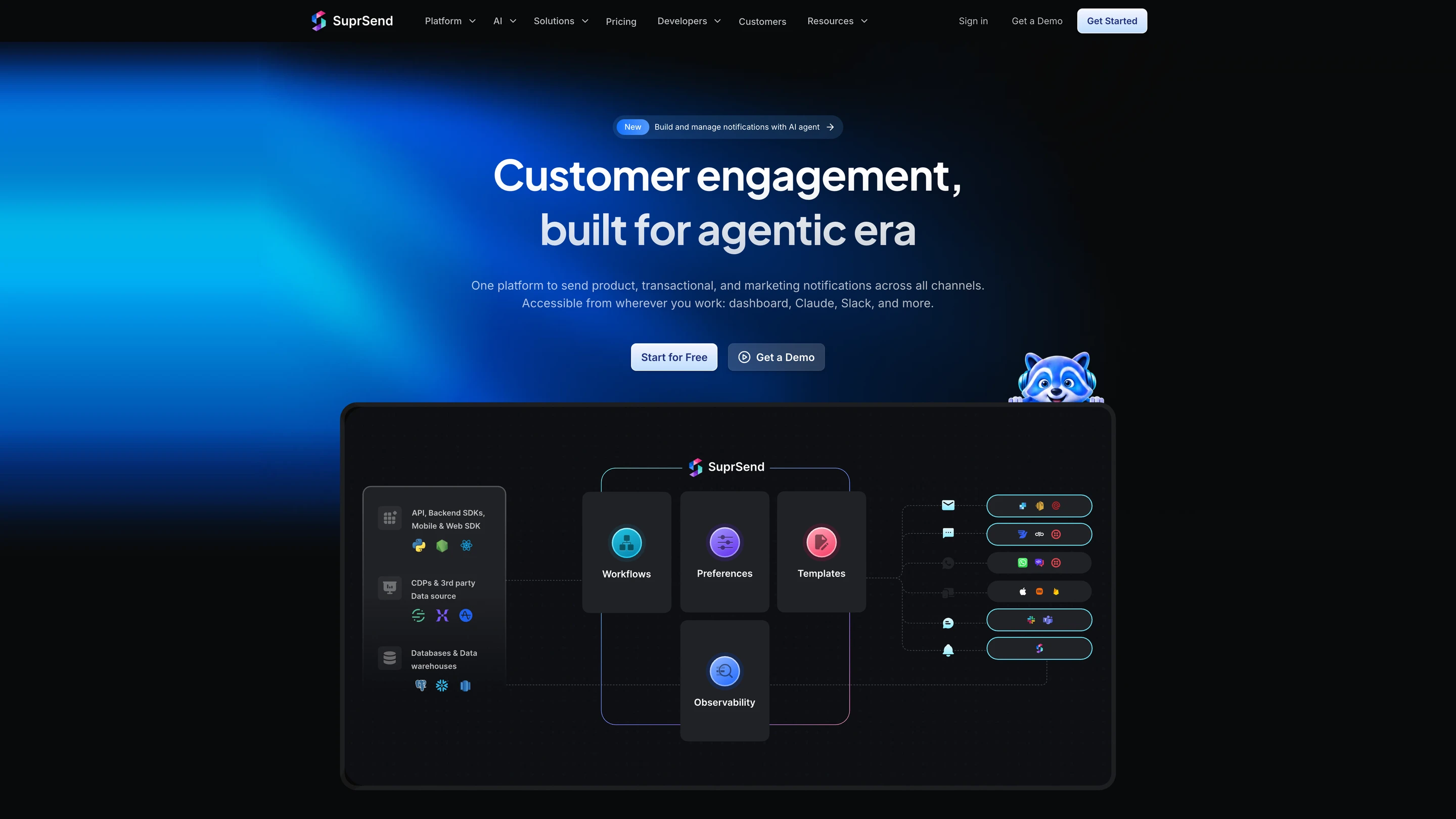
SuprSend is a notification infrastructure platform that wraps FCM, APNs, and other delivery transports with the orchestration layer FCM deliberately omits. When you move beyond FCM, the actual gap is rarely the transport: it is templates, cross-channel routing, user preferences, channel fallback when push tokens go stale, and per-notification logs that show exactly what was attempted and what delivered. SuprSend provides that layer without replacing FCM under the hood.

For teams currently on FCM directly, the migration is additive: integrate your existing FCM and APNs credentials, keep the same Android and iOS SDKs, and route notification triggers through SuprSend's workflow engine instead of direct FCM API calls.

Key features:

  • Multi-channel from one API: mobile push (FCM, APNs), web push, email, SMS, in-app inbox, WhatsApp, Slack, MS Teams
  • Workflow engine with channel routing, vendor fallback, batching, digest, conditional delays, and throttle per user
  • First-class multi-tenancy: per-tenant templates, branding, vendor credentials, and preferences
  • Drop-in in-app inbox SDKs for React, Vue, Angular, Next.js, React Native, Flutter, Android, and iOS
  • Pre-built user preference center with category and channel-level opt-outs
  • Step-by-step per-notification logs across all vendors and channels
  • SOC 2 Type 2, HIPAA, and GDPR compliant

Pros: Covers the full orchestration layer FCM intentionally omits. Channel fallback (push to in-app inbox to email) configured once, applied to every workflow. Multi-tenancy first-class for B2B SaaS products. Generous free tier at 10,000 notifications/month across all channels.

Cons: More platform than a team needs if push is the only channel and orchestration is not a requirement. Self-hosted deployment not yet generally available; Novu is the current option for teams with hard self-hosting requirements.

Pricing (verified May 2026 from suprsend.com/pricing): Free 10,000 notifications/month across all channels. Essentials $79/month for 50K. Business $299/month with batching, digest, preferences, multi-tenancy, and Objects. Enterprise custom with dedicated SLAs, RBAC, SSO, and audit trail.

Best for: Teams where push is one channel of a multi-channel notification stack, B2B SaaS products that need per-tenant configuration, and any team that needs the orchestration layer FCM leaves out.

2. OneSignal

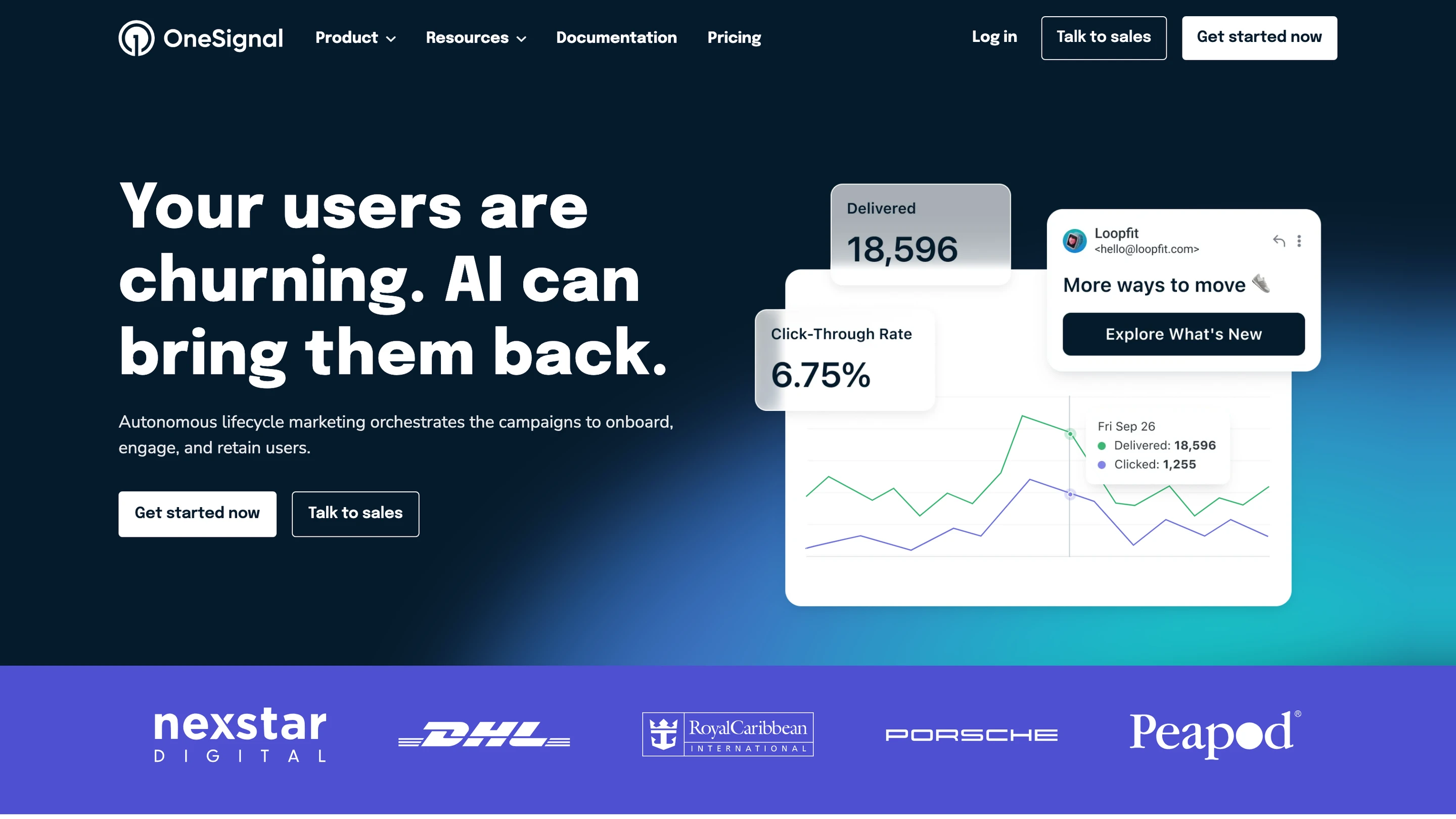
OneSignal is the most common managed push platform and the FCM alternative most developers learn first. It sits above FCM (Android), APNs (iOS), and W3C Web Push, adding segmentation, templates, scheduling, A/B testing, and analytics.

Key features:

  • Mobile and web push with unified API across Android, iOS, web
  • Email, SMS, in-app messaging on the same platform
  • Journey workflows with branching and delays
  • A/B testing and intelligent delivery scheduling
  • SDKs for iOS, Android, React Native, Flutter, Unity, Cordova, and major web frameworks

Pros: Most generous free tier for push-only use cases (unlimited mobile push subscribers). Mature platform with strong push delivery infrastructure. Large customer base and Stack Overflow footprint.

Cons: Pricing model is subscriber-tiered, not message-based, which can punish high-volume transactional traffic. In-app inbox, Slack, and MS Teams are not supported. Multi-tenancy is not first-class. Pro tier requires an annual contract.

Pricing (verified May 2026 from onesignal.com/pricing): Free $0/month with 10,000 monthly emails, unlimited mobile push, max 10,000 web push subscribers per send. Growth from $19/month plus usage. Professional and Enterprise custom with annual contracts.

Best for: Consumer apps where mobile and web push are the primary channels and per-subscriber pricing fits the audience pattern.

3. Airship

Airship is the enterprise-leaning option in this category. It is the longest-running push platform (originating as Urban Airship in 2009) and is most commonly picked by media, retail, airlines, and large consumer brands.

Key features:

  • Push, in-app, SMS, email, web, mobile wallet channels
  • Deep segmentation by attributes, behavior, and predicted churn
  • Journey orchestration with conditional branching
  • Mobile wallet (Apple Wallet, Google Wallet) campaigns
  • Carrier-grade SLAs and dedicated customer success

Pros: Mature platform with the deepest enterprise customer base. Strong wallet and rich-media push capabilities. Robust analytics and predictive features.

Cons: Pricing is sales-only and significantly higher than developer-first competitors. Enterprise contracts typically run $25,000 to $500,000+ per year. Developer experience trails OneSignal and Pusher Beams. Overkill for early-stage products.

Pricing (May 2026): Quote-based, no published list price. Per Vendr transaction data, Growth contracts run $25K-$75K/year, Enterprise $200K-$750K+/year, depending on MAU count and channel scope. (Source: Vendr Airship pricing data)

Best for: Enterprises with 1M+ MAUs and complex multi-channel orchestration needs where carrier-grade SLAs and predictive analytics outweigh per-message price.

4. Pusher Beams

Pusher Beams is a pure push notification API focused on developer experience. It does not pretend to be an engagement platform; it is a clean abstraction over FCM and APNs with end-to-end encryption support for authenticated users.

Key features:

  • Unified push API for iOS, Android, and web
  • Device interests for topic-based targeting
  • Authenticated user model with end-to-end encryption
  • SDKs for Swift, Kotlin, Java, Node.js, Python, Ruby, Go, PHP, .NET
  • Unlimited notifications per device on all plans (no per-message fees)

Pros: Cleanest developer experience among managed push services. Unlimited notifications per device. Strong authentication model for sensitive use cases (banking, healthcare).

Cons: Push only. No email, SMS, in-app, or other channels. No journey builder or A/B testing. Lower throughput limits than enterprise platforms.

Pricing (verified May 2026 from pusher.com/beams/pricing): Free 2,000 devices. Startup $29/month for 10,000 devices. Pro $99/month for 100,000 devices. Unlimited notifications on all plans.

Best for: Developer teams that want a clean push API with predictable per-device pricing and no engagement-platform overhead.

5. Amazon SNS

Amazon SNS (Simple Notification Service) is AWS's pub/sub messaging service and supports mobile push to FCM, APNs, ADM, and Baidu Cloud Push. SNS is positioned as infrastructure, not as a managed engagement platform.

Key features:

  • Pub/sub messaging with mobile push as one delivery target
  • FCM, APNs, ADM (Kindle Fire), and Baidu Cloud Push support
  • Fan-out from SNS topics to multiple subscribers
  • IAM-based access control
  • Integration with AWS Lambda, SQS, EventBridge

Pros: Lowest per-message price among major options. Natural fit for AWS-native architectures. Pub/sub fan-out pattern is useful beyond push alone.

Cons: No segmentation, templates, A/B testing, or journey logic. You build all of that on top. No web push support (only mobile and a few legacy desktop platforms).

Pricing (May 2026): $0.50 per million mobile push notifications. First 1 million per month free. See aws.amazon.com/sns/pricing for full rates.

Best for: AWS-native engineering teams who want low-cost push delivery and will build segmentation, templates, and journeys in-house.

6. AWS End User Messaging

AWS End User Messaging is the surviving push, SMS, voice, and WhatsApp piece of Amazon Pinpoint. Pinpoint stopped accepting new customers on May 20, 2025 and reaches end of support on October 30, 2026; End User Messaging is the AWS-native go-forward path for transactional push. (Source: AWS Pinpoint end of support documentation)

Key features:

  • Mobile push (FCM, APNs), SMS, MMS, WhatsApp, text-to-voice
  • Push token management and lifecycle handling
  • IAM-based access control
  • EventBridge integration for delivery event streaming
  • Pay-per-message pricing with no monthly minimum

Pros: Natural fit for AWS-native teams. Multi-channel beyond just push (SMS, WhatsApp, voice). Pay-as-you-go with no platform fee.

Cons: No campaign management, templates, segmentation, or workflow logic. Documentation still catching up after the rebrand from Pinpoint. SDK is the standard AWS SDK rather than a dedicated push SDK.

Pricing (May 2026): Mobile push effectively free at low volume; rates align with SNS pricing. SMS, WhatsApp, and voice are billed per channel. See aws.amazon.com/end-user-messaging/pricing for current rates.

Best for: Teams migrating off Pinpoint who need transactional push plus SMS and WhatsApp in the same AWS-native stack.

7. WonderPush

WonderPush is a European-headquartered push notification service positioned on GDPR-friendly defaults and unlimited push volume. It is most often picked by EU-based teams that want EU data residency and transparent flat pricing.

Key features:

  • Mobile and web push with unified API
  • Segmentation by tags, attributes, and geo
  • A/B testing and scheduling
  • EU data residency by default
  • Unlimited notifications on all plans

Pros: Transparent flat pricing per subscriber tier. EU data residency. Unlimited push volume on every plan. Solid GDPR-default posture for European audiences.

Cons: Smaller ecosystem than OneSignal. Fewer SDKs and integrations. No in-app inbox, Slack, or Teams channels. Documentation is solid but lighter than competitors.

Pricing (May 2026): Free tier for low volume. Paid plans scale by monthly active subscribers, starting at around €1 per 1,000 MAUs on the lowest paid tier. See wonderpush.com/en/pricing for current rates.

Best for: EU-based teams that need GDPR-friendly push with flat per-subscriber pricing and no per-message variable cost.

8. Pushy

Pushy is the only major push service that does not rely on FCM or APNs as a delivery transport. It operates its own MQTT-based push infrastructure with persistent connections to user devices, which gives reliable delivery on Android even without Google Play Services (Huawei devices, AOSP builds, regions where Google services are blocked).

Key features:

  • FCM-independent push delivery via persistent MQTT connections
  • Works on Huawei, AOSP, and Google-service-free Android devices
  • iOS push via APNs (FCM not in the path)
  • Web push and desktop SDKs
  • Pay-per-device pricing

Pros: Only major option that bypasses FCM entirely. Reliable on Android devices without Google services. Predictable per-device pricing.

Cons: Smaller customer base than incumbents. Persistent MQTT connections use slightly more battery than FCM/APNs on standard Android devices. No segmentation, templates, or workflows beyond basic targeting.

Pricing (May 2026): Free tier for up to 100 devices. Paid plans from $39/month scaling by device count. See pushy.me/pricing for current tiers.

Best for: Teams that need push delivery on Android-without-Google-services (Huawei devices, regions where Google Play Services are unavailable, AOSP-based devices).

9. Braze

Braze is a customer engagement platform with strong push notification capabilities embedded in a broader marketing-automation stack. It is most often shortlisted alongside Airship and Iterable by enterprise marketing teams.

Key features:

  • Mobile push, web push, email, SMS, in-app, content cards
  • Canvas journey builder with branching and AI-recommended paths
  • Predictive segmentation and Sage AI features
  • Strong analytics with funnel and cohort views
  • Currents data export to Snowflake, BigQuery, Redshift

Pros: Strong analytics and segmentation. Mature platform with substantial enterprise customer base. Canvas journey builder is among the best in category.

Cons: Pricing is sales-only and enterprise-tier. Platform skews marketing rather than developer. Heavy implementation lift; typically 3-6 months to onboard. Overkill for transactional-only push.

Pricing (May 2026): Contact sales. Enterprise contracts typically run six figures annually based on MAU count and channel scope.

Best for: Marketing-led teams at enterprise scale where push is one channel of an integrated engagement strategy.

Which FCM Alternative Fits Your Stack?

name
Alternative Platform Coverage Free Tier Starting Paid Plan Best For
SuprSend Push (FCM/APNs), web push, email, SMS, in-app, WhatsApp, Slack, Teams 10K notifications/mo (all channels) $79/mo (50K) Multi-channel orchestration above FCM, B2B SaaS
OneSignal iOS, Android, web, plus email/SMS/in-app Unlimited mobile push, 10K emails $19/mo + usage Consumer apps, push-primary
Airship iOS, Android, web, wallet, plus SMS/email None $25K+/year Enterprise with 1M+ MAUs
Pusher Beams iOS, Android, web 2K devices $29/mo (10K devices) Clean push API, no engagement bloat
Amazon SNS FCM, APNs, ADM, Baidu 1M push/mo $0.50/M push AWS-native, build orchestration in-house
AWS End User Messaging FCM, APNs, plus SMS/WhatsApp/voice Pay-as-you-go Pay per message AWS-native multi-channel transactional
WonderPush iOS, Android, webLimited free tier ~€1 per 1K MAUs EU teams, GDPR-friendly
Pushy Android (incl. no-Google), iOS, web 100 devices $39/mo Android without Google services
Braze iOS, Android, web, plus email/SMS/in-app None Six-figure enterprise Enterprise marketing teams

For a broader push platform comparison, see best push notification platforms and the three-channel decision guide.

Frequently Asked Questions

Is Firebase Cloud Messaging being deprecated?

FCM itself is not being deprecated. The legacy FCM HTTP and XMPP APIs reached end of life on June 20, 2024, and developers must use the FCM HTTP v1 API going forward. The underlying push delivery service continues and remains free. (Source: Firebase FCM deprecation FAQ)

What is the best free FCM alternative in 2026?

For pure push use cases, OneSignal's free tier (unlimited mobile push subscribers, 10,000 monthly emails) is the most generous. Pusher Beams (2,000 devices free) is the cleanest developer experience. WonderPush has an EU-friendly free tier for low-volume teams.

Can I move off FCM entirely?

For Android push, the only mainstream FCM-independent option is Pushy, which uses persistent MQTT connections. iOS push always goes through APNs regardless of which alternative you pick (no other path exists). Most "FCM alternatives" still use FCM under the hood for Android delivery but add a platform layer above it.

Why do teams choose OneSignal over FCM?

FCM handles delivery but provides no segmentation, templates, scheduling, A/B testing, or rich analytics. OneSignal adds all of those plus a unified Android + iOS + web API. Teams typically switch when FCM's bare-bones model forces them to build segmentation and template logic in application code.

Is Amazon SNS a real FCM alternative?

SNS is a pub/sub messaging service with mobile push as one delivery target. It is the cheapest credible option for AWS-native teams but provides no segmentation, templates, or workflow features. If you need those, layer SNS with another tool or pick a managed push platform instead.

How do I send push notifications to Android devices without Google Play Services?

For Huawei devices, AOSP builds, or regions where Google services are blocked, FCM does not deliver. The mainstream options are Pushy (independent MQTT-based push) or vendor-specific services like Huawei Push Kit. SuprSend can route to Pushy as a delivery vendor while still abstracting the multi-channel orchestration on top.

Should I use FCM directly or use a managed push platform on top?

For prototypes and very early-stage products, FCM directly is fine. The infrastructure is free and the SDKs are mature. The pivot point is usually when you need segmentation beyond topics, templates with variables, scheduling, A/B testing, or analytics beyond basic delivery. Above that threshold, a managed platform saves enough engineering time to pay for itself.

Summary

The best FCM alternative in 2026 depends on what you optimize for. Pick SuprSend when push is one channel of a multi-channel stack and you need the orchestration layer FCM intentionally omits, OneSignal for the most generous free tier and a broad multi-channel platform, Airship for enterprise marketing scale, Pusher Beams for the cleanest pure push API, Amazon SNS for AWS-native low-cost push delivery, AWS End User Messaging for transactional push plus SMS in the AWS stack, WonderPush for EU GDPR-friendly defaults, Pushy for FCM-independent Android delivery, or Braze for enterprise engagement platforms.

Past a certain volume or when the second notification channel arrives, the better question is not which push service to choose but how to orchestrate push alongside email, SMS, and in-app inbox. Notification infrastructure platforms handle that layer so application code can stay focused on the event, not the delivery mechanics.

Want push notifications orchestrated alongside email, SMS, and in-app inbox from one API? Start building for free or book a demo to see how SuprSend handles push as one channel of a complete notification stack.

Written by:
Yashika Mehta
Growth & Strategy, SuprSend
Implement a powerful stack for your notifications
By clicking “Accept All Cookies”, you agree to the storing of cookies on your device to enhance site navigation, analyze site usage, and assist in our marketing efforts. View our Privacy Policy for more information.