


8 best Brevo alternativesfor customer engagement (2026)

Eight Brevo alternatives compared on the messages they cover, who on your team can run them, what an agent can do in them, ease of setup and pricing.

By , SuprSendOct 5, 2026

Brevo, formerly Sendinblue, is a marketing platform that sends email, SMS, WhatsApp and push campaigns, with a CRM, live chat and a transactional email API alongside.

Teams evaluating or already running Brevo tend to look elsewhere when their own product has to send the messages: alerts, in-app updates and digests that need workflows, user preferences and an inbox inside the app. They also want engineering, product and growth, and the agents they work with, to run every kind of message from one place.

Quick guide: Brevo alternatives by use case

If you needChoose
Transactional and marketing messages in one platform?Shared users, preferences, unsubscribes and logs across both.SuprSendSuprSendCustomer.io
A full orchestration layer with digests, preferences, retries and fallback?SuprSendSuprSend
Product and growth teams changing messages without an engineer?SuprSendSuprSendCustomer.io
An agent that builds and debugs workflows, or your own agent over MCP?SuprSendSuprSend
An in-app bell and notification feed inside your product?Brevo has no in-app notification inbox. SuprSend's inbox syncs read state across devices, adds tabs, toasts and per-tenant feeds, and ships six client SDKs for web and mobile.SuprSendSuprSend
Customers who control which alerts they get, per category and channel, inside your product?SuprSendSuprSend
Each of your customers with its own branding, templates and providers?SuprSendSuprSend
Open source with free self-hosting?Novu
Workflows written as code in your own repository?Novu
Purely marketing campaigns from a UI, such as newsletters and store flows?KlaviyoMailchimpActiveCampaign
Notifications running in your own cloud, with vendor support?SuprSendSuprSend
Marketing email, a CRM and live chat for a small team, already live?Brevo covers this today. See when to stay.Brevo

What Brevo does

Brevo, based in Paris, took its name in 2023, when Sendinblue renamed itself. Its Marketing Platform sends email, SMS, WhatsApp, web push and mobile push campaigns. Automations move contacts through triggers, conditional splits, percentage splits, time delays and waits for an event.

Three more products sit in the same account. The Sales Platform holds CRM deals and pipelines. Conversations adds live chat and phone. The Messaging API sends transactional email, SMS and WhatsApp from your code.

Aura, Brevo’s built-in agent, drafts the structure of an automation from a description. Brevo’s MCP server lets Claude, Cursor and other clients manage contacts, campaigns, templates and CRM records.

LicenceProprietary, cloud only.
ChannelsEmail, SMS, WhatsApp, web push, mobile push (Professional and Enterprise plans), live chat.
Backend SDKsOfficial API clients, including Node, Python and PHP.
Frontend SDKsA website tracker for events and web push, and push SDKs for iOS and Android.
ComplianceISO 27001:2022 certified, GDPR, servers in the EU.
Billing unitEmails sent per month; SMS and WhatsApp bought as credits.
Self-hostingNot offered.

Where Brevo is strong

  • One account covers email and SMS campaigns, a CRM, live chat and transactional email, so a small team runs marketing and sales from one login.
  • Marketing plans are priced on emails sent, so a large list you mail now and then costs less than it would on a per-contact plan.
  • G2 reviewers score it 8.9 for ease of setup.
  • The MCP server spans 27 modules, from contacts and campaigns to CRM deals, sender domains and webhooks.
PlanPriceWhat it adds
Free$0300 emails a day, Brevo logo on emails
StarterFrom $9 a monthFrom 5,000 emails a month, no daily cap
StandardFrom $18 a monthMarketing automation without the contact limit, A/B tests
ProfessionalFrom $499 a monthFrom 150,000 emails a month, mobile push
EnterpriseCustomCustom volume and contract

Why teams look elsewhere

  1. 01Product notifications need an orchestration engine. Brevo's automation editor offers triggers, conditional and percentage splits, time delays and waits for an event. Its help section for the editor lists no step that collects many events into one digest and no throttle step. Transactional sends go through the Messaging API one call at a time, so the logic for who gets what, and when, stays in your code.
  2. 02Engineering wants to change notifications from the repo or an agent. Brevo's MCP server has modules for contacts, lists, segments, email, SMS and WhatsApp campaigns, templates, CRM records, senders, domains and webhooks. None of the 27 covers automations, so an agent in your editor can draft a campaign but cannot build or change the journey that sends it. Aura drafts an automation's outline in the dashboard, and a person configures each step from there.
  3. 03Your product has to notify users inside the app, too. Brevo's channels reach a contact's inbox, phone or browser. Its docs describe no in-app notification feed, so a bell with unread counts, read state and a history of past alerts is something your team builds and keeps in step with what Brevo sends by email.
  4. 04Mobile push sits on the top plans. Brevo sends mobile push only on Professional and Enterprise, and Professional starts at $499 a month. A team that needs app push next to email on a smaller budget either pays for that jump or adds a second tool.
  5. 05The free plan runs on a daily cap. Brevo's free plan sends 300 emails a day, about 9,000 a month, and a busy day cannot borrow from a quiet one. Automations on the Free and Starter plans reach up to 2,000 contacts. SuprSend's free plan covers 10,000 notifications a month across channels (see pricing).
  6. 06Every message goes out through Brevo's own sending. Brevo is the email and SMS sender. A second provider that takes over when the first one fails, or a switch to another email provider later, has to be built outside Brevo.

How we compared these tools

For each tool we read the product docs, API reference, pricing page, trust or security page and G2 reviews, including G2’s ease-of-setup scores. What we compared on: feature depth, use cases covered, billing model, developer experience, AI authoring, and ease of use for technical and non-technical team members.

Three different kinds of product get called “Brevo alternatives,” and they solve different problems.

Layer 1: Delivery providers

Amazon SES, SendGrid, Twilio, FCM and APNs move a message to an inbox or a device. Everyone pays one of these, directly or inside another product’s price. Brevo plays this role for email and SMS through its Messaging API. SendGrid is on this list as the email API answer for teams that mainly need sending.

Layer 2: Unified notification platforms

These sit on top of the providers and decide who gets which message, on which channel, and when. SuprSend runs transactional, product and engagement notifications in one platform, and the SuprSend agent, any MCP client and the CLI can build and change its workflows. Novu is open source and puts workflows in your TypeScript code; its MCP server has 23 tools, and its Copilot arranges workflow steps.

Layer 3: Customer engagement platforms

This is Brevo’s layer, along with Customer.io, Klaviyo, Mailchimp, ActiveCampaign and OneSignal. They run campaigns and journeys for marketing and growth teams, often at consumer scale. Most now ship an MCP server or an agent, and those agents mostly read data, manage contacts and help draft inside the campaign canvas. Product notifications and an inbox embedded in your app are usually left to you.

The best Brevo alternatives

ToolBuilt aroundStrongest atMeant forBilling unitFree planPaid fromG2
SuprSendSuprSendA notification engine for transactional, product and engagement messages on every channelWorkflows, in-app inbox, preferences and tenants; run from the SuprSend agent, MCP and CLIEngineering, product and growth teams sending from their productNotifications per channel10,000 notifications a month$100 a month for 50,000 (Essentials)4.8 (129 reviews)Ease of setup: 9.4
Customer.ioCustomer data and behavioural journeys, starting from emailJourneys on people and object data, a transactional API; agent, MCP server and CLILifecycle and marketing teams at software companiesProfilesNone$100 a month for 5,000 profiles (Essentials)4.4 (953 reviews)Ease of setup: 7.9
KlaviyoStore and customer profiles feeding email, SMS and push flowsEcommerce data, predictive analytics, flows; official MCP serverEcommerce and Shopify brandsActive profiles250 active profiles, 500 emails a month$20 a month for up to 500 profiles (Email)4.6 (1,360 reviews)Ease of setup: 8.5
MailchimpEmail campaigns and audiences, with a transactional add-onEmail editor and templates; MCP server for Mailchimp TransactionalSmall businesses and solo marketersContactsYes, for a small audience$13 a month (Essentials)4.3 (12,911 reviews)Ease of setup: 8.6
ActiveCampaignEmail marketing automation with a CRMAutomations and sales CRM; MCP connector for reporting and contactsSmall and mid-size marketing and sales teamsContactsNone (14-day trial)$15 a month for 1,000 contacts (Starter)4.4 (14,802 reviews)Ease of setup: 8.0
SendGridAn email API, with marketing campaigns as a separate planHigh-volume email sending, subusers, dedicated IPsDevelopers sending app email at volumeEmails sent60-day trial, 100 emails a day$19.95 a month for 50,000 (Essentials)4.0 (368 reviews)Ease of setup: 8.2
OneSignalMobile and web push, with email, SMS and in-app messages addedPush at consumer scale, Live Activities; agent and MCP on every planMobile app and consumer web teamsMonthly active users and subscribersPush and in-app up to 1,000 monthly active users$19 a month plus usage (Growth)4.7 (1,237 reviews)Ease of setup: 8.9
NovuAn open-source notification framework with workflows in TypeScriptFree self-hosting, code-first workflows, GitHub Action; MCP server with 23 toolsDeveloper teams who want to own the stackWorkflow runs10,000 runs a month$30 a month for 30,000 runs (Pro)4.6 (22 reviews)Ease of setup: 8.8

1.SuprSendSuprSend

Best for running transactional, product and engagement notifications from one platform, operated by your whole team and its agents
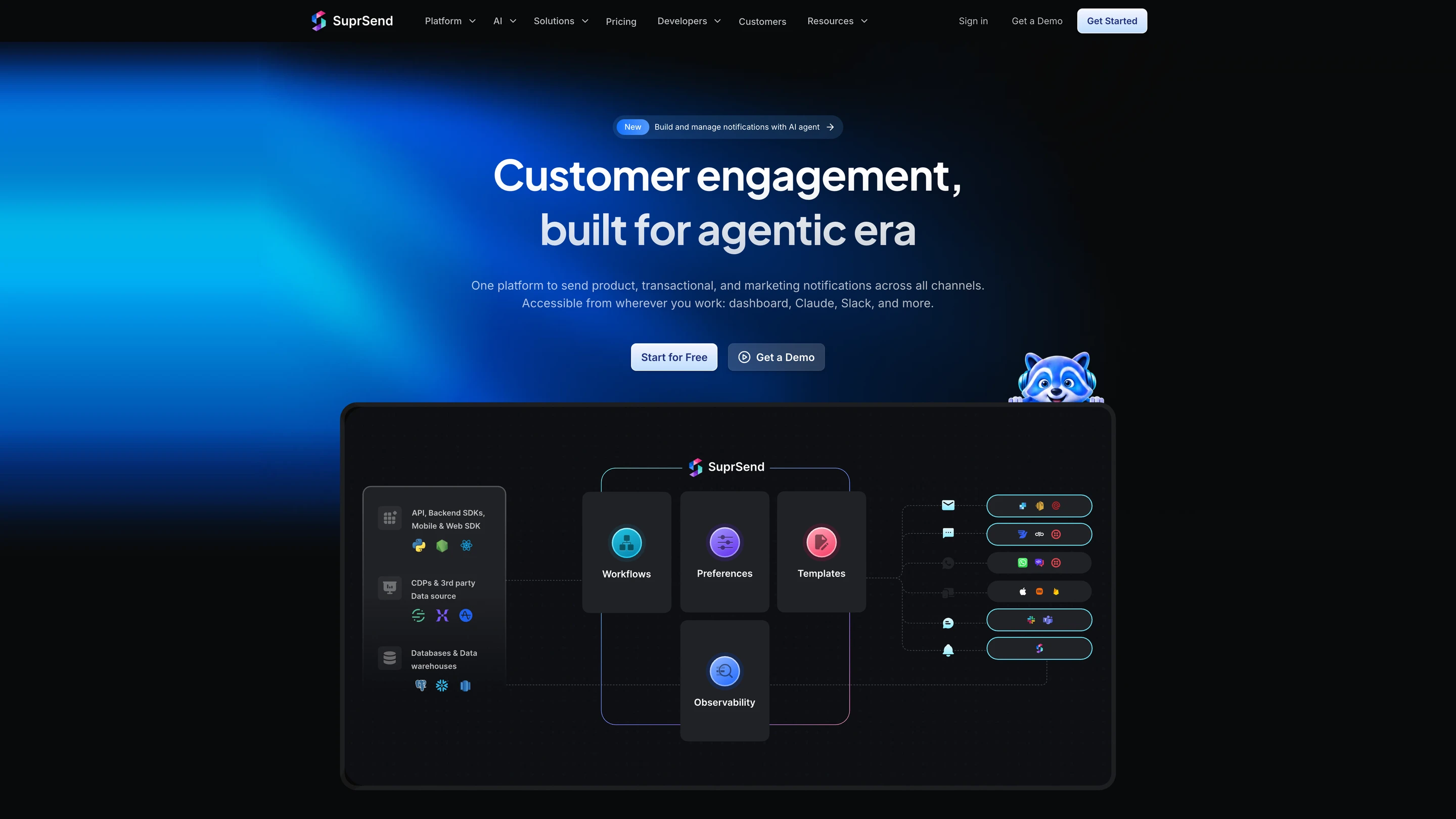
SuprSend's architecture: your API calls, SDKs, CDPs and data warehouses feed workflows, preferences, templates and observability, which send through email, SMS, WhatsApp, push, Slack and Microsoft Teams providers and the in-app inbox

What SuprSend is

SuprSend is a US company, founded in 2022, that runs every notification a product sends from one platform, from transactional alerts to engagement campaigns. Engineering, product and growth teams work in it alongside their agents.

A complete orchestration engine

WorkflowsA workflow engine with branches, conditions, delays, throttling, data fetch and webhook steps, and sends in each user's timezone. One send step reaches the user's channels in your order. Built visually, through the CLI or by an agent, with version history and rollback. Builder on every plan; throttling, fetch, webhook and timezone from Essentials.
In-app inboxA real-time bell and feed, read state synced across devices, tabs, toasts and per-tenant feeds, six client SDKs, embedded or headless. Every plan, Free included.
Batching and digestsCollect events over a window and send one message, at a time the user picks. Business.
User preferencesUsers opt in or out per category and channel, in a preference centre you embed or host. Business.
TemplatingEditors for every channel, variants by tenant, user or language, version history with rollback, translation files. Every plan; translation files on Business.
Per-tenant setupsEach of your customers gets its own branding, templates, preferences and provider routing. Business add-on, Enterprise.
ObservabilityStep-by-step workflow logs and message logs with the provider's error; 30 days on Free, 90 on paid plans; warehouse sync on Business.
Retries and fallbackBring your own providers; if one does not confirm delivery, the next one sends. Essentials.
DeploymentSuprSend cloud with 99.9% uptime, or your own VPC, on-prem or BYOC with vendor support; SOC 2 Type II, ISO 27001, GDPR, HIPAA, CPRA. Self-hosted and BYOC on Enterprise.

How your team operates it

In the dashboard

The SuprSend agent builds a workflow from a description, drafts the copy for each channel and traces why a send failed. Product and growth work here and in Slack.

In your own agent

Connect the MCP server to Claude, ChatGPT, Cursor or any MCP client, then build and change workflows, templates and tenants, test and send, and read the delivery log and analytics from there.

In your IDE or codebase

The CLI pushes and pulls workflows, templates, schemas and translation files, promotes staging to production and generates TypeScript types, so a bulk change is one command reviewed in a pull request.

Pricing. Free up to 10,000 notifications a month. Essentials starts at $100 a month for 50,000, then $2 per 1,000. Business starts at $250 a month for 50,000, then $5 per 1,000. Enterprise is custom.

Verdict. Choose SuprSend when your product sends the messages and you want transactional, product and marketing notifications, the inbox and user preferences in one system that engineering, product and growth all operate; choose Brevo when marketing campaigns, a CRM and live chat for a small team are the whole job. For the head-to-head, see how SuprSend differs from Brevo.
2.Customer.io

Best for lifecycle messaging driven by what customers do in a software product

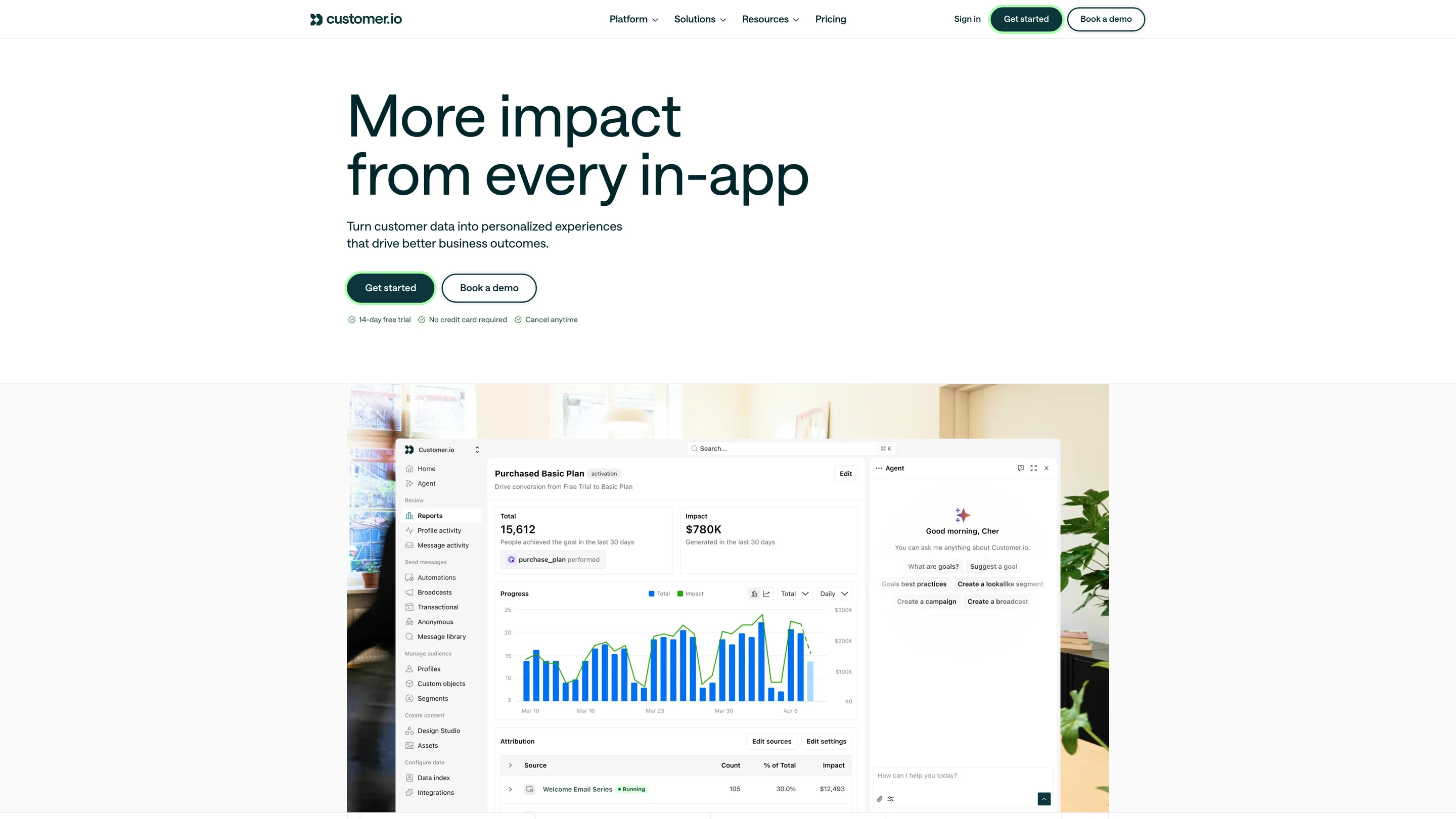
Customer.io's dashboard: a campaign goal report with conversions over time, attribution by message, and the agent panel

Where it goes deep. Customer.io started with email and builds journeys on people and objects, such as accounts or workspaces, fed by events from your product. A transactional API sends receipts and resets from the same account as campaigns. Its MCP server and CLI act under the signed-in user’s role, with writes held for approval where the client supports it, and an in-product agent drafts messages.

Where it stops. There is no free plan, and pricing counts profiles, so a large list of users you rarely message still raises the bill.

Pick it if you are a lifecycle team at a software company that wants behavioural journeys and transactional email in one account.

Verdict. Customer.io is the step up from Brevo for teams whose messages depend on product events and account data. Teams with a marketing list and occasional sends may find the profile pricing heavy.

3.Klaviyo

Best for ecommerce brands that market on store and purchase data

Where it goes deep. Klaviyo builds each customer profile from store data, then predicts next order date, churn risk and lifetime value. Flows send email, SMS and mobile push from those profiles; email came first, with SMS and push added later. Its official MCP server reports on performance and manages marketing objects such as campaigns and lists.

Where it stops. Pricing counts active profiles, and the tool is shaped around an online store, so it fits poorly when your messages come from a software product.

Pick it if you run a Shopify or similar store and want marketing driven by what people buy.

Verdict. Klaviyo is the ecommerce answer, with deeper store data and analytics than Brevo. Its price rises with each active profile you add.

4.Mailchimp

Best for small businesses that mostly send newsletters and simple automated emails

Where it goes deep. Mailchimp, owned by Intuit, is built around audiences, an email editor and a large template library, with simple customer journeys on top. Mailchimp Transactional, formerly Mandrill, sends app email as an add-on, and its official MCP server sends messages and checks delivery status.

Where it stops. Transactional email is a separate product with its own billing, and pricing counts contacts across the account.

Pick it if your work is newsletters and a few automations, and your team wants the most familiar tool.

Verdict. Mailchimp is the closest like-for-like swap for Brevo's email marketing side. In-app and push messages sit outside it.

5.ActiveCampaign

Best for small and mid-size teams that want marketing automation tied to a sales CRM

Where it goes deep. ActiveCampaign started with email in 2003. Its automations branch on contact behaviour and feed a sales pipeline. SMS came as a credit add-on, WhatsApp as a separate plan line, and transactional email through Postmark, which it acquired in 2022. Its MCP connector for Claude and ChatGPT reports on campaigns, looks up contacts and adds a contact to an automation.

Where it stops. There is no free plan. Starter caps an automation at five actions, and the docs list no official SDKs, staging environment or CLI.

Pick it if marketing and sales share one contact list and you want deeper automation than Brevo’s lower plans.

Verdict. ActiveCampaign suits teams that live in their automations and CRM. Product notifications and in-app messages stay outside it.

6.SendGrid

Best for developers who mainly need to send app email at volume

SendGrid's site, announcing that SendGrid's email products are moving onto Twilio.com

Where it goes deep. SendGrid, part of Twilio since 2019, is an email API with subusers, address validation and a dedicated IP on its Pro plan. Marketing Campaigns runs on a separate plan for newsletters. An EU data residency option is available.

Where it stops. It sends email only, and activity history is kept for three days below Pro and seven on Pro.

Pick it if you used Brevo mainly for transactional email through the API.

Verdict. SendGrid replaces Brevo's Messaging API for email. Everything above sending, like journeys, push and SMS, sits elsewhere.

7.OneSignal

Best for mobile app and consumer web teams where push is the main channel

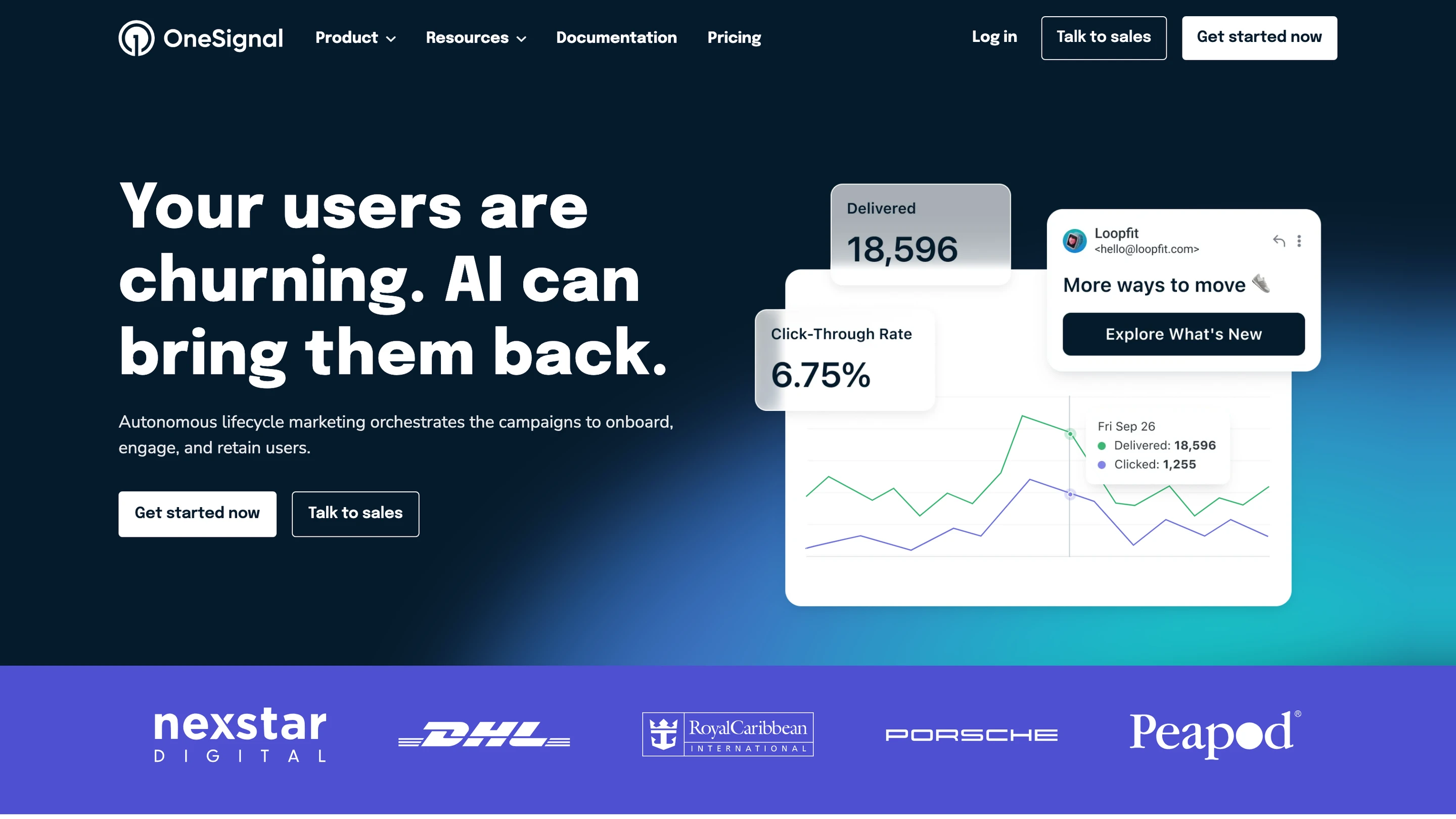
OneSignal's homepage: lifecycle marketing campaigns with a delivered and click-through-rate chart and an email preview

Where it goes deep. OneSignal started with push and added email, SMS and in-app messages. Journeys branch across those channels, and iOS Live Activities are supported. Its agent and MCP server, on every plan, work with users, segments, templates, sends and exports.

Where it stops. There is no WhatsApp channel, no stored per-user message history for a lasting in-app feed, and mobile billing counts users who have not opted in to push.

Pick it if your audience lives in a mobile app and Brevo’s push sits on a plan you do not need.

Verdict. OneSignal gives mobile push on its free plan, where Brevo keeps it for Professional. Teams whose volume is mostly email campaigns will want an email-first tool.

8.Novu

Best for developer teams that want open-source notification infrastructure they can host

Novu's homepage: open-source notification infrastructure for products and AI agents, with Slack, Teams, SMS, email, WhatsApp and Telegram channels

Where it goes deep. Novu’s core is MIT-licensed and free to self-host. Workflows can live as TypeScript in your app, with a GitHub Action to sync them, and users can set quiet hours. Its MCP server has 23 tools for subscribers, preferences, workflows, triggers and logs.

Where it stops. Each step sends on one channel, workflows have no version history, and there is no automatic failover between providers. Billing counts workflow runs.

Pick it if your engineers want to own the notification code and the servers it runs on.

Verdict. Novu is the open-source route for product notifications. Marketing campaigns and a CRM are outside its scope.

When you should stay on Brevo

  • Your messages are marketing campaigns and newsletters, and the people who send them also work the CRM and live chat in Brevo.
  • You mostly send email to a large list you mail now and then, and a price based on emails sent fits that pattern.
  • Your product sends a handful of transactional emails, such as password resets and receipts, with no in-app feed or per-user preferences on the roadmap.
  • Your data has to stay on servers in the EU.
  • You have no app, so mobile push and an in-app inbox never come up.

Teams that move usually do so because of the code they wrote around Brevo: a job that groups events into a daily digest, a table of who wants which alerts, a notification feed inside the app, and retry logic around transactional sends. That code is a hidden cost: your team builds it, maintains it, and pays for it in engineering time on top of Brevo’s price. The switch comes when product notifications need their own system and the marketing account can no longer carry them.

How to migrate off Brevo

  1. 01Record your baselines. Export a month of delivery, open, click and unsubscribe rates per message type, so you can compare after the move.
  2. 02Rebuild your workflows. List every automation and every Messaging API call, then rebuild them as workflows. With the SuprSend CLI they live in your repository and move from staging to production in one command.
  3. 03Move contacts, tokens and attributes. Export contacts with their attributes, and carry over web and mobile push tokens so you do not have to ask users for permission again.
  4. 04Carry consent state. Export unsubscribes, blocklists and list memberships, and map them to categories and channels before the first send.
  5. 05Build the in-app inbox. Add the inbox component to your app and point product alerts at it, alongside email and push.
  6. 06Send from both for a short period. Run each message type through the new system while Brevo still sends, then compare against your baselines and switch over one type at a time.
  7. 07Keep Brevo for 30 days. Keep the account and its logs for a month after the last send, in case you need to check a past delivery.

Conclusion

Brevo covers marketing email, SMS, WhatsApp and push campaigns, a CRM, live chat and a transactional email API in one account, priced on the emails you send. For a small team running campaigns, that is a complete toolkit.

Move when your product starts sending the messages: when you need every kind of notification in one system, a complete orchestration engine with an inbox, digests and preferences, and a platform that engineering, product, growth and their agents all operate. SuprSend’s free plan covers 10,000 notifications a month, enough to rebuild your first workflows and compare.

FAQ

Is Brevo free?

Brevo has a free plan that sends 300 emails a day, about 9,000 a month, with the Brevo logo on emails. Automations on the free plan reach up to 2,000 contacts, and mobile push needs the Professional plan.

What is the cheapest Brevo alternative?

It depends on the unit each tool counts. On free plans, SuprSend covers 10,000 notifications a month, Novu 10,000 workflow runs, Brevo 300 emails a day, Klaviyo 500 emails to 250 active profiles, and OneSignal push for up to 1,000 monthly active users. At 50,000 messages a month, SuprSend Essentials is $100 with $2 per extra 1,000 (Business is $250 with $5 per extra 1,000), SendGrid Essentials is $19.95 for email only, and Novu Pro is $30 for 30,000 runs plus $1.20 per extra 1,000. A Novu run can reach several channels, so runs and notifications are different units. Customer.io and Klaviyo charge by profiles, so their price follows the size of your list.

Which Brevo alternatives include an in-app inbox?

SuprSend and Novu ship an in-app notification inbox you embed in your product; SuprSend's comes with six client SDKs, tabs, toasts and per-tenant feeds. OneSignal sends in-app messages but keeps no stored per-user message history, so there is no lasting feed. Brevo has no in-app notification inbox.

Which Brevo alternatives have an MCP server or agent authoring?

SuprSend's agent builds workflows from a description, and its MCP server and CLI let your own agent build and change workflows, templates and tenants, test and send, and query logs and analytics. Novu's MCP server has 23 tools. Customer.io and OneSignal offer an agent and an MCP server. Klaviyo's MCP server reports on performance and manages marketing objects. ActiveCampaign's connector reports and adds contacts to automations. Mailchimp's official MCP server covers Mailchimp Transactional. Brevo's MCP server covers 27 modules, none of them automations.

Can one platform handle both transactional and marketing messages?

Yes. SuprSend runs transactional, product and engagement notifications with shared users, preferences, unsubscribes and logs. Customer.io and Brevo pair marketing tools with a transactional API in one account. Mailchimp and ActiveCampaign sell transactional email as a separate product.

Which channels do Brevo alternatives support?

SuprSend covers email, SMS, WhatsApp, mobile push, web push, Slack, Microsoft Teams, in-app and webhook on every plan. Klaviyo covers email, SMS and mobile push. OneSignal covers push, email, SMS and in-app messages. Novu covers email, SMS, WhatsApp, push and in-app. SendGrid sends email only.

Does Brevo send mobile push on every plan?

No. Brevo sends mobile push only on Professional and Enterprise; web push is available more widely. OneSignal includes mobile push on its free plan, and SuprSend includes mobile push on every plan.

Which Brevo alternatives meet SOC 2, ISO 27001, GDPR and HIPAA requirements?

SuprSend holds SOC 2 Type II and ISO 27001 and covers GDPR, HIPAA and CPRA. Novu Cloud lists SOC 2 Type II, ISO 27001, GDPR and a HIPAA BAA. ActiveCampaign lists SOC 2 and GDPR. Brevo is ISO 27001:2022 certified and keeps its servers in the EU.

Can I self-host a Brevo alternative?

Novu is free to self-host, and your team runs it. SuprSend runs in your own VPC, on-prem or as BYOC with vendor support on the Enterprise plan. Brevo and the other tools on this list run as cloud services only.

Do I still pay email and SMS providers if I switch?

With SuprSend and Novu, yes: you connect your own email, SMS and push providers and pay them directly, which also lets you add a fallback provider. Brevo, Klaviyo, Mailchimp, ActiveCampaign and SendGrid do the sending themselves, so delivery is part of their price or bought as credits.

Related Resources

How does SuprSend compare with Brevo feature by feature?SuprSend vs Brevo
What does SuprSend cost at your volume?SuprSend pricing
How do SuprSend workflows handle digests, delays and fallback?SuprSend workflows
How do agents build and debug notifications in SuprSend?SuprSend for AI agents

There’s no better place for you
to build notifications

Join thousands of product & engineering teams using SuprSend to build and ship better notifications—faster.