
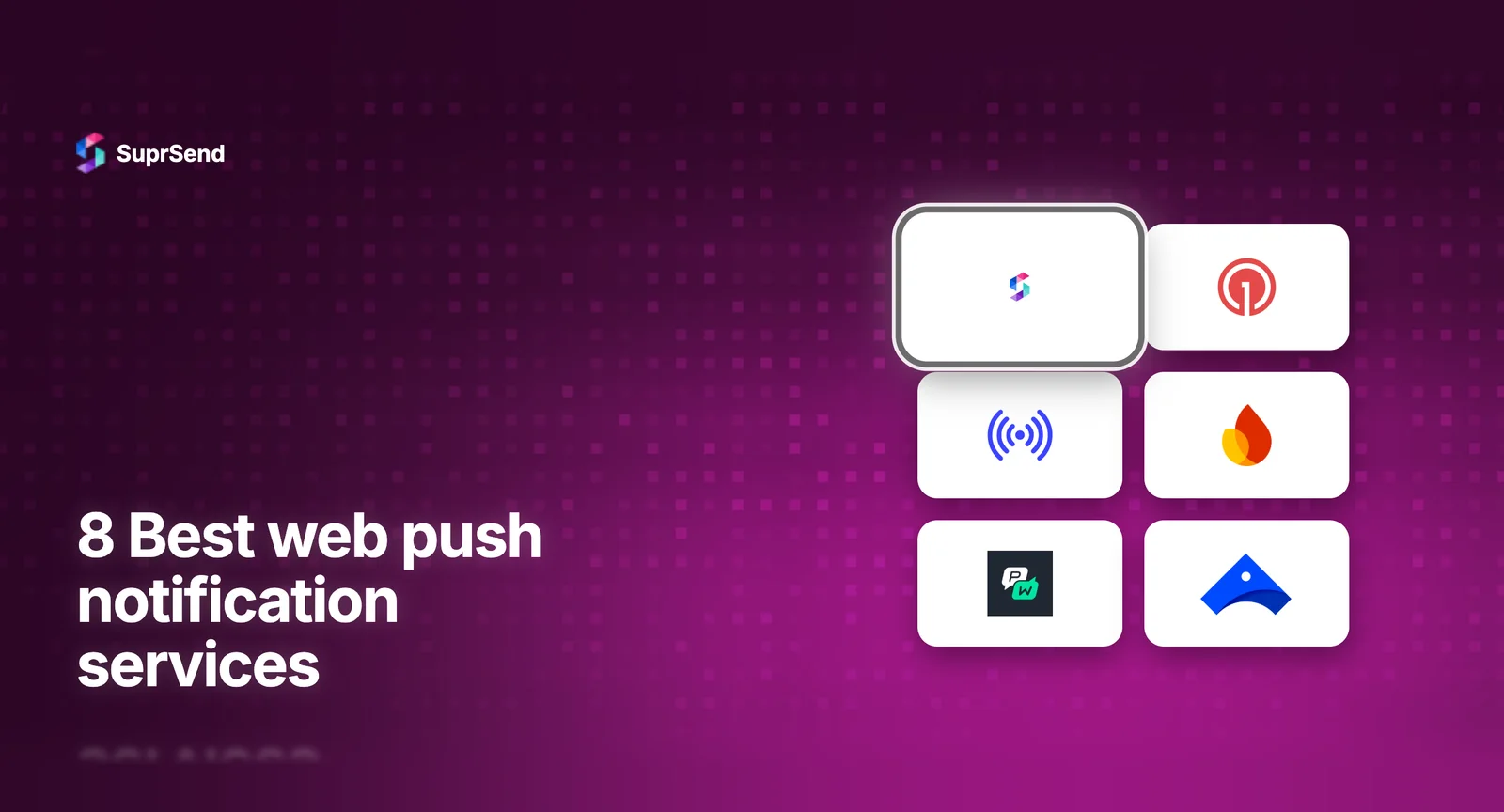
The best web push notification services in 2026 are SuprSend, OneSignal, PushEngage, Firebase Cloud Messaging, WonderPush, Pushwoosh, VWO Engage, and Airship. The right choice depends on whether you need web push as part of multi-channel product notifications, a dedicated e-commerce campaign tool, or an enterprise engagement suite. This guide compares all eight on pricing, channels, and fit, with pricing verified in May 2026.
Web push lets you re-engage users in their browser without an email address or phone number, which makes it one of the lowest-friction channels to add. The trade-off is that “web push service” means very different things depending on whether you are a developer wiring notifications into a product or a marketer running cart-abandonment campaigns. We cover both, starting with how to tell which you need.
What Is a Web Push Notification Service?
A web push notification service is a platform that handles browser push notifications: managing subscriptions, storing tokens, rendering messages, and delivering them through browser push protocols over HTTPS. It abstracts away service workers, VAPID keys, and the differences between Chrome, Firefox, Safari, and Edge so you don’t have to build that plumbing yourself. For background on how the channel fits into product communication, see our overview of how push notification services work.
If you want to understand the mechanics first, our technical primer on getting started with web push and service workers walks through how the channel works under the hood.
How to Choose a Web Push Notification Service
Five factors decide the choice for most teams:
- Use case: developer-owned product notifications versus marketer-owned campaigns like cart abandonment and promotions.
- Channels: web push only, or web push as one channel alongside email, SMS, mobile push, and in-app.
- Pricing model: transparent and subscriber-based versus quote-based, and whether a free tier exists to start.
- Setup: developer SDKs and APIs versus no-code dashboards.
- Compliance: GDPR and CCPA readiness, and data residency if you operate internationally.
With those in mind, here are the eight services worth shortlisting.
1. SuprSend
SuprSend is notification infrastructure that includes native web push as one channel alongside email, SMS, mobile push, in-app inbox, WhatsApp, and Slack. It is the best fit for developer and product teams that want web push as part of a broader product-notification stack rather than a standalone marketing tool.
Key features:
- Native web push with subscription handling and VAPID keys managed for you
- Single API across web push, mobile push, email, SMS, in-app inbox, WhatsApp, and Slack
- Visual workflow builder with routing, batching, and fallback across channels
- Preference center and step-by-step delivery logs out of the box
Pros: web push sits inside true multi-channel orchestration, so you can route to push first and fall back to email or SMS; developer-first API with a transparent free tier. Cons: not a pure-play web push marketing tool, so dedicated e-commerce campaign automations like cart-abandonment series are deeper in specialists like PushEngage.
Pricing: free tier plus usage-based paid plans, no annual lock-in. See the SuprSend pricing page.
G2: SuprSend profile (Momentum Leader, High Performer, Easiest Setup badges).
Best for: developer and product teams that need web push as part of multi-channel product notifications. Get started with the web push quick start.
2. OneSignal
OneSignal is one of the most popular push platforms, covering web and mobile push with a generous free tier and easy setup.
Key features:
- Web and mobile push, plus email, SMS, and in-app
- Segmentation and automated journeys
- Broad platform and integration support
- Developer-friendly SDKs
Pros: generous free plan, fast setup, wide integrations. Cons: push-centric, so advanced lifecycle marketing is lighter than enterprise suites.
Pricing: free plan at $0/month (unlimited mobile push); Growth from $19/month; Professional and Enterprise custom. Verified May 2026 on the OneSignal pricing page.
G2: OneSignal profile.
Best for: teams that want a free, easy starting point for web and mobile push.
3. PushEngage
PushEngage is a web-push specialist built for e-commerce and marketing teams that want behavior-based campaigns like cart abandonment and price-drop alerts.
Key features:
- Web push automation for e-commerce (cart abandonment, browse abandonment, price drops)
- No-code campaign builder
- Segmentation and A/B testing
- Goal tracking and analytics
Pros: deep e-commerce web-push automation, transparent low-cost pricing. Cons: focused on web push marketing, not a multi-channel product-notification platform.
Pricing: free plan up to 200 subscribers (30 campaigns); Business from $14/month ($8/month billed annually) for up to 50,000 subscribers. Verified May 2026 on the PushEngage pricing page.
G2: PushEngage profile.
Best for: e-commerce teams running behavior-based web push campaigns.
4. Firebase Cloud Messaging (FCM)
Firebase Cloud Messaging is Google’s free cross-platform messaging service, covering web, Android, and iOS push at no cost.
Key features:
- Free cross-platform push for web, Android, and iOS
- Integrated with Firebase Analytics
- Topic-based and token-based messaging
- Backed by Google infrastructure
Pros: free and reliable, native fit for teams already on Firebase. Cons: a low-level delivery API, not a managed service; you build segmentation, scheduling, and UI yourself. For when to use it directly versus a platform, see our guide on sending push notifications through Firebase.
Pricing: free.
G2: FCM profile.
Best for: developers who want a free, low-level push API and will build the rest themselves.
5. WonderPush
WonderPush is a European web and mobile push service known for GDPR compliance and simple, transparent flat-rate pricing.
Key features:
- Web push, plus iOS and Android
- GDPR-focused with EU data handling
- Flat-rate, predictable pricing
- Segmentation and automation
Pros: strong GDPR/EU compliance posture, transparent flat-rate pricing. Cons: smaller ecosystem than the largest players.
Pricing: flat-rate plans based on usage; see the WonderPush pricing page for current tiers.
G2: WonderPush profile.
Best for: EU teams that prioritize GDPR compliance and predictable pricing.
6. Pushwoosh
Pushwoosh is a customer engagement platform covering web and mobile push with journey automation across channels.
Key features:
- Web and mobile push, plus email and in-app
- Customer journey builder
- Segmentation and behavioral triggers
- Cross-platform SDKs
Pros: multi-channel engagement features beyond pure push. Cons: smaller brand than OneSignal, and pricing scales with subscribers and features.
Pricing: subscriber-based tiers; see the Pushwoosh pricing page for current rates.
G2: Pushwoosh profile.
Best for: teams wanting web and mobile push with journey automation.
7. VWO Engage
VWO Engage (formerly PushCrew) is a web push tool aimed at marketing and conversion teams, part of the VWO experimentation suite.
Key features:
- Web push campaigns and automation
- Triggered notifications based on behavior
- Segmentation and A/B testing
- Part of the broader VWO optimization platform
Pros: fits teams already using VWO for experimentation, marketing-friendly. Cons: web push marketing focus, not multi-channel product notifications.
Pricing: subscriber-based; see the VWO Engage pricing page for current tiers.
G2: VWO Engage profile.
Best for: marketing teams already in the VWO ecosystem.
8. Airship
Airship is an enterprise customer engagement platform with web push as part of a broad suite spanning mobile push, in-app, SMS, email, and wallet.
Key features:
- Web push within a full enterprise engagement suite
- Sophisticated journey orchestration
- Strong analytics and predictive features
- Enterprise compliance and support
Pros: enterprise-grade orchestration and analytics. Cons: quote-based enterprise pricing and a heavy footprint for teams that only need web push.
Pricing: custom, quote-based. Airship does not publish public pricing; contact sales.
G2: Airship profile.
Best for: enterprises that want web push inside a full engagement suite.
Which Web Push Service Fits Your Team?
The table summarizes the eight services by pricing and best fit.
| Service | Pricing | Focus | Best For |
|---|---|---|---|
| SuprSend | Free tier + usage-based | Multi-channel notification infra | Product notifications with web push |
| OneSignal | Free + from $19/mo | Web + mobile push | Easy, free starting point |
| PushEngage | Free + from $14/mo | E-commerce web push | Behavior-based campaigns |
| FCM | Free | Low-level push API | DIY developer setups |
| WonderPush | Flat-rate | GDPR-focused push | EU compliance-first teams |
| Pushwoosh | Subscriber-based | Web + mobile engagement | Journey automation |
| VWO Engage | Subscriber-based | Marketing web push | VWO ecosystem teams |
| Airship | Quote-based | Enterprise engagement | Enterprise suites |
If your need is web push as part of reliable product notifications, SuprSend is the right shape. If you want dedicated e-commerce campaigns, PushEngage leads; for a free DIY base, FCM; for EU compliance, WonderPush; and for enterprise suites, Airship. For the wider push category beyond web, see our roundup of the best push notification platforms.
Add Web Push as Part of Your Notification Stack
If you need web push alongside email, SMS, mobile push, and in-app rather than as a standalone tool, SuprSend handles all of them from one API with routing, fallback, and preferences built in. Start building for free, or book a demo to see how it fits your stack.
FAQ
What is the best web push notification service?
It depends on the job. SuprSend is best for web push as part of multi-channel product notifications, OneSignal for an easy free start, PushEngage for e-commerce campaigns, and FCM for a free low-level developer API.
Is there a free web push notification service?
Yes. Firebase Cloud Messaging is free, OneSignal and PushEngage offer free tiers, and SuprSend has a free tier with usage-based pricing. Free plans usually cap subscribers or sends, so check the limits against your volume.
Do web push notifications work on all browsers?
Web push works on Chrome, Firefox, Edge, and Safari, though support and behavior vary by browser and operating system. A good web push service abstracts these differences and requires HTTPS to function.
What is the difference between web push and a notification platform?
A dedicated web push tool handles browser notifications only. A notification platform like SuprSend treats web push as one channel alongside email, SMS, mobile push, and in-app, with routing and fallback across all of them.
Which web push service is best for e-commerce?
PushEngage is purpose-built for e-commerce web push, with cart-abandonment, browse-abandonment, and price-drop automations. For product notifications inside an e-commerce app beyond marketing campaigns, SuprSend covers the transactional side.
Do I need an email or phone number for web push?
No. Web push works from a browser opt-in alone, with no email or phone number required, which is why it is one of the lowest-friction channels to add for re-engagement.