



8 best Airship alternativesfor customer engagement (2026)

Eight Airship alternatives compared on the messages they cover, who on your team can run them, what an agent can do in them, ease of setup and pricing.

By , SuprSendOct 4, 2026

Airship is a mobile-first customer experience platform that sends push, SMS, email and mobile wallet messages and builds no-code experiences inside apps and websites.

Teams evaluating or already running Airship tend to look elsewhere when they need published pricing, an in-app feed on the web, or product and transactional notifications run from the same system as campaigns. Many now also want engineering, product and growth teams, and their agents, to change those notifications without a ticket.

Quick guide: Airship alternatives by use case

If you needChoose
A mobile engagement suite like Airship, with published prices?OneSignal and Pushwoosh both have free tiers up to 1,000 monthly active users.OneSignalPushwooshCleverTap
Consumer journeys at enterprise scale, on a quoted contract?BrazeMoEngage
A bell and feed inside your product, on web and mobile?Airship's Message Center has no Web SDK. SuprSend's inbox syncs read state across devices, adds tabs, toasts and per-tenant feeds, and ships six client SDKs for web and mobile.SuprSendSuprSend
Transactional, product and marketing notifications in one platform?One set of users, preferences and logs for transactional alerts and campaigns.SuprSendSuprSend
A full orchestration layer: workflows, digests, preferences, fallback?SuprSendSuprSend
An agent that builds and debugs notifications, or your own agent over MCP?SuprSendSuprSend
Workflows and templates kept in your repo and reviewed in pull requests?SuprSendSuprSend
Product and growth teams change messages without an engineer?SuprSendSuprSendBrazeCustomer.io
Purely marketing campaigns, run from a UI?Customer.ioCleverTapMoEngage
Each of your customers gets its own branding, templates and preferences?See how multi-tenant notifications work in SuprSend.SuprSendSuprSend
Run it yourself, for free or in your own cloud with vendor support?None of these platforms is open source. The free route is FCM and APNs with your own code; SuprSend runs in your VPC, on-prem or BYOC on Enterprise.FCM + APNs in-houseSuprSendSuprSend
Airship already covers every requirement and is live in your apps?Wallet passes, Live Activities and no-code app Scenes are hard to replace. See when to stay on Airship.Airship

What Airship does

Airship (formerly Urban Airship) is a customer experience platform for consumer brands whose app drives revenue. Marketers build journeys across push notifications, web push, SMS, MMS and RCS, email and Apple and Google Wallet passes. Inside the app and website, Airship adds no-code Scenes, Stories and surveys, an inbox called Message Center, a preference center, feature flags and holdout experiments.

Airship sells two packages. Airship Essentials is self-service and covers push, in-app experiences, Message Center, Journeys and A/B testing. The Airship Experience Platform adds mobile wallet, email and SMS, data management and strategic services under an annual or multi-year contract. A fleet of agents (Scenes AI, Journeys AI, Campaigns AI, Recommendations AI, Accessibility AI and a Brand Hub agent) works inside the dashboard.

LicenceProprietary, cloud only, on Google Cloud and AWS.
ChannelsMobile push, web push, in-app, Message Center, SMS, MMS, RCS, email, Apple and Google Wallet, and open channels for custom delivery.
Backend SDKsJava, PHP, Python and Ruby for the REST API.
Frontend SDKsiOS, Android, React Native, Flutter, Cordova, Capacitor, Unity, .NET and Web.
ComplianceSOC 2 Type II; security programme aligned with ISO 27001:2022.
Billing unitMonthly active users, contacts and Scene impressions, quoted on an annual or multi-year contract, with email and SMS volumes committed separately.
Self-hostingNone; cloud only.

Where Airship is strong

  • Mobile depth built over many years: iOS Live Activities, Android Live Updates, App Clips, quiet time and badge management are documented SDK features.
  • Apple and Google Wallet passes as a channel, with flight, event and loyalty pass APIs.
  • No-code native Scenes, Stories and surveys that marketers publish to app and web without a release.
  • SDKs for nine client platforms, including Unity, Capacitor and .NET.
  • SMS, MMS and RCS with branded senders, keyword webhooks and link shortening.
PlanPriceWhat it covers
Essentials Starter and EssentialsSelf-service sign-up; no price publishedPush and web notifications, Scenes, Stories and surveys, Message Center, preference center, Journeys, feature flags, A/B tests
Airship Experience PlatformCustom quoteEverything in Essentials, with email, SMS and wallet bought as separate packages, plus customer data management and strategic services
Free planNoneG2 lists a free trial

Why teams look elsewhere

  1. 01You need to know the price before you talk to sales. Airship publishes no prices. The Experience Platform is quoted, contracts run annual or multi-year, and Essentials shows a sign-up button with no figure. There is no free plan, so a team cannot run real traffic before signing. By contrast, SuprSend's pricing is published and its free plan sends 10,000 notifications a month.
  2. 02Product and transactional notifications need the same system as campaigns. Airship is organised around the marketing lifecycle: its use cases are acquisition, onboarding, upsell, retargeting, churn prevention and win-back. A comment reply, an approval request, a failed payment or a weekly digest of a user's activity is a product notification triggered by your backend. Airship's journeys have no digest step, no fallback to a second provider and no version history. Teams that send many of these end up with a second system beside Airship, and two places to manage users, preferences and logs.
  3. 03Your web app needs an in-app feed too. Message Center has SDK guides for iOS, Android, React Native, Flutter, Cordova, Capacitor, Unity and .NET. Airship's Web SDK docs cover push, in-app experiences, embedded content and a preference center, and list no Message Center. A product with a web dashboard builds its own bell and feed there.
  4. 04Engineers and agents want to change notifications from the repo. Airship's MCP server is open source and runs locally. Its docs describe it as a development tool: it sends test pushes, looks up channels, tags and segments, migrates SDK versions and registers email and SMS channels through Skills. The docs list no tools for building Journeys or editing message templates, There is no CLI, and a Sequence cannot be exported or promoted between projects, so those changes still happen by hand in the dashboard.
  5. 05Setup and day-to-day admin take longer than planned. G2 reviewers rate Airship 7.0 for ease of setup and 7.4 for ease of admin. Rollout means native SDKs in every app, a project and app key per app, and onboarding run with Airship's services team. Smaller teams without a dedicated mobile marketing owner feel that load most.

How we compared these tools

We read each vendor’s documentation, API reference, pricing page and trust page, and each tool’s G2 reviews and ease-of-setup scores. What we compared on: feature depth, use cases covered, billing model, developer experience, AI authoring, and ease of use for technical and non-technical team members.

Three different kinds of product get called “Airship alternatives,” and they solve different problems.

Layer 1: Delivery providers

FCM, APNs, Twilio and Amazon SES move a message to a device, phone or inbox. Every tool on this list sends through one of them. On their own they store no user profile, journey or log beyond delivery status, so everything above the send is your code.

Layer 2: Unified notification platforms

Unified notification platforms such as SuprSend, Knock and Courier sit between your backend and the providers. They hold users, workflows, templates, preferences and an in-app inbox for transactional, product and marketing sends. The ones built for agents can be run from outside the dashboard, through an MCP server, a CLI and an agent; what differs is how much that agent can operate end to end.

Layer 3: Customer engagement platforms

Airship, Braze, MoEngage, CleverTap, OneSignal, Pushwoosh and Customer.io run campaigns and journeys for consumer audiences. Their agents mostly read data and help inside the campaign canvas. Product notifications triggered by your backend, a customer-facing inbox and per-customer setups are usually left to you.

The best Airship alternatives

ToolBuilt aroundStrongest atMeant forBilling unitFree planPaid fromG2
SuprSendSuprSendOne engine for transactional, product and engagement notifications across nine channelsWorkflows, inbox and preferences; SuprSend agent, MCP server and CLIEngineering, product and growth teams running every notificationPer notification per channel10,000 notifications a monthEssentials $100 a month for 50,0004.8 (129 reviews)Ease of setup: 9.4
BrazeCanvas journeys on a real-time customer profileExperiment paths, warehouse segments; BrazeAI Operator and a remote MCP for analytics and contentLarge consumer brands with marketing operations teamsData points, quoted contractNoneQuote4.4 (1,929 reviews)Ease of setup: 7.6
OneSignalPush delivery with journeys across push, email, SMS and in-appQuick push setup and Live Activities; AI agent and MCP on every planSmall and mid-sized app teamsPer mobile MAU and web subscriberPush and in-app to 1,000 MAUGrowth $19 plus $0.012 per MAU4.7 (1,238 reviews)Ease of setup: 8.9
CleverTapProduct analytics and segmentation with campaigns on topBehavioural segments, journeys, WhatsApp; MCP server (beta) that queries data and drafts push campaignsConsumer apps that want analytics and engagement in one toolPer MAUTrial onlyEssentials from $75 a month for 5,000 MAU4.6 (681 reviews)Ease of setup: 8.6
MoEngageInsight-led campaigns and journeys for consumer brandsMerlin AI agents in the dashboard; read-only MCP over campaign dataMid-market and enterprise consumer brandsQuoted contractTrial onlyQuote4.5 (523 reviews)Ease of setup: 8.8
PushwooshPush and in-app with journeys, billed per active userLow push cost at scale; Messaging MCP and ManyMoney AI over MCPApp teams that want push-led engagement on published pricesPer MAUFirst 1,000 MAUPush only $7 per 1,000 MAU4.4 (52 reviews)Ease of setup: 8.8
Customer.ioEvent-driven marketing campaigns, starting from emailJourneys on behavioural data; MCP server and CLI acting under the user's roleLifecycle marketing teamsPer profileNoneEssentials $100 a month for 5,000 profiles4.4 (957 reviews)Ease of setup: 7.9
FCM + APNs in-houseRaw push transport called from your own codeNo vendor bill and full controlTeams with engineers to build targeting, logs and retriesFree; you pay in engineering timeUnlimitedNo paid plan-

1.SuprSendSuprSend

Best for running transactional, product and engagement notifications from one platform, operated by your whole team and its agents
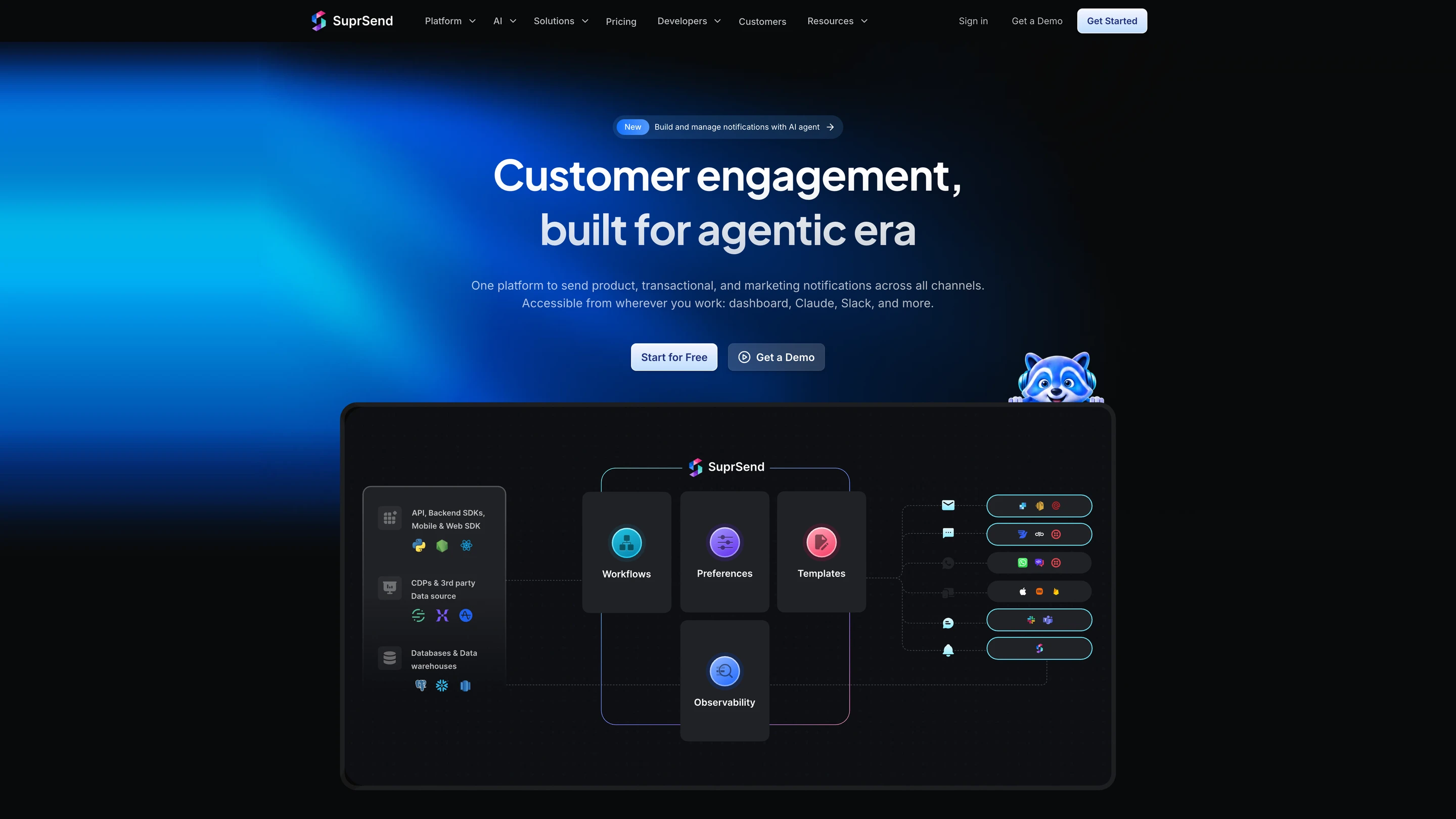
SuprSend's architecture: your API calls, SDKs, CDPs and data warehouses feed workflows, preferences, templates and observability, which send through email, SMS, WhatsApp, push, Slack and Microsoft Teams providers and the in-app inbox

What SuprSend is. SuprSend is a US company, founded in 2022, that runs every notification a product sends from one platform, from transactional alerts to engagement campaigns. Engineering, product and growth teams work in it alongside their agents.

A complete orchestration engine

WorkflowsBranches, conditions, delays, throttling, data fetch and webhook steps, and sends in each user's timezone. One send step reaches a user's channels in your order. Built visually, through the CLI or by an agent, with version history and rollback. Builder on every plan; throttling, fetch, webhook and timezone from Essentials. Workflows.
In-app inboxReal-time bell and feed for web and mobile, read state synced across devices, tabs, toasts and per-tenant feeds, embedded or headless, with six client SDKs. Every plan, Free included.
User preferencesUsers opt in or out per category and channel, in a preference centre you embed or host. Business. Preferences.
Batching and digestsCollect a user's events over a window and send one message, at a time the user picks. Business. Batching and digests.
TemplatingEditors for every channel, variants by tenant, user or language, version history with rollback, and translation files. Every plan; translation files on Business. Templates.
Per-tenant setupsEach of your customers gets its own branding, templates, preferences and provider routing. Business add-on and Enterprise. Tenants.
ObservabilityStep-by-step workflow logs and message logs with the provider's error, 30 days on Free and 90 on paid plans, with warehouse sync on Business. Analytics and logs.
Retries and fallbackBring your own providers. If one does not confirm delivery, the next one sends. Essentials. Providers.
DeploymentSuprSend cloud with 99.9% uptime, or your own VPC, on-prem or BYOC with vendor support on Enterprise. SOC 2 Type II, ISO 27001, GDPR, HIPAA and CPRA. Bring your own cloud.

How your team operates it

In the dashboard

The SuprSend agent builds a workflow from a description, drafts the copy for each channel and traces why a send failed. Product and growth work here and in Slack.

In your own agent

Connect the MCP server to Claude, ChatGPT, Cursor or any MCP client and build and change workflows, templates and tenants, test and send, and read the delivery log and analytics from there.

In your IDE or codebase

The CLI pushes and pulls workflows, templates, schemas and translation files, promotes staging to production and generates TypeScript types, so a bulk change is one command reviewed in a pull request.

Pricing. Free up to 10,000 notifications a month. Essentials starts at $100 a month for 50,000, then $2 per 1,000. Business starts at $250 a month for 50,000, then $5 per 1,000. Enterprise is custom.

Verdict. Choose SuprSend when product, transactional and engagement notifications should share one engine, one inbox across web and mobile, and one set of preferences, run from the dashboard, an agent or the repo. Choose Airship or another engagement platform when wallet passes, no-code app Scenes or predictive marketing at consumer scale are the core of the job. For the head-to-head, see how SuprSend differs from Airship.

2.Braze

Best for large consumer brands that want the most mature journey canvas in the category

Braze's homepage: a customer engagement platform for marketers, with a loyalty push notification on a phone

Braze began as Appboy in 2011, a mobile engagement tool, and grew into a cross-channel platform with WhatsApp, LINE, KakaoTalk and email on its own IPs.

Where it goes deep. Canvas journeys with experiment paths, decision splits, agent steps and version history. SQL Segment Extensions build audiences on warehouse data, and Currents streams engagement events back out. BrazeAI Operator works in the dashboard, and a remote MCP server reads analytics and creates templates and content blocks.

Where it stops. Contracts are quoted and bill on data points. There is no CLI, and Braze’s own stated average time to value is six weeks.

Pick it if a marketing operations team runs journeys for tens of millions of profiles.

Verdict. Braze is the like-for-like move up from Airship for journey depth and data. Expect a sales-led contract and a rollout measured in weeks.

3.OneSignal

Best for app teams that want Airship's push strengths on published, self-serve pricing

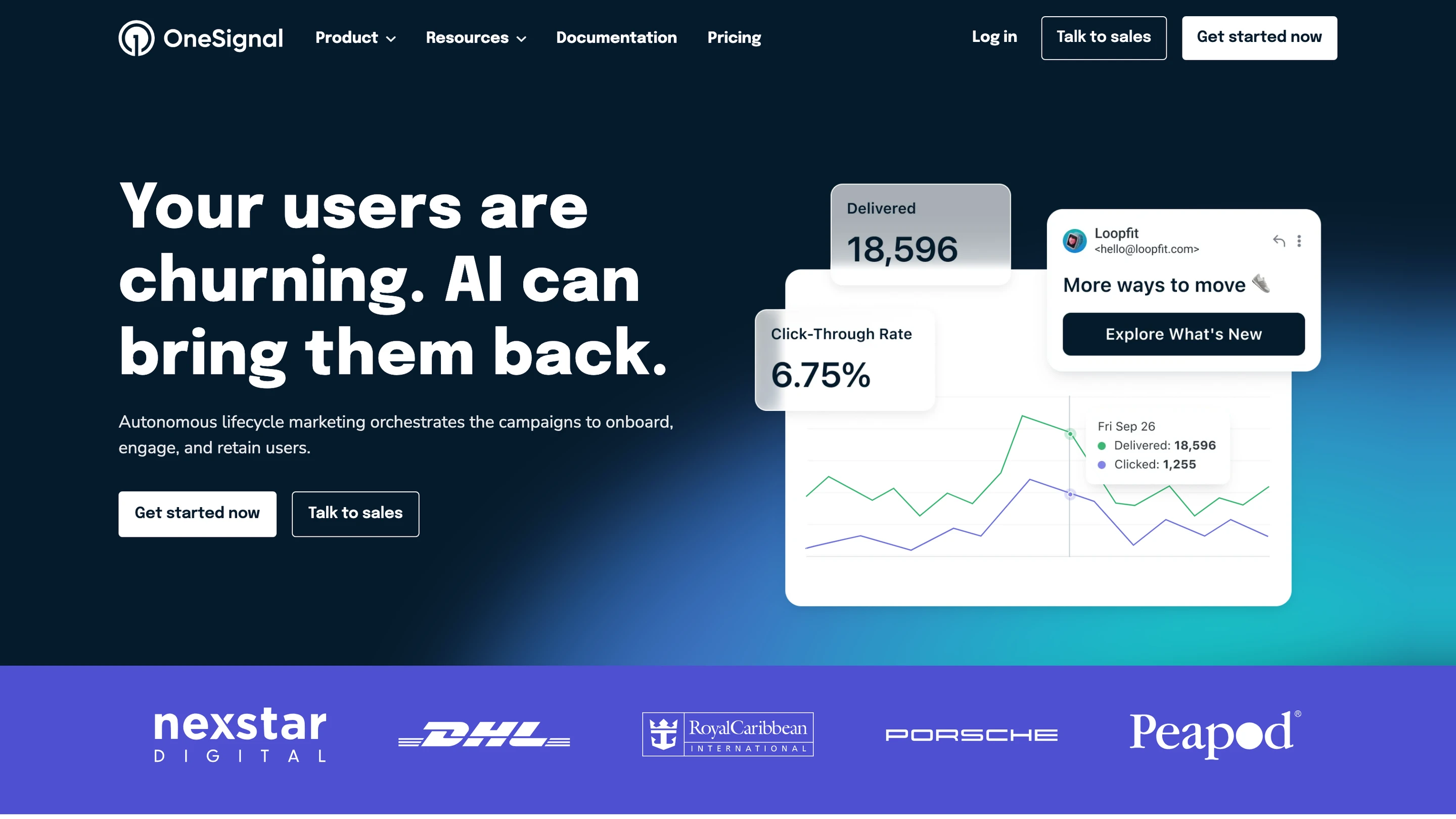
OneSignal's homepage: lifecycle marketing campaigns with a delivered and click-through-rate chart and an email preview

OneSignal started as a push service and added email, SMS and in-app messages later.

Where it goes deep. Mobile and web push with a fast SDK setup, Live Activities, and journeys that branch across push, email, SMS and in-app. An AI agent and an MCP server on every plan work with users, segments, templates, sends and exports.

Where it stops. Mobile push and in-app are free only up to 1,000 monthly active users, and the MAU count includes users who never opted in. OneSignal’s docs list no WhatsApp channel, no stored per-user message history for a lasting feed, and no CLI.

Pick it if push is your main channel and you want to start today without a sales call.

Verdict. OneSignal is the closest self-serve replacement for Airship's push and in-app features. Model the MAU bill before you scale.

4.CleverTap

Best for consumer apps that want product analytics and campaigns in the same tool

CleverTap's homepage: live 1:1 personalization with CleverAI, and cards for events, product launches and case studies

Where it goes deep. Event analytics, cohorts and behavioural segmentation feed journeys across push, in-app, email, SMS and WhatsApp. On G2, analytics is the strength reviewers mention most, in 45 reviews. Its MCP server, in public beta, queries account data, builds past-behaviour segments and drafts push campaigns that a person publishes from the dashboard.

Where it stops. Self-serve Essentials covers up to 100,000 MAU; above that, and for Advanced and Cutting Edge, pricing is quoted. Reviewers cite a learning curve on advanced features.

Pick it if your growth team wants to analyse and act on app behaviour without exporting to another tool.

Verdict. CleverTap suits mobile-first consumer brands that want analytics and engagement together. It replaces Airship's marketing role and leaves product notifications to your own code.

5.MoEngage

Best for mid-market and enterprise consumer brands that want agents working inside the campaign tool

MoEngage's homepage: an agentic customer engagement platform, with agent cards for in-app templates and per-user decisioning

Where it goes deep. Journeys across push, email, in-app, web, SMS and messaging apps, with analytics and funnels built in. Merlin AI agents, including custom agents with marketer-set guardrails, draft and optimise campaigns. A hosted MCP server gives Claude or ChatGPT nine read-only tools over campaign data.

Where it stops. Pricing is quoted, with a trial and no free plan. The MCP server reads campaigns and does not build or change them.

Pick it if marketers run the program and want built-in agents more than outside automation.

Verdict. MoEngage is a like-for-like Airship replacement with higher G2 setup scores. Product and transactional notifications still sit outside it.

6.Pushwoosh

Best for push-led app teams that want published per-user pricing

Pushwoosh started with push and added email, SMS, WhatsApp, Telegram, LINE and Kakao.

Where it goes deep. Mobile and web push, in-app messages and a customer journey builder, priced per monthly active user with the first 1,000 free. A Messaging MCP server, in beta, gives an agent one tool to send on any channel, and the ManyMoney AI MCP server runs the Control Panel’s assistant from Claude or Cursor.

Where it stops. G2 reviewers flag reporting and dashboard issues, and enterprise terms start once monthly spend passes $3,000.

Pick it if you want Airship-style push and in-app at a lower, predictable price.

Verdict. Pushwoosh is the budget answer in Airship's own category. Teams needing wallet passes or no-code app Scenes will miss them.

7.Customer.io

Best for lifecycle marketing teams that run event-driven campaigns on published pricing

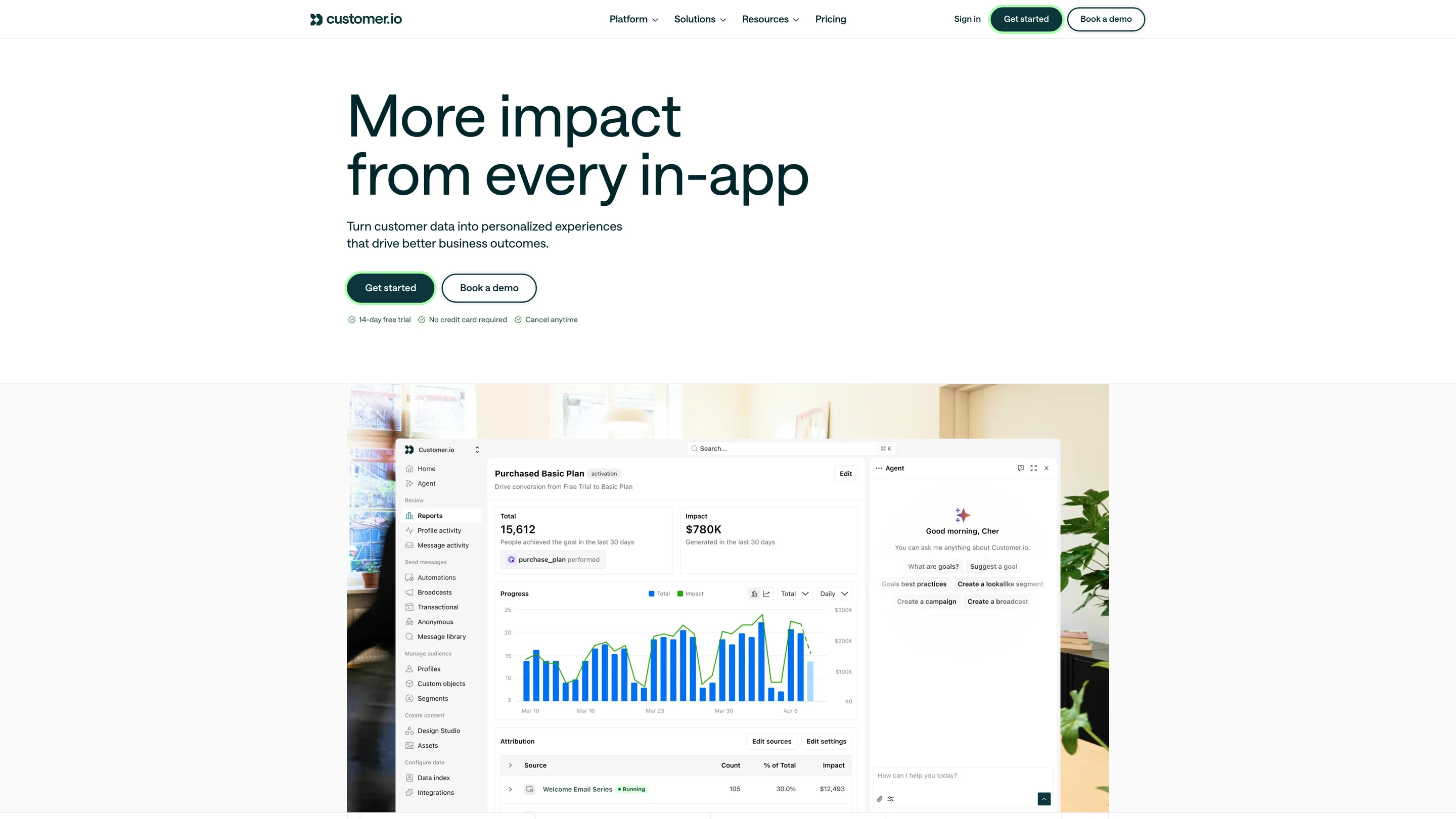
Customer.io's dashboard: a campaign goal report with conversions over time, attribution by message, and the agent panel

Customer.io started with email and added push, SMS and in-app messages.

Where it goes deep. Campaigns triggered by behavioural events and attributes, with branching, A/B tests and data pipelines. An in-product agent drafts messages, and an MCP server and CLI act under the signed-in user’s role, holding writes for approval where the client supports it.

Where it stops. There is no free plan, and billing counts profiles, so audience growth raises the bill even when sends stay flat.

Pick it if email leads your program and mobile push is one channel among several.

Verdict. Customer.io is a sensible step for teams whose Airship use has shifted toward email and lifecycle marketing. Mobile-first teams will find Airship's app tools deeper.

8.FCM + APNs in-house

Best for teams that only need push and have engineers to own it

Where it goes deep. Firebase Cloud Messaging and Apple Push Notification service are free at any volume, and you control every byte of the payload. FCM adds topic subscriptions and a console composer for simple campaigns.

Where it stops. You build and run token storage and cleanup, targeting, templates, retries, logs and any in-app feed yourself. Android registrations expire after 270 days of inactivity, so stale tokens need regular pruning.

Pick it if push is a small, stable part of your product and engineering time is cheaper for you than a vendor contract.

Verdict. Building on FCM and APNs removes the vendor bill and moves the work to your team. It suits narrow use cases and gets expensive as channels and journeys grow.

When you should stay on Airship

  • Apple and Google Wallet passes, boarding passes or loyalty cards are part of how customers use your product.
  • Your marketers ship no-code Scenes, surveys and onboarding flows inside the app every week and would lose that speed elsewhere.
  • Almost every message you send is a marketing campaign, and your product sends few notifications triggered by your backend.
  • You are mid-contract and use Airship's strategic services team for planning and execution.
  • Your apps run on platforms such as Unity or .NET where Airship has SDKs and the alternative you are weighing does not.

Teams that stay on Airship while their product grows usually write code around it: a service that maps product events to named users and tags before each send, a separate bell and feed for the web app, and a job that groups a burst of events so one user does not get ten pushes. That code is a hidden cost: your team builds it, maintains it, and pays for it in engineering time on top of Airship’s price. A switch is worth planning when product and transactional notifications grow to match your campaigns, or when the contract renewal is the moment to compare.

How to migrate off Airship

  1. 01Record baselines. Export opt-in rates, direct open rates, click rates and delivery counts per channel for the last 90 days, so you can compare like for like after the switch.
  2. 02Rebuild Journeys and automations as workflows. List every Journey, automation and scheduled send, then rebuild them in the new platform. In SuprSend, keep them as code with the CLI so they can be reviewed and promoted from staging to production.
  3. 03Move users, tokens and channels. Map Airship named users to your user IDs and export email addresses and phone numbers. Push tokens refresh when the new SDK ships in an app update, so keep the Airship SDK until most users have updated.
  4. 04Carry consent state. Export subscription lists, push opt-in status and SMS opt-ins and opt-outs, and import them before the first send. A lost opt-out is a compliance problem.
  5. 05Rebuild the inbox. Replace Message Center with the new inbox component on each app, and on the web if you add one. Decide whether to backfill recent messages or start the feed fresh.
  6. 06Dual-send. Route a small share of one workflow through the new platform, compare delivery and engagement with the baselines, then widen it one workflow at a time.
  7. 07Keep Airship for 30 days. Leave the old setup in place for a month after the last cut-over, so you can roll back and serve users still on older app versions.

Conclusion

Airship covers mobile engagement for consumer brands: push, SMS, email, wallet passes and no-code experiences inside the app and website, sold on a quoted contract with a services team. For wallet-heavy and app-centric marketing programs it remains a strong choice.

Move when your notifications outgrow marketing campaigns. If you need every message in one system, a complete orchestration engine with an inbox on web and mobile, and a platform your engineers, product and growth teams and their agents can all operate, SuprSend covers all three, and its free plan sends 10,000 notifications a month.

FAQ

Is Airship free?

No. Airship has no free plan and publishes no prices. Airship Essentials is a self-service package, and the Airship Experience Platform is sold by custom quote on annual or multi-year contracts. G2 lists a free trial.

What is the cheapest Airship alternative?

It depends on the billing unit. Free with free: SuprSend sends 10,000 notifications a month free, while OneSignal and Pushwoosh are free up to 1,000 monthly active users. At 50,000 notifications a month to 20,000 active users, SuprSend Essentials costs $100, Pushwoosh Push only about $133 (19,000 paid MAU at $7 per 1,000), and OneSignal Growth about $259 ($19 plus $0.012 per MAU). SuprSend counts notifications, while OneSignal and Pushwoosh count users. FCM and APNs cost nothing but engineering time.

Which Airship alternatives include an in-app inbox?

SuprSend ships an inbox for web and mobile on every plan, with six client SDKs, tabs, toasts and read state synced across devices. Braze offers Content Cards. OneSignal shows in-app messages but stores no lasting per-user history for a feed.

Which Airship alternatives have an MCP server or agent authoring?

Most have one, and they differ in what the agent can do. SuprSend's MCP server and agent build and change workflows, templates and tenants, send tests and query logs and analytics. OneSignal's agent can also work with users, segments, templates and sends. CleverTap's beta MCP drafts push campaigns for a person to publish, MoEngage's MCP is read-only, and Airship's MCP server is a development tool for test pushes, channel lookups and SDK migration.

Can one platform handle transactional and marketing notifications?

Yes. SuprSend runs transactional alerts, product notifications and marketing broadcasts through the same workflows, users, preferences and logs. Engagement platforms such as Airship, Braze and MoEngage are built around marketing campaigns, and teams often pair them with a second system for product notifications.

Which channels does SuprSend support compared with Airship?

SuprSend supports email, SMS, WhatsApp, mobile push, web push, Slack, Microsoft Teams, an in-app inbox and webhooks on every plan. Airship covers push, web push, in-app, SMS, MMS, RCS, email and Apple and Google Wallet passes. Wallet passes and RCS are Airship's; WhatsApp, Slack and Teams are SuprSend's.

Which compliance certifications do these platforms hold?

SuprSend holds SOC 2 Type II and ISO 27001 and is GDPR, HIPAA and CPRA compliant. Airship holds SOC 2 Type II and aligns its security programme with ISO 27001:2022. Check each vendor's trust page for the current list before you sign.

Can I self-host an Airship alternative?

Airship, Braze, OneSignal, MoEngage, CleverTap, Pushwoosh and Customer.io are cloud only. SuprSend runs in your own VPC, on-prem or as BYOC with vendor support on an Enterprise licence. Building directly on FCM and APNs is the free route, with your team owning the whole system.

Do I still pay delivery providers with SuprSend?

Yes. SuprSend connects to your own email, SMS and WhatsApp providers, and you pay them directly. Push through FCM and APNs is free. Switching providers is a settings change, and fallback to a second provider starts on Essentials.

Related Resources

How does SuprSend compare with Airship feature by feature?SuprSend vs Airship
What does SuprSend cost at your volume?SuprSend pricing
How does SuprSend's in-app inbox work on web and mobile?SuprSend in-app inbox
Can SuprSend run in your own cloud?Bring your own cloud

There’s no better place for you
to build notifications

Join thousands of product & engineering teams using SuprSend to build and ship better notifications—faster.