

8 best Plivo alternativesfor SMS and multi-channel notifications (2026)

Eight tools compared on the messages they cover, who on your team can run them, what an agent can do in them, ease of setup and pricing.

By , SuprSendOct 5, 2026

Plivo is a cloud communications company that sells voice, SIP trunking, AI voice agents and SMS, MMS, RCS and WhatsApp messaging through APIs.

Teams evaluating or already running Plivo look elsewhere when they need SMS on a self-serve plan, more than the US on day one, or messages that reach users on email, push and in-app as well as the phone. Others need the logic around each message (retries, preferences, digests, a backup provider) handled outside their own code, and a way for product teams and agents to change notifications without a deploy.

Quick guide: Plivo alternatives by use case

If you needChoose
US SMS on a self-serve account, with no monthly minimum?TTelnyxTwilioAEAWS End User Messaging
SMS, WhatsApp and RCS in many countries under one contract?IInfobipSinchVVonage
US voice and SMS on a carrier that runs its own network, with 911 services?BBandwidth
Transactional and marketing messages across SMS, email, push and in-app, from one platform?SuprSendSuprSend
A full orchestration layer over your SMS provider: templates, preferences, digests, retries and a backup provider?You keep paying the SMS provider underneath, Plivo included.SuprSendSuprSend
Each of your customers gets its own branding, templates and sending setup?SuprSendSuprSend
Product and growth teams change a message without an engineer or a deploy?SuprSendSuprSend
An agent that builds and debugs notification workflows, or your own agent over MCP?For an agent that only sends a text from Claude or Cursor, Telnyx and Infobip publish MCP servers that send.SuprSendSuprSendTTelnyx
An in-app bell and notification feed inside your product?Plivo has no inbox. SuprSend's in-app inbox syncs read state across devices, adds tabs, toasts and per-tenant feeds, and ships six client SDKs for web and mobile.SuprSendSuprSend
Notifications that run in your own cloud, with vendor support?For SMS inside your AWS account and IAM, AWS End User Messaging is the provider-level answer.SuprSendSuprSendAEAWS End User Messaging
Plivo's voice agents or SIP trunks are the whole requirement, and they are already live?See when you should stay on Plivo.PPlivo

What Plivo does

Plivo sells communications infrastructure through APIs. Its documentation now opens by describing Plivo as a voice AI platform for building voice agents that talk on real phone calls, through WebSocket audio streaming or SIP trunking into tools such as LiveKit, ElevenLabs, Retell and Vapi.

The messaging side covers SMS, MMS, RCS and WhatsApp, with 10DLC and toll-free registration APIs for US sending, Powerpack number pooling, and a Verify API for one-time passcodes. Plivo also rents and ports phone numbers, runs SIP trunks and offers number masking.

Plivo has two plans. Professional is pay as you go and, in the US data region, covers voice and SIP trunking only. Enterprise starts at $1,000 a month and adds SMS, MMS, RCS, WhatsApp, Verify, short codes, coverage outside the US, a HIPAA BAA and SSO.

LicenceProprietary, cloud only, with US and India data regions.
ChannelsVoice, SIP trunking, SMS, MMS, RCS, WhatsApp and Verify; the messaging channels sit on Enterprise in the US data region.
Backend SDKsPython, Node.js, Ruby, PHP, Java, .NET and Go.
Frontend SDKsBrowser and mobile SDKs for voice calls; no notification feed SDK.
ComplianceSOC 2 Type II, PCI DSS Level 1 and GDPR; HIPAA with a BAA on Enterprise.
Billing unitPer message segment, per call minute and per number per month, plus US carrier surcharges.
Self-hostingNone.

Where Plivo is strong

  • Voice agents: real-time audio streaming over WebSocket for frameworks like Pipecat, and SIP trunking for LiveKit, ElevenLabs, Retell and Vapi.
  • Low number rental: a US local number is $0.50 a month and a toll-free number $1.00.
  • Published detail: account limits, per-carrier US surcharges and an llms.txt index of the docs, which G2 reviewers single out for praise.
  • Published migration guides from Twilio for both messaging and voice.
  • Powerpack number pooling with sticky sender for high-volume SMS from many numbers.
PlanPriceWhat it includes (US data region)
ProfessionalPay as you go; free credits for the first 3 weeksVoice and SIP trunking, voice AI agents, US coverage, 2 requests a second, usage capped at $2,500 a month
EnterpriseFrom $1,000 a month, volume pricingSMS, MMS, RCS, WhatsApp, Verify, short codes and custom sender IDs, global coverage, HIPAA BAA, SSO, a dedicated Slack channel
US SMS rate$0.0077 per long-code SMS sent or received; $0.0079 toll-freeCarrier surcharges added per message; MMS from $0.018
Numbers$0.50 a month local; $1.00 toll-freeShort codes priced separately

Why teams look elsewhere

  1. 01SMS should be available on a self-serve plan. Plivo's plan page lists SMS, MMS, RCS, WhatsApp and Verify as Enterprise features in the US data region, and Enterprise starts at $1,000 a month. A team sending 30,000 texts a month would pay about $231 at the $0.0077 list rate, before carrier fees, and still meets the $1,000 floor. Plivo's own SMS rate card still shows those per-message prices, so check which plan your account is on before you budget. For comparison, SuprSend's free plan covers 10,000 notifications a month across channels, and you still pay your SMS provider for each text.
  2. 02The provider's focus should match what you send. Plivo's documentation leads with voice agents: audio streaming, SIP trunking and integration guides for agent frameworks. Messaging follows as one section of the docs. Teams whose product depends on texts, passcodes and WhatsApp updates read this as a signal about where new work goes, and weigh it against providers whose main product is messaging.
  3. 03The account has to grow without a hard stop. The Professional plan in the US data region covers the United States, allows 2 requests a second by default, and caps usage at $2,500 a month. Plivo's docs say that when an account passes its limit, requests fail until the limit is raised or the month resets. Going past $2,500, sending outside the US, or raising throughput means moving to an Enterprise contract.
  4. 04The logic around each message needs a workflow engine. Plivo sends one message per API call and reports delivery through callbacks. Its docs list number pooling, queuing and delivery reports, and no workflow steps for delays, conditions, batching, digests, per-user preferences, quiet hours or a fallback to another provider. Each of those becomes code your team writes and keeps running: a retry queue, an opt-out table, a timezone check, a second provider client.
  5. 05Users need more channels than the phone. Plivo covers voice, SMS, MMS, RCS and WhatsApp. A product that also sends email, mobile push, web push, an in-app feed or Slack and Teams messages adds another vendor for each, with separate user records, templates, unsubscribes and logs. A user who opts out of a message type in one place can still receive it in another.
  6. 06Changing a message should work from the repo or an agent, without a deploy. SMS text sent through Plivo lives in your application code, so a wording change goes through a code release. Plivo's MCP server has one tool, a documentation search, so an agent in Claude or Cursor can answer questions about the API but cannot edit, test or send a message. Plivo's docs list no template store for SMS, no environments and no version history for message content.

How we compared these tools

We read each tool’s documentation, API reference, pricing and plan pages, trust or security page and G2 reviews, and each provider’s US SMS rate card where one is published. What we compared on: feature depth, use cases covered, billing model, developer experience, AI authoring, and ease of use for technical and non-technical team members.

Three different kinds of product get called “Plivo alternatives,” and they solve different problems.

Layer 1: Delivery providers

Plivo sits here, alongside Twilio, Telnyx, Vonage, Infobip, Sinch, Bandwidth and AWS End User Messaging. These companies own the connection to the carriers: they rent you numbers, register your 10DLC campaigns, deliver each text and bill per message segment or per call minute. Every product that sends SMS pays one of them. Switching between them is mostly about price, coverage, throughput and support.

Layer 2: Unified notification platforms

SuprSend, Knock, Courier and Novu sit above the providers. They hold your users, templates, preferences and workflows, and send through the provider you connect, so you keep paying Plivo or Twilio for each text. SuprSend and Knock cover transactional and marketing messages in one system. SuprSend, Knock and Courier can be run from outside the dashboard: an MCP server, a CLI and an agent that builds or changes workflows. Novu also publishes an MCP server.

Layer 3: Customer engagement platforms

Braze, Customer.io and MoEngage run campaigns and journeys at consumer scale from a marketing UI, often with SMS bought through a provider like the ones above. Their agents mostly read data and help inside the campaign canvas. Product notifications, an inbox you embed and preferences your customer’s admin controls are usually left to you.

The best Plivo alternatives

ToolBuilt aroundStrongest atMeant forBilling unitFree planPaid fromG2
PlivoVoice AI agents and SIP trunking, with messaging on an enterprise contractAudio streaming and SIP for voice agents; low number rental; MCP server that searches the docsEngineering teams building voice productsSegment, minute or numberFree credits for 3 weeks, voice onlyEnterprise from $1,000/mo for SMS4.5 (747 reviews)Ease of setup: 8.8
SuprSendSuprSendOne platform for transactional, product and engagement notifications over the providers you chooseWorkflows, inbox, preferences and provider fallback, run by the SuprSend agent, an MCP server and a CLIEngineering, product and growth teamsNotification per channel10,000 notifications/mo$100/mo for 50,000, then $2 per 1,0004.8 (129 reviews)Ease of setup: 9.4
TwilioMessaging, voice, passcode and email APIs under one companyBreadth of products and number types; MCP server in beta that searches docs and API specsEngineeringSegment, minute or emailTrial credit$0.0083 per US SMS segment4.1 (529 reviews)Ease of setup: 7.5
TelnyxSelf-serve SMS, voice and numbers at a low per-message rateUS SMS price; MCP server that sends SMS, MMS and WhatsApp, places calls and manages numbersEngineeringMessage part or minuteTrial credit$0.004 per US SMS part4.7 (525 reviews)Ease of setup: 9.0
VonageInternational messaging on one Messages API, plus voiceSMS, WhatsApp, RCS and Viber through one API; MCP tooling server that sends SMS and WhatsAppEngineeringMessage or minute, by destinationTrial creditPer message, by destination4.2 (404 reviews)Ease of setup: 8.7
InfobipGlobal messaging across SMS, WhatsApp, RCS, Viber and voiceChannel range by country; MCP servers that send SMS, WhatsApp, Viber and RCS and run passcode flowsMid-market and enterprise teamsMessage, by countryFree trial to numbers you confirmQuoted4.3 (58 reviews)Ease of setup: 8.7
SinchSMS, RCS, WhatsApp and email under one enterprise contractCarrier connections in many countries; MCP server that sends across channels, including Mailgun emailEnterprise engineering and procurementMessage; volume quotedTrial number that texts your own phoneQuoted3.8 (35 reviews)Ease of setup: 6.5
BandwidthUS voice and SMS on its own carrier networkDirect US carrier routes, 911 services and number porting; MCP server in betaEngineering with mostly US trafficMessage or minute; quotedFree trialQuoted4.4 (504 reviews)Ease of setup: 8.6
AWS End User Messaging + Amazon SESSMS and email inside your AWS accountIAM permissions, AWS event services and the AWS CLIPlatform engineering on AWSMessage part; emailPay as you goSMS by destination; SES $0.16 per 1,000 emails on new accounts-

1.SuprSendSuprSend

Best for running transactional, product and engagement notifications from one platform, with Plivo or any SMS provider underneath
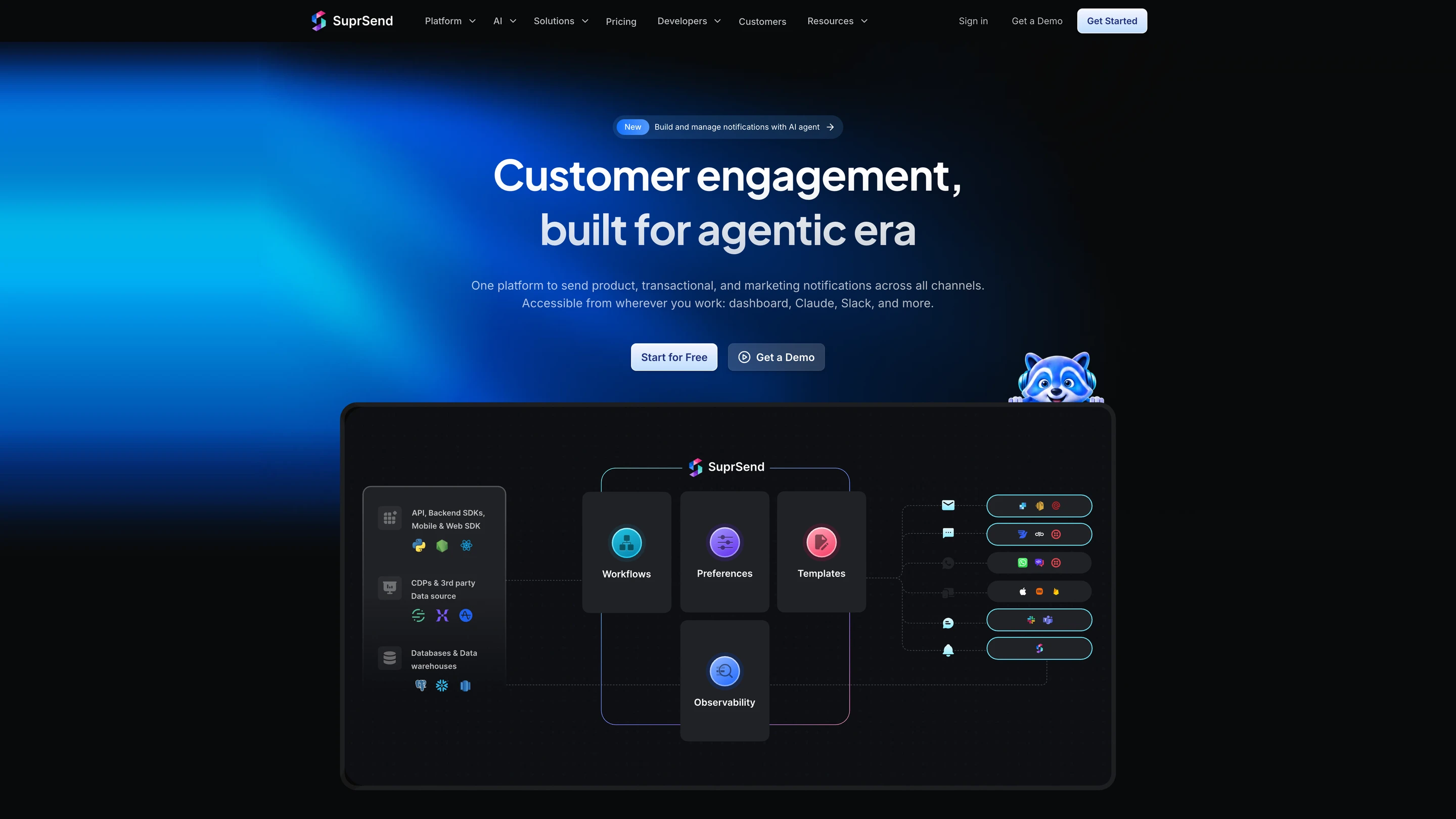
SuprSend's architecture: your API calls, SDKs, CDPs and data warehouses feed workflows, preferences, templates and observability, which send through email, SMS, WhatsApp, push, Slack and Microsoft Teams providers and the in-app inbox

What SuprSend is

SuprSend is a US company, founded in 2022, that runs every notification a product sends from one platform, from transactional alerts to engagement campaigns. Engineering, product and growth teams work in it alongside their agents.

SuprSend sits above your delivery providers. You keep paying your SMS provider for each text; SuprSend sends through it, along with your email, push and chat providers, and adding or switching a provider is a settings change. One user record, one set of preferences and one log cover every channel.

A complete orchestration engine

WorkflowsA workflow engine with branches, conditions, delays, throttling, data fetch and webhook steps, and sends in each user's timezone. One send step reaches the user's channels in your order. Built visually, through the CLI or by an agent, with version history and rollback. Builder on every plan; throttling, fetch, webhook and timezone from Essentials.
Retries and fallbackBring your own providers. If one does not confirm delivery, the next one sends, so an SMS can fall back from one provider to another (provider integrations). From Essentials.
TemplatingEditors for every channel, variants by tenant, user or language, version history with rollback, and translation files (templates). Every plan; translation files on Business.
User preferencesUsers opt in or out per category and channel, in a preference centre you embed or host. Business.
Batching and digestsCollect events over a window and send one message, at a time the user picks (batching and digests). Business.
In-app inboxReal-time bell and feed, read state synced across devices, tabs, toasts, per-tenant feeds, six client SDKs, embedded or headless. Every plan, Free included.
Per-tenant setupsEach of your customers gets its own branding, templates, preferences and provider routing (tenants). Business add-on, Enterprise.
ObservabilityStep-by-step workflow logs and message logs with the provider's error; 30 days on Free, 90 on paid plans; warehouse sync on Business (logs and analytics).
DeploymentSuprSend cloud with 99.9% uptime, or your own VPC, on-prem or bring your own cloud with vendor support. SOC 2 Type II, ISO 27001, GDPR, HIPAA and CPRA. Self-hosted and BYOC on Enterprise.

How your team operates it

In the dashboard

The SuprSend agent builds a workflow from a description, drafts the copy for each channel and traces why a send failed. Product and growth work here and in Slack.

In your own agent

Connect the MCP server to Claude, ChatGPT, Cursor or any MCP client and build and change workflows, templates and tenants, test and send, and read the delivery log and analytics from there.

In your IDE or codebase

The CLI pushes and pulls workflows, templates, schemas and translation files, promotes staging to production and generates TypeScript types, so a bulk change is one command reviewed in a pull request.

Pricing. Free up to 10,000 notifications a month; Essentials starts at $100 a month for 50,000, then $2 per 1,000; Business starts at $250 a month for 50,000, then $5 per 1,000; Enterprise is custom. SMS provider charges are paid to the provider.

Verdict. Choose SuprSend when texts are one channel among several and you want workflows, preferences, an inbox and a backup provider without building them around Plivo or any other carrier. Choose a carrier from this list on its own when SMS or voice is the whole requirement.

2.Twilio

Best for the widest set of communication APIs on a self-serve account

Twilio's homepage: a platform for customer conversations across channels, for humans and AI agents

Where it goes deep. Twilio sells SMS, MMS, RCS, WhatsApp, voice, Verify for passcodes and SendGrid email, with numbers in many countries and pay-as-you-go billing from a trial account. Plivo publishes migration guides from Twilio, so the two APIs map closely in either direction.

Where it stops. SendGrid runs as a separate account with its own users and logs. Twilio’s official MCP server, in public beta since May 2026, searches docs and API specs and does not send messages. G2 reviewers rate its ease of setup at 7.5.

Pick it if you want SMS without a contract and expect to use more of Twilio’s products later.

Verdict. Twilio is the self-serve answer for a team that needs Plivo's channels without the Enterprise minimum. Budget for carrier fees on top of its per-segment rate.

3.Telnyx

Best for low-cost self-serve SMS and voice with an MCP server that sends

Where it goes deep. Telnyx charges one rate per US SMS part sent or received, with carrier fees separate and no platform fee, on a self-serve account. Its official MCP server lets an agent send SMS, MMS and WhatsApp, place calls and manage numbers. G2 reviewers score its support at 9.2.

Where it stops. Telnyx is a carrier and an API. Its docs list no workflow engine for preferences, digests or quiet hours, so that logic stays in your code.

Pick it if you are moving US SMS off Plivo and want the lowest per-message rate without a contract.

Verdict. Telnyx is the closest like-for-like replacement for a team that used Plivo as a cheap SMS and voice carrier. It also scores highest for ease of setup among the carriers here.

4.Vonage

Best for international messaging across several chat apps from one API

Where it goes deep. The Vonage Messages API sends SMS, MMS, WhatsApp, RCS, Viber and Messenger through one endpoint, alongside voice APIs. Its MCP Tooling Server lets an agent send SMS and WhatsApp, manage numbers and check the account balance, and a separate MCP server searches the docs.

Where it stops. US SMS prices are shown per destination, so cost modelling takes more work than with a single published rate. G2 rates it 4.2 across 404 reviews, below the other large carriers here.

Pick it if your users are spread across countries where WhatsApp or Viber matters as much as SMS.

Verdict. Vonage suits teams whose traffic is mostly outside the US and spread across chat apps. For a US-only SMS workload, Telnyx or Twilio is simpler to price.

5.Infobip

Best for global messaging under one contract, with channels chosen country by country

Where it goes deep. Infobip sends SMS, WhatsApp, RCS, Viber and voice from one account. Its MCP servers let an agent send and schedule SMS, send WhatsApp, Viber and RCS messages with SMS failover, read delivery reports and logs, and run passcode flows by SMS, voice or email.

Where it stops. Pricing is quoted per country, and the free trial sends only to numbers you confirm first. G2 has 58 reviews, mostly from mid-market companies, so there is less public signal than for the larger carriers.

Pick it if you need WhatsApp, RCS and SMS across many countries and want one contract and one support team.

Verdict. Infobip is the enterprise answer for global, multi-app messaging. Its MCP servers go further than Plivo's documentation search.

6.Sinch

Best for SMS, RCS, WhatsApp and email bought together on one enterprise contract

Where it goes deep. Sinch’s Conversation API covers SMS, WhatsApp, RCS and other chat channels, and Sinch owns Mailgun for email. Its MCP server sends messages, sends Mailgun email, runs verification and voice, and manages RCS senders, and its Cursor plugin includes a 10DLC skill.

Where it stops. Pricing is quoted. G2 shows 3.8 across 35 reviews and an ease-of-setup score of 6.5, the lowest on this list.

Pick it if procurement wants text and email from one vendor and you have the volume for a negotiated rate.

Verdict. Sinch fits large teams consolidating messaging and email vendors. Smaller teams usually get started faster elsewhere.

7.Bandwidth

Best for US voice and SMS on a carrier that runs its own network

Where it goes deep. Bandwidth runs its own US network and sells voice, messaging, 911 services and number porting on it. Its MCP server, in beta, covers SMS, MMS and RCS messaging, number lookup, MFA and reports. G2 reviewers score its support at 8.9.

Where it stops. Pricing is quoted, and the network advantage is mostly a US one.

Pick it if your traffic is US voice and SMS at volume and you want fewer intermediaries between you and the carriers.

Verdict. Bandwidth is the choice for US-heavy voice and messaging where network control matters. For international reach, Infobip or Vonage covers more.

8.AWS End User Messaging + Amazon SES

Best for teams on AWS that want SMS and email inside their own account

Where it goes deep. AWS End User Messaging sends SMS, MMS and RCS from your AWS account, under IAM permissions, with events flowing into AWS event services and setup through the AWS CLI. Amazon SES handles email in the same account.

Where it stops. You build everything above delivery yourself: templates, preferences, retries and logs. A US 10DLC number sends one message a second by default.

Pick it if your platform team already runs on AWS and prefers to own the notification logic.

Verdict. AWS gives the most control and the least done for you. It works best for teams that would write the orchestration code anyway.

When you should stay on Plivo

  • Your product is a voice agent or a calling product, and Plivo's audio streaming or SIP trunks already carry it in production.
  • You already have an Enterprise contract with rates you negotiated, and your monthly spend sits comfortably above the $1,000 floor.
  • Your traffic is US and India calling, where your number count makes rental prices a real line on the bill.
  • You send a handful of message types, nobody outside engineering edits them, and a code release for a wording change is acceptable.
  • Your messages are passcodes only, and Verify on your current contract already covers them.

Look at the code your team has written around Plivo before you decide. Teams running texts at scale usually end up with a retry queue, an opt-out table checked before each send, a quiet-hours check by timezone, a second provider client in case Plivo has an outage, and separate integrations for email and push with their own unsubscribe lists. That code is a hidden cost: your team builds it, maintains it, and pays for it in engineering time on top of Plivo’s price. A switch is usually driven by one of three things: the Enterprise minimum for SMS, a product that now needs email, push and in-app alongside texts, or product teams waiting on engineers to change a message.

How to migrate off Plivo

  1. 01Record your baselines. Export a month of delivery rates, error codes, latency and cost per message by country and by number type from Plivo's logs, so you can compare the new setup against real numbers.
  2. 02Rebuild your message logic as workflows. List every place your code calls Plivo's Messages API and turn each into a workflow with its template, conditions and delays. With SuprSend, the CLI pulls these into your repo so they are reviewed like code.
  3. 03Move numbers and registrations. Port your long codes and toll-free numbers to the new provider, or keep Plivo as a connected provider during the move. Register your 10DLC brand and campaigns again with the new provider and verify toll-free numbers before cutover; this step takes the longest.
  4. 04Carry consent state. Export every STOP and opt-out recorded against your Plivo numbers and import it before the first send, so nobody who opted out receives a message from the new setup.
  5. 05Add the inbox and other channels. Plivo had no in-app feed, so this is new work: embed the inbox, connect email and push providers, and decide which messages go to which channel and in what order.
  6. 06Dual-send for a short window. Route a small share of traffic, or one low-risk message type, through the new setup while Plivo carries the rest, and compare delivery against your baselines.
  7. 07Keep Plivo for 30 days. Leave the account, numbers and webhooks live for a month after cutover, so replies to old numbers and late delivery receipts still land.

Conclusion

Plivo covers voice agents, SIP trunking, phone numbers and SMS, MMS, RCS and WhatsApp messaging, with clear docs and low number rental. Its self-serve plan now centres on voice in the US, and its messaging channels sit on an Enterprise contract from $1,000 a month.

Move when the contract minimum outweighs your SMS volume, when your product needs email, push and an in-app feed beside texts, or when product and growth teams keep waiting on engineers to change a message. A carrier like Telnyx or Twilio replaces the delivery. A platform like SuprSend runs every kind of message in one system, gives you a complete orchestration engine, and lets engineering, product, growth and their agents operate it, starting on a free plan of 10,000 notifications a month.

FAQ

Is Plivo free?

Plivo gives new accounts free credits for the first 3 weeks. After that, the Professional plan is pay as you go with no monthly fee, but in the US data region it covers voice and SIP trunking only. SMS, WhatsApp and Verify are on the Enterprise plan, which starts at $1,000 a month.

Does Plivo still offer pay-as-you-go SMS?

Plivo's plan comparison lists SMS, MMS and RCS as Enterprise features in the US data region, with Enterprise starting at $1,000 a month. Its SMS rate card still shows per-message prices of $0.0077 for a US long code, which apply under the contract. Ask Plivo which plan your account is on before you budget.

What is the cheapest Plivo alternative?

At 50,000 US texts a month, Telnyx costs about $200 at $0.004 per part and Twilio about $415 at $0.0083 per segment, both before carrier fees. Plivo's list rate gives about $385, but SMS needs its Enterprise plan with a $1,000 monthly minimum. SuprSend is a different layer: it is free up to 10,000 notifications a month and Essentials is $100 a month for 50,000, then $2 per 1,000, on top of what you pay your SMS provider. Providers bill per message segment; SuprSend bills per notification per channel.

Is Plivo cheaper than Twilio?

On list prices, Plivo charges $0.0077 per US long-code SMS against Twilio's $0.0083, and $0.50 a month for a local number against Twilio's $1.15. Carrier surcharges apply on both. Plivo's SMS sits on an Enterprise plan from $1,000 a month, while Twilio sells SMS pay as you go, so at low volume Twilio usually costs less in total.

Which Plivo alternatives include an in-app inbox?

SuprSend is the one tool on this list built around an embeddable notification inbox, with a real-time feed, read state across devices and six client SDKs. Plivo, Twilio, Telnyx, Vonage, Infobip, Sinch, Bandwidth and AWS End User Messaging deliver messages to phones and messaging apps; a feed inside your own product is something you build on top of them.

Which alternatives have an MCP server or agent authoring?

Plivo's MCP server searches its documentation, and Twilio's official MCP server, in beta, searches docs and API specs. Telnyx, Vonage, Infobip and Sinch publish MCP servers that send messages, and Bandwidth has one in beta. SuprSend's agent and MCP server go further: they build and change workflows, templates and tenants, test and send, and query logs and analytics.

Can one platform handle transactional and marketing messages?

Yes. SuprSend runs passcodes, order updates and alerts through workflows and sends campaigns as broadcasts, with one set of users, preferences and unsubscribes across both. The carriers on this list deliver either kind of message but leave the logic and the audience to your code.

Which alternatives support WhatsApp and RCS?

Plivo offers WhatsApp and RCS on its Enterprise plan. Twilio, Vonage, Infobip and Sinch sell both on their own accounts, and Telnyx's MCP server sends WhatsApp. SuprSend sends WhatsApp alongside SMS, email, push, in-app, Slack and Teams through the providers you connect.

Is Plivo HIPAA compliant?

Plivo lists HIPAA with a business associate agreement as an Enterprise feature. SuprSend holds SOC 2 Type II, ISO 27001, GDPR, HIPAA and CPRA, with a HIPAA BAA on Enterprise; details are on the SuprSend trust centre.

Can I self-host a Plivo alternative?

The carriers here are cloud services, since they connect to phone networks. AWS End User Messaging runs inside your own AWS account. SuprSend can be self-hosted in your VPC or on-prem under an Enterprise licence with vendor support.

Do I still pay an SMS provider if I use SuprSend?

Yes. SuprSend sends texts through the SMS provider you connect, such as Plivo or Twilio, and that provider bills you for each message and number. SuprSend bills for the notifications it orchestrates, and lets you add a second provider as a fallback.

Related Resources

What does SuprSend cost at your volume?SuprSend pricing
How do transactional SMS, email and push run from one workflow?Transactional notifications on SuprSend
How do agents build and operate notifications on SuprSend?SuprSend for AI agents

There’s no better place for you
to build notifications

Join thousands of product & engineering teams using SuprSend to build and ship better notifications—faster.