



7 best Klaviyo alternativesfor customer engagement (2026)

We compared seven Klaviyo alternatives on the messages they cover, who on your team can run them, what an agent can do in them, ease of setup and pricing.

By , SuprSendOct 5, 2026

Klaviyo is an email, SMS and mobile push marketing platform for consumer brands, with its roots in ecommerce, billed by the number of active profiles you keep.

Teams evaluating or already running Klaviyo look elsewhere when their product starts sending its own messages: receipts and alerts that cannot wait for a review, a bell inside the app, and settings each customer controls. They want one system for every message, one their engineers, marketers and agents can all work in.

Quick guide: Klaviyo alternatives by use case

If you needChoose
Ecommerce email, SMS and web push from a marketer UI, at a lower entry price?OOmnisendBrevo
Transactional and marketing messages in one platform, with no approval step for receipts and alerts?Password resets and win-back campaigns share one user record, one preference set and one log in SuprSend's transactional workflows.SuprSendSuprSend
SMS is the channel that drives most of your revenue?AAttentive
Journeys across tens of millions of consumer profiles, run by a marketing operations team?BrazeIterable
Product and growth teams changing messages without an engineer?Both run on product events. SuprSend also lets them change transactional messages and in-app feeds from the same dashboard.SuprSendSuprSendCustomer.io
An in-app bell and notification feed inside your product?Klaviyo has no in-app inbox; its in-app forms are pop-ups. SuprSend's in-app inbox syncs read state across devices, adds tabs, toasts and per-tenant feeds, and ships six client SDKs for web and mobile.SuprSendSuprSend
Each of your customers is a business that needs its own branding, templates and preferences?See multi-tenant notifications.SuprSendSuprSend
A full orchestration layer, where users control what they get inside your product?Batching and digests, a preference centre you embed, provider fallback and step-level logs.SuprSendSuprSend
An agent that builds and debugs workflows, or your own agent working over MCP?The SuprSend agent builds a workflow from a description and traces why a send failed.SuprSendSuprSend
Workflows changed in your repo and reviewed in a pull request?SuprSend's CLI pushes and pulls workflows and templates, promotes staging to production and generates TypeScript types.SuprSendSuprSend
Messaging that runs in your own cloud?SuprSend runs in your VPC, on-prem or BYOC with vendor support on Enterprise.SuprSendSuprSend
Store marketing by email and SMS is the whole job, and Klaviyo already runs it?See when you should stay on Klaviyo.Klaviyo

What Klaviyo does

Klaviyo calls itself a B2C CRM. It stores customer profiles, the events your store sends about them, and your product catalog. Marketers use that data to build segments, send campaigns and run flows, which are automated sequences triggered by an event such as a placed order, a list signup or a price drop.

Email came first. SMS and other mobile messages (MMS, RCS and WhatsApp) are bought as credits on top of the email plan, and mobile push reaches the iOS and Android apps you connect with its SDKs. Forms, reviews, a helpdesk and a self-service Customer Hub sit in the same account. Composer, Klaviyo’s agent, audits and creates flows and campaigns from a prompt.

LicenceProprietary, cloud only.
ChannelsEmail, SMS, MMS, RCS, WhatsApp, mobile push for iOS and Android apps, in-app forms; its docs describe no web push.
Backend SDKsAPI libraries for Python, Node, PHP and Ruby, plus a CLI that covers every API operation.
Frontend SDKsJavaScript for onsite tracking and forms; iOS, Android, React Native and Flutter.
ComplianceSOC 2, ISO 27001, ISO 27017, PCI DSS, GDPR, CCPA.
Billing unitActive profiles, plus credits for SMS and other mobile messages.
Self-hostingNone.
G24.6 across 1,362 reviews; ease of setup 8.5.

Where Klaviyo is strong

  • Store data arrives ready to use: Shopify, WooCommerce, Magento, BigCommerce and 350+ marketplace apps feed orders, products and browsing events into profiles.
  • Prebuilt ecommerce flows, such as abandoned cart, browse abandonment and back in stock, with revenue attributed to each campaign and flow.
  • Segmentation on purchase history and behaviour that marketers build without a data team.
  • A broad MCP server with more than 260 tools that can create, schedule and send campaigns, create flows and manage segments, plus a CLI generated from the full API.
PlanPriceWhat it includes
Free$0Up to 250 active profiles, 500 email sends a month, $5 of mobile messages a month, Klaviyo branding, email support for the first 60 days
EmailFrom $20 a month251 to 500 active profiles; the price rises with your active profile count
Email and SMSFrom $35 a monthThe Email plan plus a monthly allotment of SMS and mobile message credits
EnterpriseCustomLarger accounts on annual contracts through sales

Why teams look elsewhere

  1. 01Receipts, password resets and alerts have to go out the moment they are triggered. Klaviyo sends transactional email from flows triggered by an event (other flow types need a request through support), and each transactional message is reviewed before Klaviyo approves it. Editing an approved message removes its transactional status, and it goes back for review. That works for an order confirmation you write once. It slows a product team that changes its account, security and billing messages every sprint.
  2. 02The bill should follow the messages you send. Since February 2025 Klaviyo bills on active profiles: every profile you can still email, text or push counts toward your tier, whether or not you messaged it that month. A product with a large signup base and a small, active audience pays for the whole base, and SMS credits sit on top.
  3. 03A free plan you can build a product on. Klaviyo's free plan stops at 250 active profiles and 500 emails a month. SuprSend's free plan covers 10,000 notifications a month across every channel, with the in-app inbox included.
  4. 04Users need to be reached inside the product and in the browser. Klaviyo's push reaches iOS and Android apps you connect; its docs describe no web push. Its in-app forms are pop-ups, and there is no persistent feed a user can come back to. Klaviyo's channel list includes no Slack or Microsoft Teams. A product that notifies users about activity, approvals or mentions ends up adding a second tool for these.
  5. 05Each of your customers is a business with its own setup. Klaviyo models people: profiles, their events and your catalog. Its docs list no tenant model that gives each business customer its own branding, templates, preferences and sending setup inside one account. B2B products end up keeping that logic in their own code.
  6. 06Engineering wants notification changes reviewed like code. Klaviyo's MCP server and new CLI both call the API one operation at a time. The CLI docs say the earlier workflow that kept flows and campaigns as local JSON files has been retired, and testing runs in a separate test account. Klaviyo's docs list no promotion of a change from staging to production. A team that wants every message change in a pull request has to build that layer itself.

How we compared these tools

For every tool we read the product docs, the API and SDK reference, the pricing page, the trust or security page, the MCP documentation where one exists, and its G2 reviews and ratings. What we compared on: feature depth, use cases covered, billing model, developer experience, AI authoring, and ease of use for technical and non-technical team members.

Three different kinds of product get called “Klaviyo alternatives,” and they solve different problems.

Layer 1: Delivery providers

Amazon SES, SendGrid, Twilio, Firebase Cloud Messaging and APNs move a message to an inbox, a phone or a device. They hold no campaign logic. Every tool on this list sends through providers like these, either its own or ones you connect.

Layer 2: Unified notification platforms

SuprSend, Knock, Courier and Novu sit between your product and the providers. They run the workflows, templates, in-app inbox, user preferences and delivery logs for every message your product sends. SuprSend, Knock and Courier cover transactional and marketing messages; Novu centres on product notifications. All four can be run from outside the dashboard through an MCP server or a CLI. SuprSend’s agent and MCP server build and change workflows, templates and tenants, send tests, and read the delivery log.

Layer 3: Customer engagement platforms

Klaviyo sits here, with Omnisend, Braze, Customer.io, Iterable, Brevo and Attentive. They run campaigns and journeys for marketers, on profiles and segments, with delivery bundled into the price. Most now publish an MCP server that can create campaigns, segments and templates, and some have an in-product agent. Transactional workflows, an embeddable inbox and preferences a customer’s admin controls are usually left to you.

The best Klaviyo alternatives

ToolBuilt aroundStrongest atMeant forBilling unitFree planPaid fromG2
SuprSendSuprSendOne system for transactional, product and engagement notifications on nine channelsWorkflows, in-app inbox, preferences and tenants; SuprSend agent, MCP server and CLIProduct, engineering and growth teams sending every kind of messageNotifications, per channel10,000 notifications a month$100 a month (Essentials, 50,000 notifications)4.8 (129 reviews)Ease of setup: 9.4
OmnisendEmail, SMS and web push for online stores, with prebuilt ecommerce automationsFast setup, store automations, unlimited email on Pro; MCP server for campaigns and segmentsSmall and mid-size ecommerce storesContacts250 contacts, 500 emails a month$16 a month (Standard)4.6 (1,250 reviews)Ease of setup: 9.1
BrazeCanvas journeys across mobile, web, email and messaging apps at consumer scaleJourney depth, SQL segments on warehouse data, Currents streaming; BrazeAI Operator and a remote MCP serverEnterprise consumer brands with a marketing operations teamData points, on a quoted contractNoneQuoted4.4 (1,929 reviews)Ease of setup: 7.6
Customer.ioEvent-driven campaigns on people and object data, from a marketer UIBehavioural triggers from product events; MCP server and CLI that act under the user's roleSaaS and app companies with event dataProfiles (people and objects)None$100 a month (Essentials, 5,000 profiles)4.4 (957 reviews)Ease of setup: 7.9
IterableCross-channel journeys for lifecycle teams at mid-market and enterprise consumer brandsJourney building and segmentation; MCP server in beta, read-only by defaultMid-market and enterprise lifecycle teamsQuoted contractNoneQuoted4.4 (839 reviews)Ease of setup: 7.8
BrevoEmail, SMS and WhatsApp marketing with a built-in CRM, priced by emails sentLow entry price, transactional email on the same account; MCP server for contacts, campaigns and sendsSmall businesses with large lists and modest send volumeEmails sent per month300 emails a day$9 a month (Starter, 5,000 emails)4.5 (2,743 reviews)Ease of setup: 8.9
AttentiveSMS-first marketing for consumer brands, with email alongsideSMS list growth and two-way texting; MCP server in beta for reporting, campaigns, journeys and segmentsEcommerce brands where SMS drives revenueQuoted contractNoneQuoted4.5 (1,276 reviews)Ease of setup: 8.7

1.SuprSendSuprSend

Best for running transactional, product and engagement notifications from one platform, with engineering, product and growth teams working in it alongside their agents
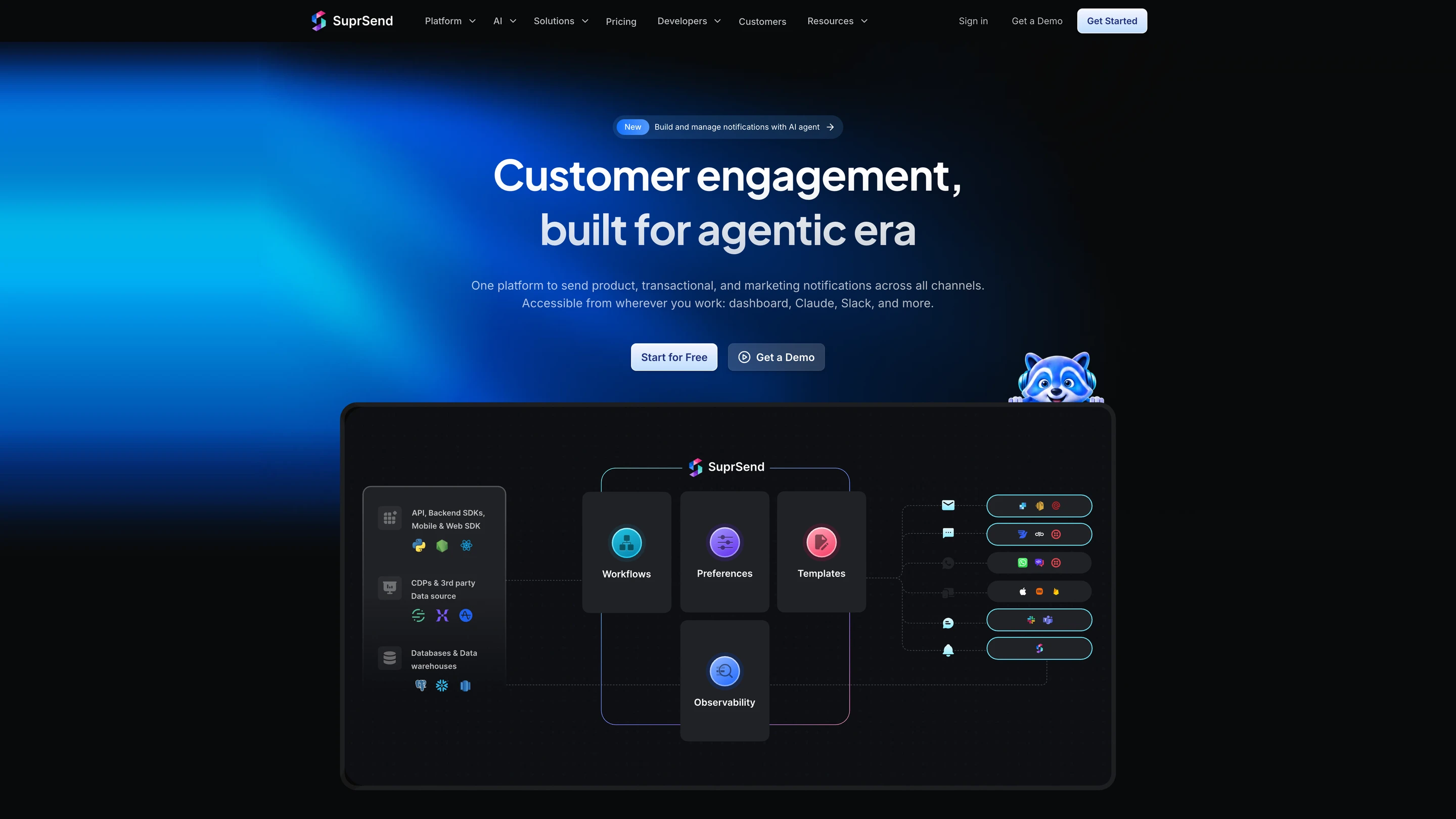
SuprSend's architecture: your API calls, SDKs, CDPs and data warehouses feed workflows, preferences, templates and observability, which send through email, SMS, WhatsApp, push, Slack and Microsoft Teams providers and the in-app inbox

What SuprSend is

SuprSend is a US company, founded in 2022, that runs every notification a product sends from one platform, from transactional alerts to engagement campaigns. Engineering, product and growth teams work in it alongside their agents.

A complete orchestration engine

WorkflowsA workflow engine with branches, conditions, delays, throttling, data fetch and webhook steps, and sends in each user's timezone. One send step reaches the user's channels in your order. Built visually, through the CLI or by an agent, with version history and rollback. Builder on every plan; throttling, fetch, webhook and timezone from Essentials.
In-app inboxA real-time bell and feed with read state synced across devices, tabs, toasts and per-tenant feeds, on six client SDKs, embedded or headless. Every plan, Free included.
User preferencesUsers opt in or out per category and channel, in a preference centre you embed or host, and every send respects it. Business.
Per-tenant setupsEach of your customers gets its own branding, templates, preferences and provider routing. Business add-on, Enterprise.
Batching and digestsCollect events over a window and send one message, at a time the user picks, with batching and digests. Business.
TemplatingEditors for every channel, variants by tenant, user or language, and version history with rollback. Every plan; translation files on Business.
ObservabilityStep-by-step workflow logs and message logs with the provider's error, kept 30 days on Free and 90 on paid plans, with warehouse sync on Business.
Retries and fallbackBring your own providers; if one does not confirm delivery, the next one sends. Essentials.
DeploymentSuprSend cloud with 99.9% uptime, or your own VPC, on-prem or BYOC with vendor support on Enterprise. SOC 2 Type II, ISO 27001, GDPR, HIPAA, CPRA.

How your team operates it

In the dashboard

The SuprSend agent builds a workflow from a description, drafts the copy for each channel and traces why a send failed. Product and growth work here and in Slack.

In your own agent

Connect the SuprSend MCP server to Claude, ChatGPT, Cursor or any MCP client and build and change workflows, templates and tenants, test and send, and read the delivery log and analytics from there.

In your IDE or codebase

The SuprSend CLI pushes and pulls workflows, templates, schemas and translation files, promotes staging to production and generates TypeScript types, so a bulk change is one command reviewed in a pull request.

Pricing. Free up to 10,000 notifications a month; Essentials starts at $100 a month for 50,000, then $2 per 1,000; Business starts at $250 a month for 50,000, then $5 per 1,000; Enterprise custom.

Verdict. Choose SuprSend when your product sends its own notifications alongside campaigns and you want one system, one preference set and one log for both; choose Klaviyo when the job is store marketing run by marketers. For the head-to-head, see how SuprSend differs from Klaviyo.

2.Omnisend

Best for online stores that want Klaviyo-style email, SMS and push automations with a faster setup and a lower entry price

Where it goes deep. Omnisend is built for the same buyer as Klaviyo: a store on Shopify, WooCommerce or BigCommerce that wants campaigns and automations without a developer. Prebuilt workflows cover welcome series, abandoned cart, browse abandonment and post-purchase follow-ups, and email, SMS and web push can sit in one workflow. Its free plan matches Klaviyo’s on contacts at 250, with 500 emails a month. Standard allows twelve emails per contact each month, and Pro removes the cap on emails and web push. G2 reviewers give it 9.1 for ease of setup, among the highest scores on this list.

Pricing is by contact, counting subscribers and non-subscribers who sit in your audience. SMS changed in May 2026: for accounts that subscribed from 4 May 2026, SMS is available only on Pro, as a separate credits subscription from $0.007 a message. Omnisend’s MCP server connects Claude, ChatGPT or Cursor to the account; the agent can analyse performance and create campaigns and segments, and a second version adds action-specific tools.

Where it stops. Omnisend is a marketing tool for stores. Product notifications such as password resets and account alerts, an in-app feed, and per-customer setups for a B2B product sit outside what it is built for. Teams that want marketing and product notifications in one place run a second system next to it.

Pick it if you are a store moving off Klaviyo for price or ease, and email, SMS and web push campaigns are the whole job.

Verdict. Omnisend is the closest like-for-like Klaviyo alternative for ecommerce, with an easier setup and lower entry pricing. It covers store marketing and leaves product notifications to another tool.

3.Braze

Best for enterprise consumer brands running journeys across mobile, web and messaging apps for tens of millions of users

Braze's homepage: a customer engagement platform for marketers, with a loyalty push notification on a phone

Where it goes deep. Braze began as Appboy in 2011, a mobile push company, and built out from there. Canvas journeys carry experiment paths, decision splits, agent steps and version history. Channels include WhatsApp, LINE and KakaoTalk, with Content Cards and Banners for in-app. SQL Segment Extensions build audiences on warehouse data, and Currents streams events back out. BrazeAI Operator works in the dashboard; the remote MCP server reads analytics and creates templates and content blocks.

Where it stops. Contracts are quoted, and Braze counts data points on profile updates, custom events and sessions. Its own stated average time to value is six weeks, and there is no CLI.

Pick it if you have a dedicated marketing operations team and a consumer audience large enough to use journey depth.

Verdict. Braze is the step up from Klaviyo when consumer scale and journey depth matter most. It suits teams with the budget and people to run it.

4.Customer.io

Best for saaS and app companies that want marketers to run event-driven campaigns on product data

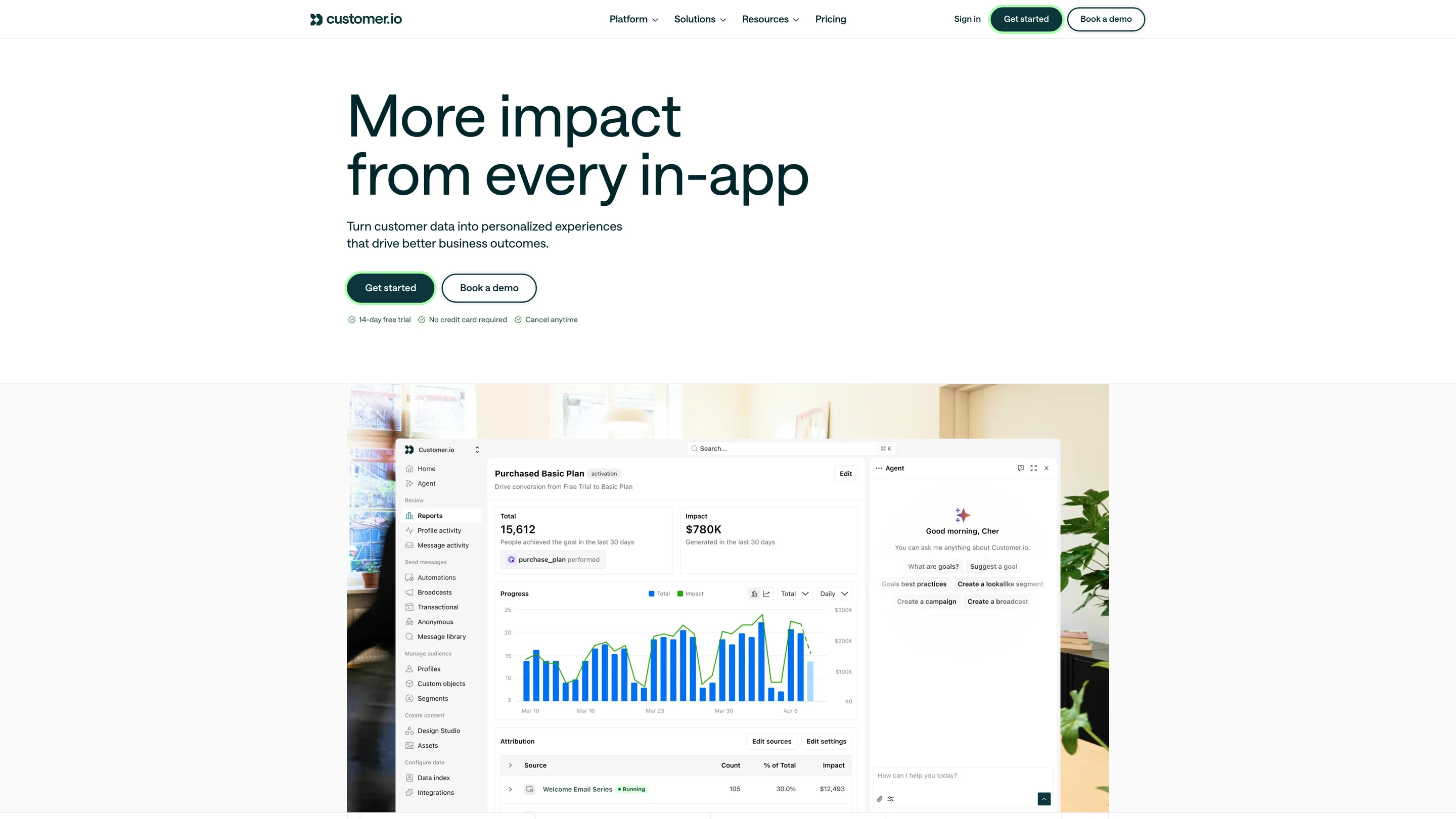
Customer.io's dashboard: a campaign goal report with conversions over time, attribution by message, and the agent panel

Where it goes deep. Customer.io started with email and triggers campaigns from the events your product sends, on people and on objects such as accounts. Essentials costs $100 a month billed monthly and covers 5,000 profiles and a million emails. An in-product agent drafts messages, and its MCP server and CLI act under the signed-in user’s role, with writes held for approval where the client supports it.

Where it stops. There is no free plan, and the bill follows profiles, people and objects together.

Pick it if your audience is product users and your marketers want behavioural campaigns without filing engineering tickets.

Verdict. Customer.io fits products better than stores do. Choose it when campaigns run on product events and marketers own them.

5.Iterable

Best for lifecycle teams at mid-market and enterprise consumer brands that want journeys across email, push, SMS and in-app

Where it goes deep. Iterable, founded in 2013, builds cross-channel journeys with segmentation, A/B tests and personalisation that lifecycle marketers run without engineering. Its MCP server, in beta, gives your agent most of Iterable’s API: it can look up a user, list campaigns, create a template or send an email. It reads by default, and you switch on writes.

Where it stops. Pricing is quoted, with no free plan, and 56% of its G2 reviewers come from mid-market companies. G2 scores its setup at 7.8.

Pick it if you need journey depth close to Braze’s at a mid-market contract.

Verdict. Iterable is a strong Klaviyo replacement for brands outgrowing ecommerce-first tooling. Budget for a contract and an implementation.

6.Brevo

Best for small businesses with large contact lists that want email, SMS and WhatsApp marketing at a low monthly price

Where it goes deep. Brevo prices by emails sent, so a large list you message rarely stays cheap. The free plan sends 300 emails a day, and Starter begins at $9 a month for 5,000 emails. Transactional email runs on the same account as campaigns, and a sales CRM sits alongside. Its MCP server lets an agent manage contacts, create email campaigns and send transactional email, SMS and WhatsApp messages.

Where it stops. SMS and WhatsApp are billed by usage on top of the email plan, and its strength is marketing to a list. Product events, an in-app feed and per-customer setups are outside its focus.

Pick it if price is the main reason you are leaving Klaviyo and your list is bigger than your send volume.

Verdict. Brevo is the low-cost route for marketing and simple transactional email. It suits small teams that want one bill for both.

7.Attentive

Best for ecommerce brands where SMS drives most of their messaging revenue

Where it goes deep. Attentive describes itself as SMS-first, and its depth is there: growing a text list, two-way conversations and SMS journeys, with email alongside. Its MCP server, in beta, lets your agent pull reporting, draft and edit campaigns, and build journeys and segments; changes to live campaigns need write mode switched on.

Where it stops. Contracts are quoted, and the product centres on SMS and email marketing.

Pick it if text messaging is your main revenue channel and you want a vendor that specialises in it.

Verdict. Attentive is the specialist pick for SMS-led brands. Teams whose revenue runs through email do better with a broader platform.

When you should stay on Klaviyo

  • You run an online store, and email and SMS campaigns are the whole messaging job.
  • Your order and shipping confirmations go through Klaviyo's approved transactional flows, and you rarely change them.
  • Your marketers own messaging end to end, and engineering has no notification roadmap.
  • You use Klaviyo for more than messaging, such as reviews, forms or its helpdesk, and replacing those is a project of its own.
  • Your active profile count stays small enough that the bill does not worry you.

The switch usually starts when the product begins sending its own messages. Teams then write code around Klaviyo: a second email service for password resets and invoices that cannot wait for review, a script that copies unsubscribes between the two, a web push tool on the side, and an in-app feed built in-house. That code is a hidden cost: your team builds it, maintains it, and pays for it in engineering time on top of Klaviyo’s price. When that pile grows, one platform for every message is cheaper than three tools held together.

How to migrate off Klaviyo

  1. 01Record your baselines. Export a month of delivery, open, click and unsubscribe rates per flow and campaign, so you can compare after the move.
  2. 02Rebuild your flows as workflows. Map each flow trigger to an event, then rebuild the steps. In SuprSend, keep the workflows in your repo with the CLI so every change is reviewed.
  3. 03Move profiles and push tokens. Export profiles and their properties through the API or the CLI, and register device tokens with the new platform's SDK before you switch sending.
  4. 04Carry consent state. Move email and SMS consent, suppressions and unsubscribes per channel and list, so nobody is messaged who opted out.
  5. 05Add the in-app inbox. Klaviyo has no feed to port, so this is new work: embed the inbox component and point it at the same workflows.
  6. 06Dual-send for a short window. Run one flow on both systems to a small segment, compare against your baselines, then move the rest flow by flow.
  7. 07Keep Klaviyo for 30 days. Leave the account in read mode for reporting and late unsubscribes before you close it.

Conclusion

Klaviyo covers store marketing well: ecommerce data arrives ready to use, flows and campaigns are quick to build, and email, SMS and mobile push run from one account billed by active profiles. For a store whose messaging is campaigns, it remains a sound choice.

Move when your product starts sending its own messages. Then you need every kind of message in one system, a complete orchestration engine with an inbox, preferences and tenants, and a platform your engineers, marketers and agents all work in. SuprSend covers those three, and its free plan includes 10,000 notifications a month to test it on real traffic.

FAQ

Is Klaviyo free?

Yes, up to 250 active profiles and 500 email sends a month, with $5 of mobile messages a month and Klaviyo branding. Paid email plans start at $20 a month for up to 500 active profiles, and the price rises with your profile count.

What is the cheapest Klaviyo alternative?

It depends on the unit each tool bills. Take 50,000 messages a month. On free plans, SuprSend covers 10,000 notifications a month on any channel, Brevo 300 emails a day, and Klaviyo and Omnisend 250 contacts with 500 emails. On the first paid plans, SuprSend Essentials is $100 a month for 50,000 notifications, then $2 per 1,000 (Business is $250, then $5 per 1,000). Brevo Starter is priced by monthly email volume from $9 for 5,000 emails, Omnisend Standard starts at $16 a month and Customer.io Essentials is $100 a month for 5,000 profiles. Klaviyo, Omnisend and Customer.io bill by profiles or contacts, so their price for 50,000 messages depends on how many people receive them. Braze, Iterable and Attentive quote contracts.

Which Klaviyo alternatives include an in-app inbox?

SuprSend ships a real-time inbox and feed on every plan, with six client SDKs for web and mobile. Braze offers Content Cards, a persistent in-app card feed. Klaviyo's in-app forms are pop-ups. For the other tools here, check their SDK docs for whether in-app messages persist as a feed before you plan on one.

Which Klaviyo alternatives have an MCP server or an agent that builds messages?

All seven publish an MCP server, and Klaviyo has one with more than 260 tools. SuprSend's agent builds workflows from a description, drafts copy and traces failed sends, and its MCP server builds and changes workflows, templates and tenants, sends tests and reads the delivery log. Omnisend's and Brevo's servers create campaigns and manage contacts. Iterable's and Attentive's are in beta, with writes switched off until you enable them. Braze's reads analytics and creates templates, and Customer.io's acts under the signed-in user's role.

Can one platform send both transactional and marketing messages?

Yes. SuprSend runs both through the same workflows, preferences and logs, so a password reset and a win-back campaign share one user record. Brevo sends transactional email on the same account as its campaigns. Klaviyo sends transactional email from event-triggered flows after each message is reviewed and approved.

Can I keep Klaviyo for email marketing and use SuprSend for the rest?

Yes. Many teams keep store campaigns in Klaviyo and run product notifications, the in-app inbox and transactional messages in SuprSend. The trade-off is two preference stores and two logs: you need to sync unsubscribes between them, and nobody sees a user's full message history in one place.

Which channels do these tools support?

SuprSend supports nine channels on every plan: email, SMS, WhatsApp, mobile push, web push, Slack, Microsoft Teams, in-app and webhook. Klaviyo covers email, SMS, MMS, RCS, WhatsApp, mobile push and in-app forms, with no web push in its docs. The others vary: Omnisend centres on email, SMS and web push, Brevo on email, SMS and WhatsApp, Attentive on SMS and email, and Braze adds messaging apps such as LINE and KakaoTalk.

Which compliance certifications do they hold?

SuprSend holds SOC 2 Type II and ISO 27001 and is compliant with GDPR, HIPAA and CPRA. Klaviyo lists SOC 2, ISO 27001, ISO 27017, PCI DSS, GDPR and CCPA. For the others, check each vendor's trust centre for the reports your security review needs.

Can I self-host a Klaviyo alternative?

SuprSend runs in your own VPC, on-prem or as BYOC with vendor support on its Enterprise plan. Klaviyo and the other engagement platforms here are cloud only.

Do I still pay email and SMS providers?

With Klaviyo, Omnisend, Brevo and Attentive, delivery is bundled: email is in the plan and SMS is bought as credits or usage. With SuprSend you connect your own providers, such as Amazon SES, SendGrid or Twilio, and pay them directly, which lets you switch provider from settings and fall back to a second one.

Related Resources

How does SuprSend compare with Klaviyo feature by feature?SuprSend vs Klaviyo
What does SuprSend cost at my volume?SuprSend pricing
How do campaigns and broadcasts work in SuprSend?SuprSend broadcasts
How do agents build and run notifications in SuprSend?SuprSend for AI agents

There’s no better place for you
to build notifications

Join thousands of product & engineering teams using SuprSend to build and ship better notifications—faster.