



8 best Amazon SNS alternativesfor multi-channel notifications (2026)

Eight tools compared on the messages they cover, who on your team can run them, what an agent can do in them, ease of setup and pricing.

By , SuprSendOct 6, 2026

Amazon Simple Notification Service (SNS) is the AWS publish and subscribe service that fans one message out to queues, functions, webhooks, mobile push, SMS and email.

Teams evaluating or already running SNS look elsewhere when a user notification needs more than delivery: templates per channel, per-user preferences, an in-app feed, a record of what each user received, and a way for product teams and agents to change messages without a deploy. The alternatives below cover delivery providers that replace one SNS channel and notification platforms with an inbox, workflows and agents that sit above whichever provider sends.

Quick guide: Amazon SNS alternatives by use case

If you needChoose
Transactional, product and engagement notifications from one platform?One set of users, preferences, unsubscribes and logs across every channel.SuprSendSuprSend
A full orchestration layer above your providers?Templates, preferences, digests, retries and provider fallback that SNS leaves to your code.SuprSendSuprSend
Product and growth teams changing messages without an engineer?SuprSendSuprSendOneSignal
An agent that builds and debugs notifications, or your own agent over MCP?SuprSendSuprSend
Push campaigns that marketers run from a UI?OneSignalPushwoosh
Mobile push only, free, with full control in your own code?FCM + APNs
SMS from a dedicated provider?Telnyx for a lower per-message price, Twilio for breadth of numbers and voice, AWS End User Messaging to stay on your AWS bill.TTelnyxTwilioAWS End User Messaging
An in-app bell and notification feed?Amazon SNS has no inbox. SuprSend's inbox syncs read state across devices, adds tabs, toasts and per-tenant feeds, and ships six client SDKs for web and mobile.SuprSendSuprSend
Each of your customers with its own branding, templates and preferences?SuprSendSuprSend
Open source, free self-hosting and workflows written in TypeScript?Novu
A notification platform inside your own VPC or AWS account, with vendor support?SuprSendSuprSend
Service-to-service fan-out to queues, functions and webhooks, already live?SNS is built for this. See when to stay on Amazon SNS.Amazon SNS

What Amazon SNS does

Amazon SNS is a pub/sub service. A publisher sends a message to a topic once, and SNS delivers a copy to every subscriber. Subscribers can be other AWS services (SQS queues, Lambda functions, Data Firehose), HTTP endpoints, or people: a phone number for SMS, a device token for mobile push, an email address.

For mobile push, you register each device token as a platform endpoint under an app for APNs, FCM or another push service, then publish to the endpoint or to a topic. SMS runs on AWS End User Messaging, the service that took over Amazon Pinpoint’s SMS, voice and push channels in 2024. Email from SNS is plain text to addresses that confirmed a topic subscription; customer email on AWS goes through Amazon SES.

Amazon SNS product page: a fully managed pub/sub service for application-to-application and application-to-person messaging
LicenceProprietary, AWS cloud only.
ChannelsMobile push (APNs, FCM, Amazon Device Messaging, Baidu, Windows), SMS, plain-text email; SQS, Lambda, HTTP/S and Data Firehose for service-to-service delivery.
Backend SDKsThe AWS SDKs for every major language, plus the AWS CLI.
Frontend SDKsNone; your app collects device tokens and your backend registers them.
ComplianceCovered by AWS programmes including SOC, ISO 27001, PCI DSS and HIPAA eligibility.
Billing unitAPI request (each 64 KB chunk counts as one) plus a delivery charge by endpoint type; SMS per message plus carrier fees.
Self-hostingNone; runs inside your AWS account and regions.

Where Amazon SNS is strong

  • Fan-out at AWS scale: one publish reaches thousands of subscribers, and filter policies let each subscriber receive only the messages it needs.
  • Cost at volume: mobile push costs $0.50 per million deliveries after the first million each month, and deliveries to SQS and Lambda carry no SNS delivery charge.
  • Security inside your account: IAM policies, encryption with AWS KMS and private access through AWS PrivateLink.
  • FIFO topics that keep message order and remove duplicates for subscribers that need both.
ItemFree each monthPrice after that
API requests (publishes)1 million$0.50 per million
Mobile push deliveries1 million$0.50 per million
HTTP/S deliveries100,000$0.60 per million
Email deliveries1,000$2.00 per 100,000
SQS and Lambda deliveriesAllNo SNS delivery charge
SMSNonePer message by country, plus carrier fees
US toll-free numberNone$2 a month per number

Why teams look elsewhere

  1. 01A user notification needs logic that decides who gets what, where and when. SNS delivers the message you publish. It has no user object, no template per channel, no delay or digest step, no quiet hours and no rule like "send an email if the push was not opened". Every one of those lives in your application, in front of each publish call.
  2. 02Device tokens are yours to keep clean. Each device needs a platform endpoint created from its token. When APNs or FCM reports a token as invalid, SNS marks the endpoint disabled, and your code has to notice, delete it and map users to their current endpoints. Teams end up running a token table and a clean-up job next to SNS.
  3. 03SMS takes setup before the first real message. New AWS accounts can send SMS only to phone numbers they add and confirm, until AWS Support approves production access. US traffic needs a registered 10DLC campaign, toll-free number or short code, and each number belongs to one AWS region.
  4. 04Several channels users expect are outside SNS. There is no in-app feed, no browser web push, no Slack or Microsoft Teams, and email is plain text to confirmed topic subscribers. A product that needs these builds them separately and joins them back to SNS in its own code.
  5. 05Answering "did this user get it" means reading CloudWatch. Delivery status logging is switched on per protocol with an IAM role and a sampling rate, and results land in CloudWatch Logs. There is no per-user message history, so support questions turn into log queries.
  6. 06Changing a message means changing code. AWS publishes an SNS and SQS MCP server that creates topics and subscriptions and publishes messages. SNS stores no templates, versions or workflows, so the copy and the rules sit in your repository and every change goes through a deploy.
  7. 07AWS's engagement layer is closing. Amazon Pinpoint, which many SNS users paired with it for segments, campaigns, journeys and templates, reaches end of support on 30 October 2026. The SMS, voice and push APIs continue as AWS End User Messaging; the campaign and journey features do not, so teams that relied on them need a new home for that logic.

How we compared these tools

For each tool we read the product docs, API reference, pricing page, trust or security page and G2 reviews, including G2’s ease-of-setup score from its compare pages. What we compared on: feature depth, use cases covered, billing model, developer experience, AI authoring, and ease of use for technical and non-technical team members.

Three different kinds of product get called “Amazon SNS alternatives,” and they solve different problems.

Layer 1: Delivery providers

SNS sits here, alongside FCM, APNs, Twilio, Telnyx, AWS End User Messaging and Amazon SES. They move one message to a device, number or inbox and bill per message or per delivery. Every product team pays at least one of them, including teams that use a platform from the next two layers.

Layer 2: Unified notification platforms

SuprSend and Novu hold the user, the preferences, the templates and the workflow, and send through layer 1 providers. SuprSend covers transactional and marketing notifications in one platform, and both can be run from outside the dashboard: Novu through workflows written in TypeScript and an MCP server, SuprSend through its agent, an MCP server and a CLI that work on workflows, templates, tenants and logs.

Layer 3: Customer engagement platforms

OneSignal and Pushwoosh run campaigns and journeys for consumer apps, starting from push. Their agents mostly read audience data and help in the campaign canvas. Product notifications tied to your backend events, and an inbox your customers’ admins control, are usually left to you.

The best Amazon SNS alternatives

ToolBuilt aroundStrongest atMeant forBilling unitFree planPaid fromG2
SuprSendSuprSendOne workflow engine for every notification a product sends, across nine channels and your choice of providersWorkflows, inbox and preferences in one platform; SuprSend agent, MCP server and CLIEngineering, product and growth teamsNotification per channel10,000 notifications a month$100 a month for 50,000 (Essentials)4.8 (129 reviews)Ease of setup: 9.4
OneSignalPush, in-app, email and SMS campaigns for consumer appsPush campaigns from a dashboard; AI agent and MCP server for users, segments, templates and sendsMarketing and growth teamsMonthly active user on mobile; web push subscriberPush and in-app to 1,000 users a month$19 a month plus $0.012 per mobile user (Growth)4.7 (1,238 reviews)Ease of setup: 8.9
FCM + APNsGoogle's and Apple's own push transportMobile and web push at no cost at any volume; Firebase MCP server sends a messageEngineers who own push in codeNoneUnlimitedNo paid tier; APNs needs the Apple Developer Program at $99 a year-
TwilioProgrammable SMS, voice and WhatsApp APIsNumbers, messaging, voice and verification under one accountEngineering teams sending SMS and voiceSMS segment, sent or received, plus carrier feesTrial credit only$0.0083 per US SMS segment4.1 (529 reviews)Ease of setup: 7.5
AWS End User MessagingAWS's SMS, MMS, RCS, voice, WhatsApp and push APIs, formerly Pinpoint's channelsMessaging on your AWS bill, IAM and regions, with RCS and SMS fallbackAWS engineering teamsMessage by country, plus carrier feesNonePer message by destination; $2 a month per US toll-free number-
TelnyxA carrier network with SMS, voice and number APIsLow per-message price; MCP server that sends SMS, MMS and WhatsApp and places callsEngineering teams sending SMS and voiceSMS part, sent or received, plus carrier feesNone published$0.004 per US SMS part4.7 (525 reviews)Ease of setup: 9.0
PushwooshMobile push campaigns with a journey builderLow per-user price for push; journeys across push, email, SMS and WhatsApp; MCP server that sendsMobile marketing teamsMonthly active user1,000 users a month$7 per 1,000 users (Push only)4.4 (50 reviews)Ease of setup: 8.7
NovuAn open-source notification framework with workflows in TypeScriptFree self-hosting; workflows as code; MCP server with 23 toolsEngineering teamsWorkflow run per subscriber10,000 runs a month$30 a month for 30,000 runs (Pro)4.6 (22 reviews)Ease of setup: 8.8

1.SuprSendSuprSend

Best for running transactional, product and engagement notifications from one platform, on top of the providers you already pay
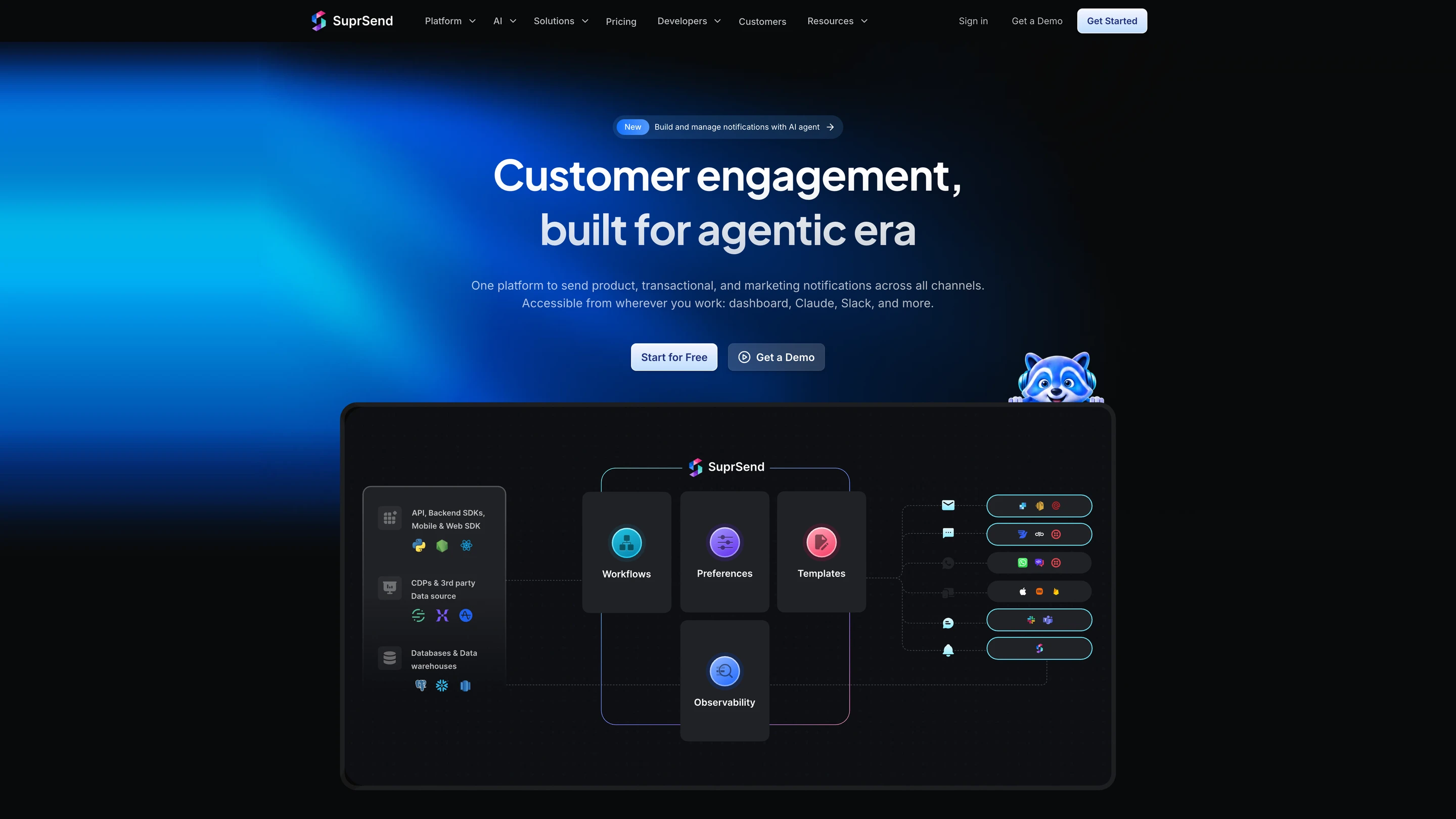
SuprSend's architecture: your API calls, SDKs, CDPs and data warehouses feed workflows, preferences, templates and observability, which send through email, SMS, WhatsApp, push, Slack and Microsoft Teams providers and the in-app inbox

What SuprSend is

SuprSend is a US company, founded in 2022, that runs every notification a product sends from one platform, from transactional alerts to engagement campaigns. Engineering, product and growth teams work in it alongside their agents.

It sends through the providers you choose: push through FCM and APNs, SMS through Amazon SNS, Twilio or another provider, email through Amazon SES or another provider. You keep paying them, and switching one is a settings change.

A complete orchestration engine

WorkflowsA workflow engine with branches, conditions, delays, throttling, data fetch and webhook steps, and sends in each user's timezone. One send step reaches the user's channels in your order. Built visually, through the CLI or by an agent, with version history and rollback. Builder on every plan; throttling, fetch, webhook and timezone from Essentials.
TemplatingEditors for every channel, variants by tenant, user or language, version history with rollback, and translation files. Every plan; translation files on Business.
Retries and fallbackBring your own providers; if one does not confirm delivery, the next one sends. From Essentials.
ObservabilityStep-by-step workflow logs and message logs with the provider's error; 30 days on Free, 90 on paid plans; warehouse sync on Business.
User preferencesOpt in or out per category and channel, in a preference centre you embed or host. Business.
Batching and digestsCollect events over a window and send one message, at a time the user picks. Business.
In-app inboxReal-time bell and feed, read state synced across devices, tabs, toasts, per-tenant feeds, six client SDKs, embedded or headless. Every plan, Free included.
Per-tenant setupsEach of your customers gets its own branding, templates, preferences and provider routing. Business add-on, Enterprise.
DeploymentSuprSend cloud with 99.9% uptime, or your own VPC, on-prem or BYOC with vendor support; SOC 2 Type II, ISO 27001, GDPR, HIPAA, CPRA. Self-hosted and BYOC on Enterprise.

How your team operates it

In the dashboard

The SuprSend agent builds a workflow from a description, drafts the copy for each channel and traces why a send failed. Product and growth work here and in Slack.

In your own agent

Connect the MCP server to Claude, ChatGPT, Cursor or any MCP client and build and change workflows, templates and tenants, test and send, and read the delivery log and analytics from there.

In your IDE or codebase

The CLI pushes and pulls workflows, templates, schemas and translation files, promotes staging to production and generates TypeScript types, so a bulk change is one command reviewed in a pull request.

Pricing. Free up to 10,000 notifications a month; Essentials starts at $100 a month for 50,000, then $2 per 1,000; Business starts at $250 a month for 50,000, then $5 per 1,000; Enterprise custom. Your provider charges (SNS, FCM, Twilio and others) stay on their own bills.

Verdict. Choose SuprSend when notifications have outgrown publish calls and you want workflows, preferences, an inbox and per-user logs that engineering, product and agents can all work in. Choose a delivery provider alone when one channel and a few messages are the whole job.
2.OneSignal

Best for consumer apps whose marketers run push campaigns from a dashboard

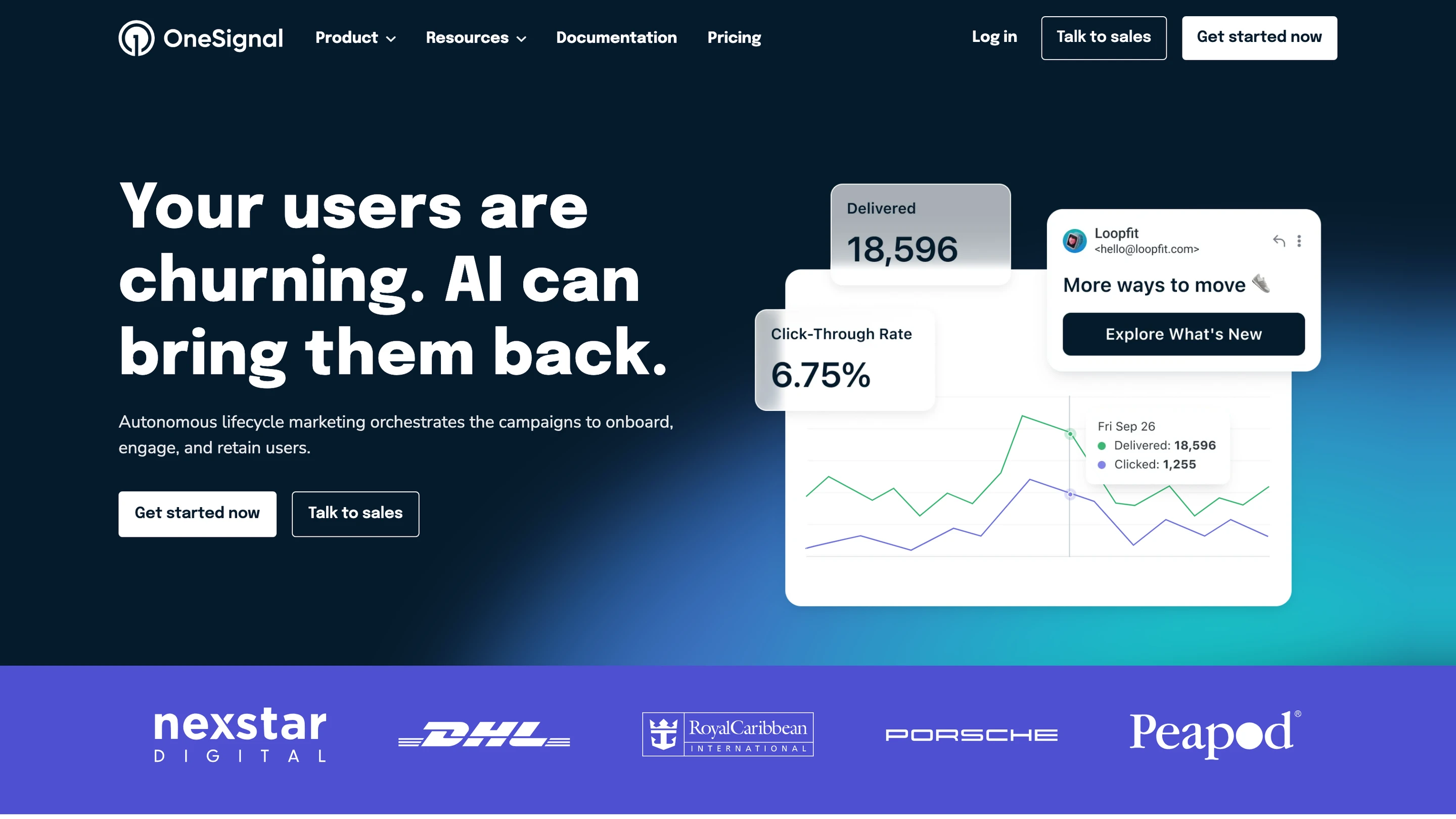
OneSignal's homepage: lifecycle marketing campaigns with a delivered and click-through-rate chart and an email preview

Where it goes deep. OneSignal started with push and added in-app messages, email and SMS. Its SDKs collect and refresh device tokens for you, and Journeys branch across push, email, SMS and in-app. An AI agent and an MCP server on every plan manage users, segments and templates and send messages.

Where it stops. It keeps no stored per-user message history, so there is no lasting in-app feed, and preferences are push categories. There is no CLI, and each environment is a separate app. Billing counts mobile monthly active users, including users who have not opted in to push.

Pick it if marketers own push and you want token handling and campaigns off your engineers’ plate.

Verdict. The closest answer for teams that used SNS for push campaigns. It moves the work from code to a dashboard, at a price that follows your user count.

3.FCM + APNs

Best for engineering teams that want free push and already own the logic in code

The Firebase Cloud Messaging product page: send notifications across platforms to drive re-engagement and retention

Where it goes deep. SNS mobile push sends through these two services, so calling them directly removes a hop. Firebase Cloud Messaging sends mobile push, web push and in-app messages at no cost at any volume, with topic subscriptions. Apple Push Notification service delivers to iOS. The Firebase MCP server can send a message.

Where it stops. There is no user object, template, preference or workflow logic, and you store and clean tokens yourself; Android registrations expire after 270 days. Email, SMS and an inbox are separate builds.

Pick it if push is your only user channel and an engineer owns it long term.

Verdict. The honest replacement for SNS mobile push when you only need transport. It costs nothing in fees and the same engineering time SNS costs today.

4.Twilio

Best for teams that want SMS, voice and verification from one well-known account

Twilio's homepage: a platform for customer conversations across channels, for humans and AI agents

Where it goes deep. Twilio sells local, toll-free and short-code numbers, SMS, MMS, RCS, WhatsApp, voice and one-time passcodes, with seven official server libraries. US SMS lists at $0.0083 per segment plus carrier fees.

Where it stops. It has no push channel or notification feed, and email is SendGrid on a separate account. Twilio’s official MCP server, in public beta, searches docs and API specs and does not send.

Pick it if SMS and voice are the reason you used SNS and you want a dedicated messaging vendor.

Verdict. A like-for-like answer for SNS SMS with more number types and channels. Expect a higher per-message price than AWS or Telnyx.

5.AWS End User Messaging

Best for AWS teams that want SMS and WhatsApp without leaving their AWS account

The AWS End User Messaging product page: SMS, RCS, MMS and WhatsApp conversations, built on AWS

Where it goes deep. It is the service SNS SMS already runs on, renamed from Pinpoint’s channel APIs in 2024. Calling it directly adds MMS, RCS with SMS fallback, voice and WhatsApp, with configuration sets for event destinations, under the same IAM and billing.

Where it stops. It is a set of channel APIs with no templates, segments or journeys. Pinpoint’s campaign features end on 30 October 2026, and AWS’s docs point engagement work to other services.

Pick it if procurement or security wants messaging on the AWS bill and your team owns the logic.

Verdict. The same-tier answer for teams staying inside AWS for SMS. It gives you more channels and more control, with the same build-it-yourself model.

6.Telnyx

Best for high-volume SMS where the per-message price drives the decision

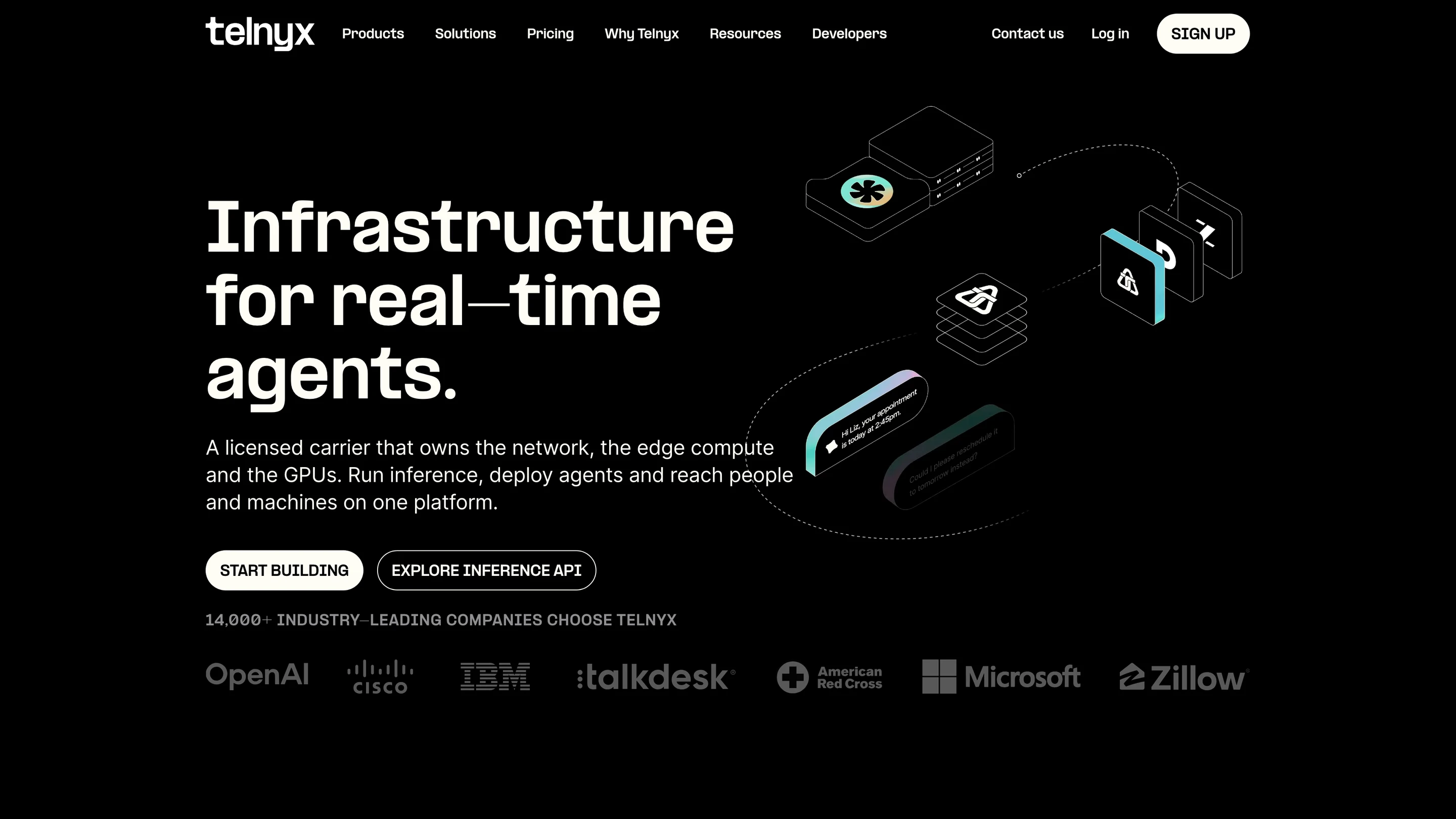
Telnyx's homepage: a licensed carrier and edge compute platform for real-time agents

Where it goes deep. Telnyx runs its own carrier network and lists US SMS at $0.004 per part, sent or received, with carrier fees separate and no platform fee. Its official MCP server sends SMS, MMS and WhatsApp, places calls and manages numbers.

Where it stops. It covers SMS, voice and numbers only: no push, no email and no workflow logic. G2 reviewers mention strict verification for new senders.

Pick it if you send SMS in volume and want a dedicated provider at a lower rate.

Verdict. The price-led SMS replacement on this list. It scores 9.0 for ease of setup on G2.

7.Pushwoosh

Best for mobile marketing teams that want push campaigns priced per person messaged

Pushwoosh's homepage: one platform for the complete user journey, from app install to repeat purchase

Where it goes deep. Pushwoosh covers iOS and Android push, including Huawei and Amazon Fire devices, plus in-app, email, SMS, WhatsApp and wallet passes. Its Customer Journey Builder runs them in one flow. Push only costs $7 per 1,000 monthly active users after the first 1,000, counting a person once across apps. Its MCP server lets an agent send on push, email, SMS and messengers and manage segments.

Where it stops. It is a marketing platform for consumer apps with no Slack or Microsoft Teams channel, and G2 reviewers cite reporting as the most common drawback.

Pick it if your engagement runs on push and marketers run the campaigns.

Verdict. A campaign tool for teams moving push off SNS and Pinpoint. Choose it when marketers need journeys and you want to pay for the people you message.

8.Novu

Best for engineering teams that want an open-source notification layer they can self-host on AWS

Novu's homepage: open-source notification infrastructure for products and AI agents, with Slack, Teams, SMS, email, WhatsApp and Telegram channels

Where it goes deep. Novu’s core is MIT licensed and free to self-host. Workflows can live in your application as TypeScript through the Novu Framework, and a GitHub Action syncs them. It has an in-app inbox, user-set quiet hours, and an MCP server with 23 tools for subscribers, preferences, workflows, triggers and logs.

Where it stops. Each step sends on one channel, there is no version history and no automatic provider failover. Slack and Teams are in beta, and RBAC starts on the Team plan.

Pick it if you want notification logic in your repository and the people to run it yourself.

Verdict. The open-source route above SNS. It bills per workflow run, so one event that reaches several channels counts once.

When you should stay on Amazon SNS

  • Your messages go from service to service: SQS queues, Lambda functions and webhooks, with filter policies doing the routing.
  • Your notifications are operational alerts to your own team, such as CloudWatch alarms and build failures.
  • You broadcast the same push to everyone on a topic and nobody needs per-user history or preferences.
  • Your volume sits inside the free tier and one engineer owns the code around it.
  • Policy requires every message to stay inside your AWS account and you would rather build than buy.

Teams that send user notifications on SNS end up writing the same code around it: a token table with a job that removes disabled endpoints, a template layer per channel, a preference check before each publish, a retry that tries SMS when push fails, and CloudWatch queries to answer support tickets. That code is a hidden cost: your team builds it, maintains it, and pays for it in engineering time on top of SNS’s price. A switch usually starts when a second channel arrives, a product manager asks to change copy without a deploy, or a customer asks to control what their users receive.

How to migrate off Amazon SNS

  1. 01Record baselines. Turn on delivery status logging if it is off, and note delivery and failure rates per channel for two weeks.
  2. 02Rebuild each notification as a workflow. Move the copy and the rules from your publish code into templates and workflows, and keep them in your repository with the CLI.
  3. 03Move tokens and users. List the endpoints for each platform application, keep only the enabled ones, and import each token against its user.
  4. 04Carry consent state. Export the numbers that opted out of SMS and import them as opt-outs, along with any preferences your own database holds.
  5. 05Keep your SMS numbers. Connect SNS as the SMS provider at first, so registered 10DLC campaigns and toll-free numbers keep working; delivery receipts for those sends stay in CloudWatch until you move SMS to another provider.
  6. 06Add the inbox and dual-send. Ship the in-app feed if you need one, then send through both paths for a small share of users and compare against the baselines.
  7. 07Keep SNS for 30 days. Leave the topics and endpoints in place after cutover, then remove the user-facing ones and keep the service-to-service topics.

Conclusion

Amazon SNS is a reliable, low-cost way to fan a message out inside AWS and to deliver mobile push and SMS. It leaves the user, the template, the preference and the record of what each person received to your code.

Move when notifications become a product of their own: several channels, messages product teams want to change, customers who want control. At that point the choice is a delivery provider plus your own logic, or a platform that runs every message in one system, with a complete orchestration engine your whole team and its agents can operate. SuprSend is free up to 10,000 notifications a month, and SNS can stay underneath as a provider.

FAQ

Is Amazon SNS free?

Amazon SNS has a free tier every month: 1 million API requests, 1 million mobile push deliveries, 100,000 HTTP/S deliveries and 1,000 email deliveries. SMS has no free tier; each message is billed by country with carrier fees, and US sending needs a registered number.

What is the cheapest Amazon SNS alternative?

For push transport alone, FCM and APNs cost nothing at any volume, and SNS push is free to 1 million deliveries a month. At 50,000 notifications a month on a platform: SuprSend is free to 10,000 and Essentials costs $100 for 50,000; Novu is free to 10,000 workflow runs and Pro costs $30 for 30,000 runs; OneSignal and Pushwoosh bill per monthly active user. These are different units: a Novu run can reach several channels, and a user-based price depends on audience size. Platform prices are on top of the providers that deliver.

Which Amazon SNS alternatives include an in-app inbox?

SuprSend includes an in-app inbox on every plan, with read state synced across devices and six client SDKs. Novu ships an in-app inbox component. OneSignal sends in-app messages but keeps no stored per-user feed. Amazon SNS, FCM and APNs, Twilio, Telnyx and AWS End User Messaging have no inbox.

Which alternatives have an MCP server or agent authoring?

The SuprSend agent builds workflows from a description, drafts copy and traces failed sends, and its MCP server lets Claude, ChatGPT or Cursor build and change workflows, templates and tenants and read logs. OneSignal, Pushwoosh, Novu, Telnyx and Firebase publish MCP servers that send messages or manage users. AWS's SNS and SQS MCP server manages topics and subscriptions and publishes. Twilio's official MCP server searches its docs.

Can one platform handle transactional and marketing notifications?

Yes. SuprSend runs transactional alerts, product notifications and engagement campaigns on the same users, preferences, unsubscribes and logs. OneSignal and Pushwoosh lean toward marketing campaigns, and delivery providers such as SNS, Twilio and Telnyx leave both kinds of logic to your code.

Which channels does each alternative support?

SuprSend covers email, SMS, WhatsApp, mobile push, web push, Slack, Microsoft Teams, in-app and webhook on every plan. OneSignal covers push, in-app, email and SMS. Pushwoosh adds WhatsApp and wallet passes. Twilio and AWS End User Messaging cover SMS, MMS, RCS, voice and WhatsApp. Telnyx covers SMS, voice and WhatsApp. FCM and APNs cover push only.

Are these alternatives compliant with SOC 2, GDPR and HIPAA?

SuprSend holds SOC 2 Type II and ISO 27001 and complies with GDPR, HIPAA and CPRA, with a HIPAA BAA on Enterprise. Novu Cloud lists SOC 2 Type II, ISO 27001, GDPR and a HIPAA BAA. Pushwoosh lists ISO 27001 and GDPR. Amazon SNS falls under AWS's compliance programmes, including HIPAA eligibility.

Can I self-host an Amazon SNS alternative?

Novu's open-source core is free to self-host, and you run it yourself. SuprSend runs in your own VPC, on-prem or as bring-your-own-cloud on an Enterprise licence, with vendor support. OneSignal, Pushwoosh, Twilio and Telnyx are cloud services.

Do I still pay SNS, FCM or Twilio if I use a notification platform?

Yes. SuprSend and Novu send through your providers, so SMS, email and WhatsApp charges stay on the provider's bill and push still goes through FCM and APNs. SuprSend can keep Amazon SNS as your SMS provider, so existing registered numbers keep working.

What happens to Amazon Pinpoint campaigns after October 2026?

AWS ends support for Amazon Pinpoint on 30 October 2026. After that date the Pinpoint console, endpoints, segments, campaigns, journeys and analytics are no longer available. SMS, voice, mobile push and OTP APIs continue as AWS End User Messaging, so sending keeps working while campaign logic needs a new home.

Related Resources

What does SuprSend cost at my volume?SuprSend pricing
Which SMS, email and push providers can SuprSend send through?Provider integrations
Can SuprSend run inside our own AWS account?Bring your own cloud
How do agents build and change notifications in SuprSend?SuprSend for AI agents

There’s no better place for you
to build notifications

Join thousands of product & engineering teams using SuprSend to build and ship better notifications—faster.