SuprSendVSMailchimp

SuprSend vs Mailchimp

Mailchimp is email-first marketing for small businesses, with SMS and transactional email sold as add-ons. SuprSend is agentic, multi-channel orchestration for every message your product sends.

Trusted infrastructure layer behind hundreds of platforms

ExaCareSiemensEmergentSarvamCrazyGamesEvocalizeEskoFrankieOneSennderDelightreeHeyReachFreightify

Mailchimp and SuprSend both send campaigns and triggered messages to your users. Mailchimp is built around a marketer sending email to an audience, with SMS and transactional email bought as add-ons. SuprSend is agentic, multi-channel orchestration: engineering, product, growth and their agents run every kind of message, on every channel, from one system.

Why teams choose SuprSend over Mailchimp

Reach customers on every channel from one integration

Email, SMS, WhatsApp, mobile push, web push, Slack, Teams, in-app inbox and webhooks run on one user profile, and transactional, product and marketing messages share the same workflows, preferences and logs. Mailchimp sells SMS as credits in 37 countries and has no push or inbox.

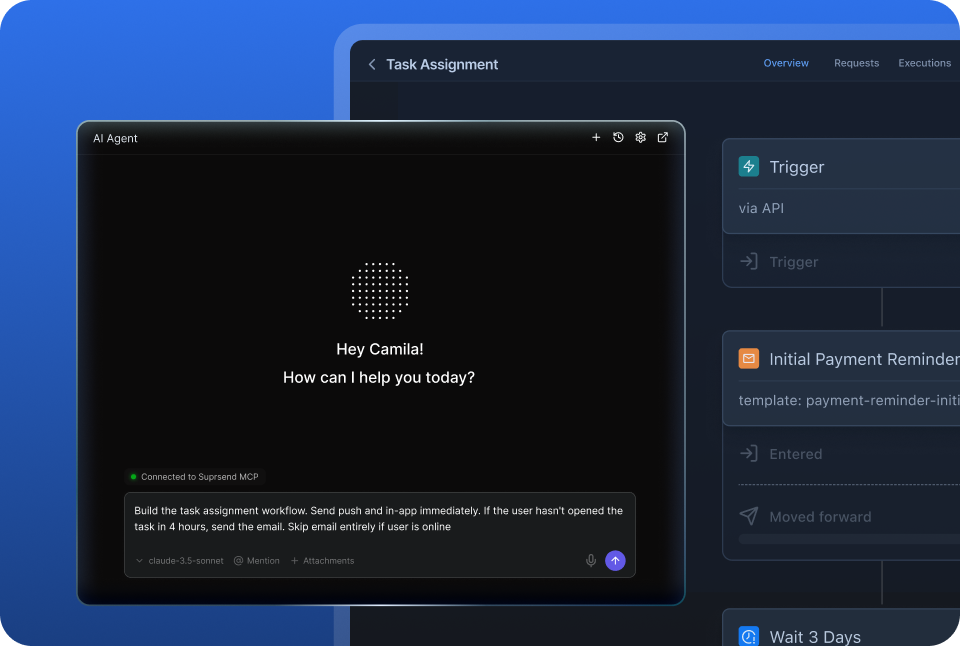
Agents build, send and manage notifications

Your team works from the tools it already uses: the dashboard, Slack, the repo, Claude or ChatGPT. Agents create workflows, write templates, trigger sends and read the delivery log. Mailchimp’s Intuit Assist writes copy inside its dashboard, and its MCP server covers transactional email only.

Customise notifications per tenant, with per-user preferences

Each tenant has its own sending domain and provider, its own template versions, its own channel defaults and a per-tenant feed, nested five levels deep. Each user sets preferences per category, channel and digest schedule. Mailchimp separates brands into audiences, capped at three on Essentials.

Failover, batching and version history under every message

A failed send moves to the next provider, bursts collapse into one digest, every workflow and template keeps versions with rollback, and test mode blocks real delivery outside production. Mailchimp delivers every email itself, and its flows have no version history or staging environment.

Build notifications in the dashboard, in your own agent, or in your codebase

A product manager changes a workflow in the dashboard. A developer commits the same workflow as a file and ships it through a pull request. A marketer asks Claude to build a list and send a campaign. All three work on the same workflows, templates and logs, so nobody waits on a ticket.

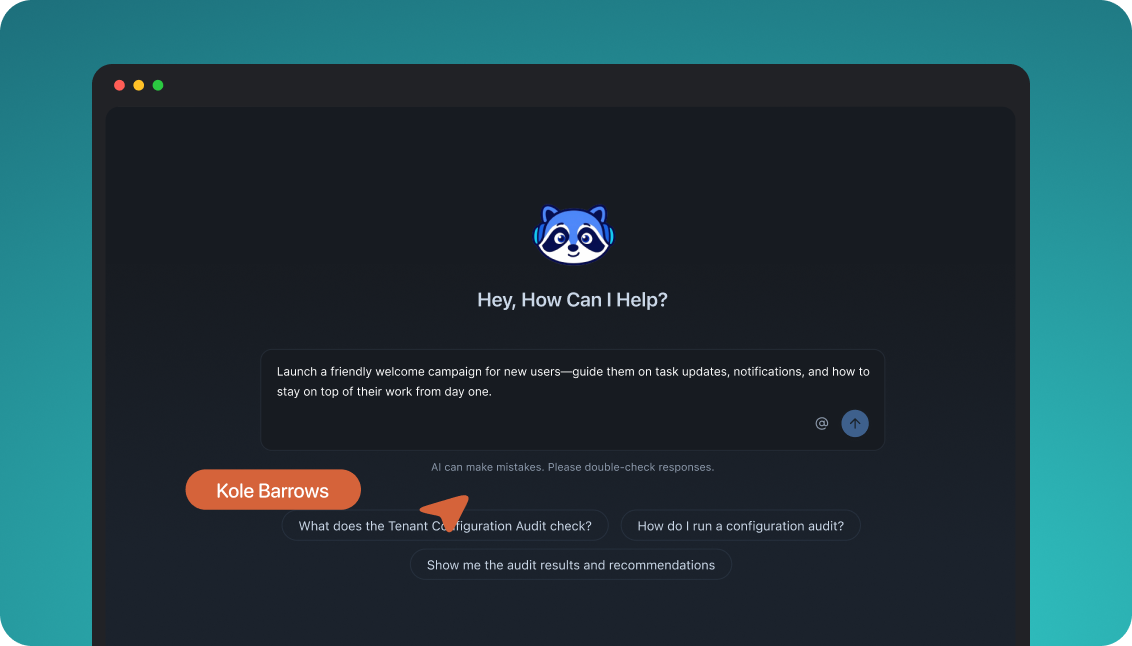
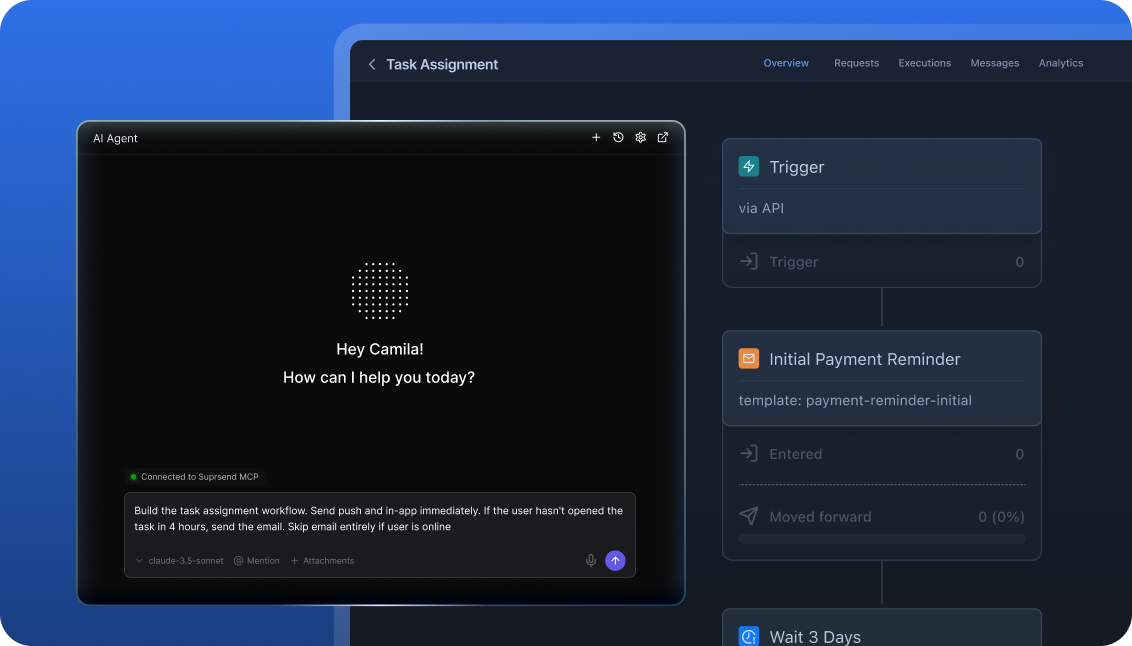
The built-in agent builds, edits and debugs notifications from a description; product and growth ship without a ticket.

In the dashboard

Connect the MCP to Claude, ChatGPT or any client and operate templates, workflows, tenants and preferences.

In your own agent

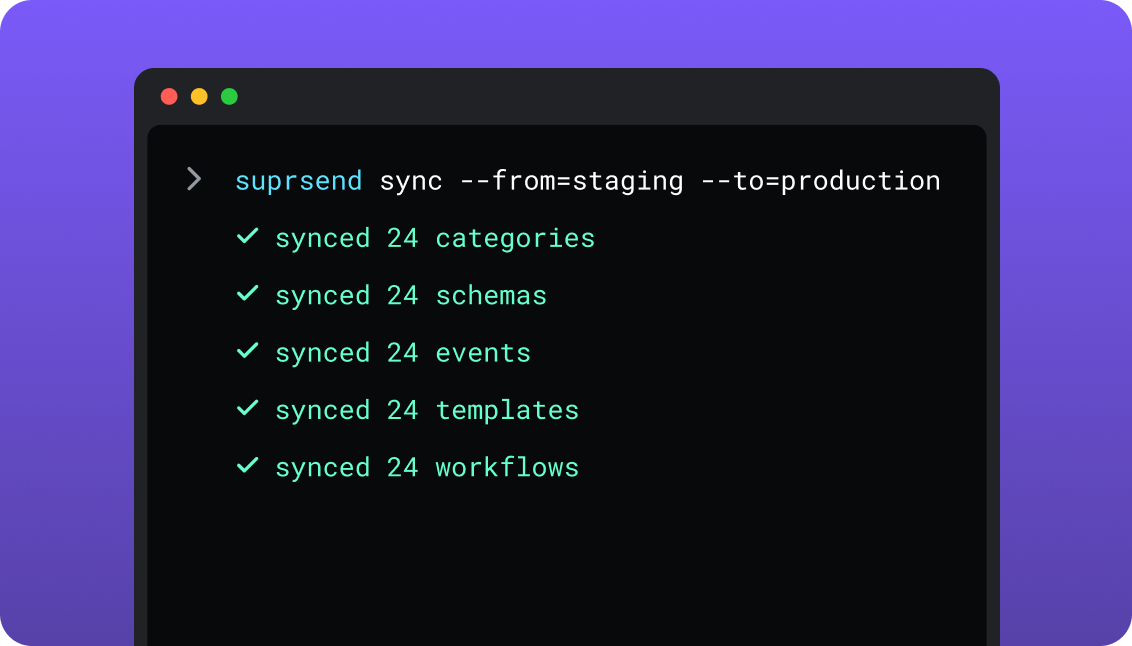
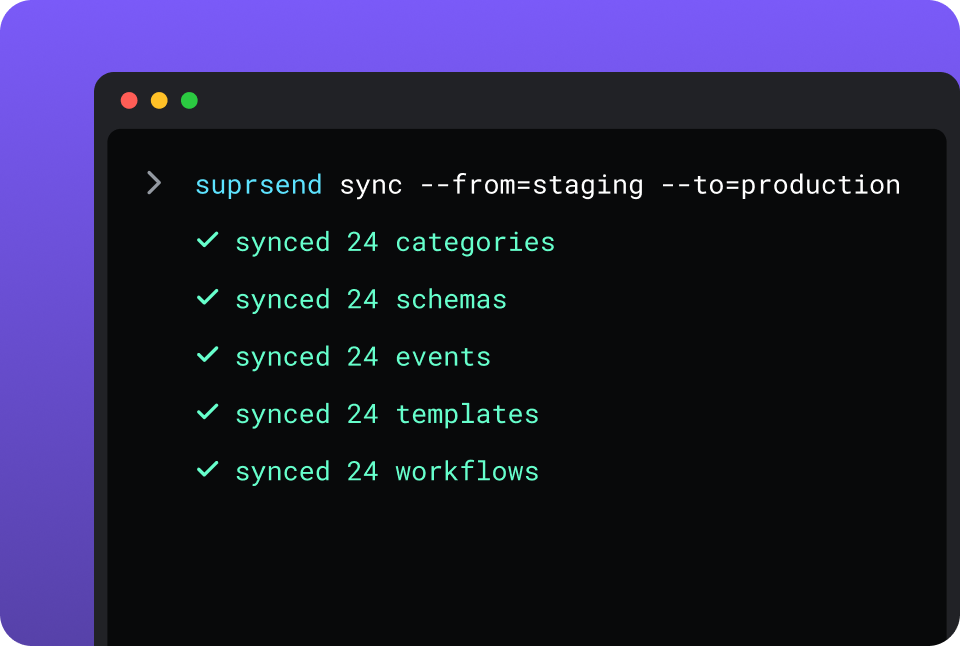
CLI and API keep workflows versioned, diffable and reviewed in pull requests; coding agents make bulk changes.

In your IDE or codebase
In the dashboardIn your own agentIn your IDE or codebase

One SuprSend customer runs its marketing email end to end from Claude Code, with nobody in the dashboard.

Mailchimp is built in its dashboard: campaigns in the email builder, automations in the Marketing Automation Flows builder, with Intuit Assist drafting copy and filling pre-built flow templates. The Marketing API manages audiences, campaigns and reports. Mailchimp’s own MCP server connects Claude, Cursor or VS Code to Mailchimp Transactional, to send email and diagnose a failed send. Each account is one live environment with no staging.

Everything your product sends, from one place

One SDK, one event stream and one user record cover all nine channels, and adding a channel is a step in a workflow. A marketing team working in the SuprSend dashboard also runs the event-driven transactional messages, from the same workflows, lists and logs as its campaigns, with no second tool and no engineering ticket.

Lists built five waysFrom segmentation rules, a scheduled SQL query on your warehouse, a CSV, the API, or a Segment, Mixpanel or Amplitude sync; see lists.
User properties with no schema to declareAny number per user, any JSON value, nested objects and arrays included. Mailchimp audience fields are created one at a time with a fixed type.
An inbox inside your productWeb, React Native, Flutter, iOS and Android, with read state, tabs and a headless option. Mailchimp’s inbox collects replies to your campaigns for your own team.
Users choose channels per category, admins set the defaultsOne opt-out holds across email, push, SMS and in-app. Mailchimp tracks email and SMS consent separately.
Bring your own providers, with fallbackSendGrid, SES, Postmark, Twilio or the providers you already pay for, in an ordered list with a timer.
Batching, digest, translations and schemasTen comments become one email, translation files ship with the templates, and every event is checked against its schema.
Logs that say whyRendered content, provider error and block reason per message, on every channel, in one view.

Short answer

If this is youChoose
A small business sends newsletters and promotions to a subscriber list, with forms, landing pages and social posts in the same toolMailchimpMailchimp
An online store runs abandoned-cart and win-back emails from its connected store dataMailchimpMailchimp
Almost everything goes out as email, to one audience, from a marketer who never needs a second channelMailchimpMailchimp
One product event has to reach the user by inbox, push, email or SMS, stopping once they respondSuprSendSuprSend
Each customer account needs its own domain, content and notification defaultsSuprSendSuprSend
Users should choose, per category, which messages they get and on which channelSuprSendSuprSend
A marketing team wants the transactional messages in the same dashboard, lists and logs as its campaignsSuprSendSuprSend
You want agents to build, send and manage your notifications from Claude, ChatGPT, Claude Code, Cursor or SlackSuprSendSuprSend
Marketing keeps Mailchimp for newsletters and store flows, and the product needs notifications Mailchimp cannot sendBoth

At a glance

SuprSendSuprSendMailchimpMailchimp
Best whenEngineering, product and growth all send to users, on every channel and for every customer accountA small marketing team sends newsletters, promotions and store emails to a subscriber list
Who uses itEngineers, product, growth, and agents over MCP; unlimited seatsMarketers; 1 seat on Free, 3 on Essentials, 5 on Standard, unlimited on Premium
Messages coveredTransactional, product and customer engagement, in one systemMarketing campaigns and flows; transactional email and SMS through the Transactional add-on
Built and changed fromDashboard agent, your own agent over MCP, CLI and APIDashboard with Intuit Assist; Marketing API; MCP for Transactional only
ChannelsEmail, SMS, WhatsApp, mobile push, web push, Slack, Teams, in-app, webhook; every planEmail; SMS add-on in 37 countries; MMS in the US and Canada on Standard
Data modelUsers with JSON properties, lists, objects, nested tenantsContacts with typed audience fields, tags and groups, inside separate audiences
Multi-tenancyNested tenants with own provider, domain, template version, defaults, feedSeparate audiences in one account; one sender setup shared
PreferencesPer category and channel, digest schedule, tenant defaultsGroups for email interests; SMS consent kept apart
WorkflowsOne send step for all channels; branch, batch, digest, routing, failoverFlows with branching on Standard; up to 4 steps on Essentials
In-appInbox for web and mobile, headless optionNo notification inbox; pop-up forms on your site
Provider failoverOrdered vendor list with timer and delivery-confirmation stopNo second provider; Mailchimp delivers every message
Environments and test modeDevelopment, staging, production; test mode blocks deliveryOne live account; test emails go to real addresses
API limitsGenerous fair-use limit, no published number10 simultaneous connections on the Marketing API
AIAgent builds workflows, writes copy, reads logs, in dashboard or Slack; Agent SDKIntuit Assist drafts copy and fills flow templates; predictive segments
HostingSuprSend cloud on every plan; your VPC, on-prem or BYOC on Enterprise, full product, supportedMailchimp cloud, on servers in the United States
Pricing modelPer notification per channel; digest counts as one; users freeContacts stored per tier, with a monthly send cap; SMS credits and Transactional blocks extra
ImplementationDays: SDK or API call, workflows in the dashboard or by CLISame day for email; SMS after an application is approved
ComplianceSOC 2 Type II, GDPR, HIPAA BAA on EnterpriseSOC 2, ISO 27001, EU-U.S. Data Privacy Framework
G24.8, 129 reviews4.3, 12,990 reviews

What each is built for

MailchimpMailchimp

Mailchimp is email marketing for small businesses, owned by Intuit. The centre is a marketer sending email to an audience: campaigns, automation flows, forms and landing pages, priced by how many contacts the audience holds.

Around that centre sit SMS on credits, social posting, retargeting ads, ecommerce data and a separate Transactional product for API email. A shop owner can run the newsletter, the welcome series and the abandoned-cart email from one account.

SuprSendSuprSend

SuprSend is agentic, multi-channel orchestration for products where messages start from what users do. One event becomes the right message on the right channel through a workflow that batches, branches, routes and fails over.

Engineering integrates once; product, growth and their agents build on top. Every channel shares one user record, one preference model and one log, and customer accounts can each carry their own setup.

Where Mailchimp wins

Email marketing depthDrag-and-drop builder, template gallery and A/B tests on Essentials; multivariate tests, send time optimisation and delivery by time zone on Standard.
A small marketer’s whole toolkit in one accountForms, landing pages, surveys and social posting on every plan; Google retargeting ads and a marketing calendar on Standard.
Ecommerce and predictive dataStore integrations and product recommendations on every plan; predicted lifetime value, purchase likelihood and predictive segments on Standard.
The price floor for small listsFree up to 250 contacts, and Essentials from $13 a month for 500 contacts and 5,000 sends.
A transactional email API with its own toolingMailchimp Transactional at $20 per 25,000 emails, dedicated IPs at $29.95 a month, subaccounts and inbound email processing, on Standard and Premium.
People to help you startOne onboarding session on Standard; four sessions, a dedicated onboarding specialist and phone support on Premium.
An MCP server for transactional emailConnect by URL from Claude, Cursor or VS Code; the agent sends email, builds a template and diagnoses a failed send.

Where SuprSend wins

Workflows and templates in your repoPull them as files, edit, push, and promote staging to production from the deploy pipeline. Twenty templates change in one command.
Environments and a test modeDevelopment, staging and production on every plan, with a test mode that blocks real delivery on every channel. Mailchimp flows are checked by sending test emails to real inboxes.
Notification logic built for product eventsOne send step for all channels, smart channel routing that stops when the user reads, throttling, a fetch-from-API step and event schemas with generated types.
Slack and Microsoft Teams as channelsDirect integrations on every plan, with card templates. Mailchimp has neither channel.
Unlimited seats on every planMailchimp includes one seat on Free, three on Essentials and five on Standard.
A price that follows messages sentUsers are free to store; the bill moves with notifications. Mailchimp tiers are set by contact count, with overage billed when a list outgrows its tier.
Room for complex automationsG2 reviewers of Mailchimp most often name cost as lists grow, a steep learning curve for advanced automation, and limited automation features as their dislikes (September 2026).
A choice of where it runsSuprSend cloud on every plan, or the full product in your VPC, on-prem or BYOC on Enterprise, with support. Mailchimp runs in its own cloud in the United States.

Who works in it

MailchimpMailchimp

Marketers build campaigns, segments, forms and automation flows in the dashboard, with Intuit Assist drafting copy and filling flow templates. Developers sync contacts and events through the Marketing API, and send transactional email and SMS through the Transactional API in Node, Python, PHP or Ruby.

Agents connect to the Transactional MCP to send email and diagnose failed sends; campaigns, audiences and flows stay with a person in the dashboard.

SuprSendSuprSend

Engineers integrate once through the API, a backend SDK in Python, Node, Java or Go, the CLI and MCP, and keep workflows and templates in the repo. Product and growth build workflows, lists, content and broadcasts in the dashboard, or have the built-in agent build them, with versions to roll back and a test mode.

Agents connect over MCP from Claude, ChatGPT, Claude Code or Cursor and create users and tenants, set preferences, write templates, trigger a notification, run a broadcast and read the log.

Feature by feature

From both pricing pages, Mailchimp’s help centre and developer documentation, and the SuprSend product, September 2026. Plan names mark the lowest plan that includes a feature.

How notifications are built and changed

Everything in SuprSend has an API and a file form behind the dashboard, so it can be scripted, versioned, staged and handed to an agent. Mailchimp’s campaigns, audiences and templates are reachable over the Marketing API; its flows are built by a person in the dashboard, on one live account.

CapabilitySuprSendSuprSendMailchimpMailchimp
Visual builder in the dashboard YES YES
Workflows by API YESCreate, update and trigger NOFlows are built in the dashboard; the API triggers a step
Templates by API YESEvery channel YESMarketing and transactional email templates
CLI push and pull of assets YESWorkflows, templates, schemas, events, categories, translations NO
Promote staging to production YESBy CLI, from CI NOOne live account
Change many assets in one command or prompt YESBy CLI or agent NOCampaigns and flows are edited one at a time
Build from a prompt in the dashboard YESWorkflows, copy and fixes PARTIALIntuit Assist fills pre-built flow templates with branded emails
Headless UI YESInbox, preference centre, template editor NOForms and pop-ups embed as Mailchimp code

Teams and scope

Mailchimp is sold to marketers, seat by seat, with forms, landing pages and social posting attached. SuprSend is one system for engineering, product, growth and support, with no seat count.

CapabilitySuprSendSuprSendMailchimpMailchimp
Who builds workflowsEngineers, product, growth, in the dashboard, by CLI or by agentMarketers, in the flow builder
Who builds audiencesAnyone: rules, warehouse SQL, CSV, CDP syncMarketers: segments on fields, tags, activity and purchases
Team seatsUnlimited on every plan1 on Free, 3 on Essentials, 5 on Standard, unlimited on Premium
Transactional messages YESEvery channel YES, BUTTransactional add-on on Standard and Premium; email and SMS
Product notifications with an inbox YES NO
Customer engagement campaigns YESLists and broadcasts on every plan YESThe core product
Landing pages, forms, social posting NO YESEvery plan

Data model and tenancy

Mailchimp stores contacts inside audiences, keyed on email address, with typed fields, tags and groups. SuprSend stores users with free-form JSON properties, the objects they belong to, and nested tenants inside one integration.

CapabilitySuprSendSuprSendMailchimpMailchimp
RecipientsUsers with channels and properties; objects such as an order, a team or a deviceContacts with an email address and an SMS phone number, inside an audience
Non-user recipients YESObjects with own channels and subscribers; Business NO
Tenants YESNested five levels; Business add-on, Enterprise PARTIALSeparate audiences: 1 on Free, 3 on Essentials, 5 on Standard
Per-tenant provider and sending domain YES NOMailchimp delivers for every audience
Per-tenant template version YESMatched by tenant ID at send NO
Tenant-admin preference defaults YESDefaults, mandatory channels, visible categories NO
Contact or user limitNone; users are free250 on Free; up to 50,000 on Essentials; 100,000 on Standard; custom above
At the contact limitNothing changesOverage billed automatically

Marketing campaigns and lists

Both run one-time and scheduled campaigns to an audience. Mailchimp sends email and SMS as separate campaigns; SuprSend sends a broadcast on any channel through the same workflow engine as transactional messages, so it batches, routes and respects preferences.

CapabilitySuprSendSuprSendMailchimpMailchimp
How a list is builtRules on properties and events; warehouse SQL; CSV; API; Segment, Mixpanel, AmplitudeSegments on fields, tags, campaign activity, purchases and site visits; CSV; 300+ integrations
Dynamic lists that refresh YES, BUTEnterprise, or an add-on on Essentials and Business YESSegments update as contacts change
User propertiesAny number, any JSON value, no field to declareTyped audience fields: text to 255 bytes, number, date, dropdown, address and others
Broadcast channelsAny of nine channels, or several in one sendEmail; SMS as its own campaign
SchedulingOne-time, scheduled, recurring; recipient’s timezone on EssentialsScheduling on Essentials; delivery by time zone and send time optimisation on Standard
Broadcast through a workflow YESBatching, routing, fallback, preferences apply NOCampaigns and flows are separate
Transactional from the same dashboard YESSame workflows, lists and logs YES, BUTTransactional add-on with its own app, templates and logs
Predictive segments NO YESLifetime value and purchase likelihood on Standard
Campaign analyticsDelivered, seen, clicked, unsubscribed per broadcast, category and tenantOpens, clicks and ecommerce revenue; custom reports on Standard
A/B testing NO YESA/B on Essentials; multivariate on Standard

Channels

Mailchimp delivers email itself and adds SMS as prepaid credits after an application, in 37 countries. SuprSend covers nine channels on every plan through providers you choose, with fallback between them.

CapabilitySuprSendSuprSendMailchimpMailchimp
Email YESThrough your provider YESMailchimp delivers
SMS YESThrough your provider YES, BUTPaid plans, application, 37 countries; credits expire monthly
WhatsApp YESProvider or Cloud API, every plan NO
Mobile push YESEvery plan NO
Web push YESEvery plan NO
Slack and MS Teams YES NO
In-app inbox YESEvery plan NO
Social posts and retargeting ads NO YESSocial posting on every plan; Google ads on Standard
Provider failover YESOrdered list with timer; Essentials NOMailchimp is the provider

Workflows

Mailchimp’s flow builder is built around marketing triggers: signups, tags, dates, email activity, purchases and carts. SuprSend’s is built around delivery: one send step for all channels, digests, routing, failover, versions and a test mode.

CapabilitySuprSendSuprSendMailchimpMailchimp
TriggersAPI event, Segment event, schedule, broadcast, listSignup, tag, date, email activity, purchase and cart, custom event by API
Send to all channels in one step YES NOOne email or SMS action per step
Branching YESBranch node and step conditions YES, BUTBranching points on Standard; Essentials flows capped at 4 steps
Delay and wait for event YES YES
Batching and digest YESUser-chosen time, batch until due date; Business NO
Channel routing that stops on read YES NO
Fetch data from an API mid-run YESEssentials NO
Hold to allowed hours YESIn the user’s timezone; Business PARTIALSMS quiet hours by sending country
Event payload schema YESJSON schema with TypeScript types NO
Version history and rollback YES NO
Test mode YESBlocks real delivery outside production NOTest emails go to real addresses

Templates and content

Mailchimp has a strong email builder with a template gallery and dynamic content on Standard. SuprSend has rich editors for all nine channels, variants per tenant and language, versions, and an editor you can embed in your own product.

CapabilitySuprSendSuprSendMailchimpMailchimp
EditorsAll nine channels; Handlebars; JSONNET for Slack and Teams cardsDrag-and-drop email builder and gallery; custom-coded HTML sends from Standard; SMS editor
Variants YESBy tenant, user, event data or language PARTIALDynamic content blocks on Standard
Translations YESTranslation files per language, pushed by CLI; Business PARTIALIntuit Assist translates copy into another language
Version history YESWith rollback NO
Embeddable template editor YESReact SDK NO
Preview and test send YES YES
AI copy YESAgent drafts per channel YESIntuit Assist drafts email, and SMS and social posts from an email

Preferences

A preference is a user’s standing choice about which messages reach them and where. Mailchimp records it as audience groups for email interests, with SMS consent tracked apart. SuprSend records it per category and channel, with a digest schedule and tenant defaults, and checks it on every send.

CapabilitySuprSendSuprSendMailchimpMailchimp
ModelPer category and channel; digest schedule; condition rulesGroups for email interests; unsubscribe per audience; SMS consent per contact
One opt-out across channels YES NOEmail and SMS consent kept separately
Tenant-admin defaults and mandatory channels YES NO
Preference centre YESHosted page and embeddable components; Business YESUpdate-profile form per audience
User-chosen digest schedule YES NO
Unsubscribe page YESGenerated per email YESLink in every campaign; SMS stop keywords
Quiet hours set by the user NO NO

In-app inbox

An in-app inbox is a persistent feed of notifications inside your product, with read state that follows the user across devices. Mailchimp has none; SuprSend ships an inbox for web and mobile.

CapabilitySuprSendSuprSendMailchimpMailchimp
Web components YESReact, Angular, Vue, JS; headless hooks NOMailchimp’s inbox holds campaign replies for your team
Mobile SDKs YESReact Native, Flutter, iOS, Android NOThe Mobile SDK syncs contact data from your app
AuthenticationExpiring JWT, refreshed by the SDKNo inbox to sign in to
Tabs, filters, per-tenant feed YES NO
Snooze, pin, archive, actions, toasts YES NO
Branding removal YESEssentials NONo inbox to brand

Analytics and logs

Mailchimp reports on campaigns, with revenue, and keeps a separate activity log in the Transactional app. SuprSend puts every message on every channel in one view: what was rendered, where it went, and why it was blocked.

CapabilitySuprSendSuprSendMailchimpMailchimp
Per-message log on every channel YESRendered content and provider error PARTIALTransactional activity for API email and SMS; campaign reports apart
Block reasons named YESOpt-out, no channel, template error PARTIALBounce and reject reasons in Transactional
Retention30 days Free, 90 days paid, custom EnterpriseNot published
Step-level workflow log YES PARTIALFlow reports per email
ExportCSV to 50 million rows; S3 Parquet; warehouse sync on BusinessReport and audience export; Export API
Monitoring tools YESDatadog, New Relic; Enterprise NOWebhooks only
Revenue attribution NO YESEcommerce revenue per campaign and flow

Developer experience

Mailchimp has two mature APIs, Marketing and Transactional, with client libraries, webhooks and an SMTP option on Transactional. SuprSend adds environments, a CLI, frontend SDKs and a test mode, because engineering integrates once and everyone else builds on top.

CapabilitySuprSendSuprSendMailchimpMailchimp
Backend SDKsPython, Node, Java, GoNode, Python, PHP, Ruby, for each of the two APIs
Frontend SDKsJS, React, React Native, Flutter, iOS, AndroidMobile SDK for contact sync on iOS and Android; no UI components
API toolingOpenAPI spec, Postman, try-itOpenAPI self-description; OAuth 2 for apps
EnvironmentsDevelopment, staging, production on every planOne live account
Published rate limits NOFair-use limit, no number YES10 simultaneous connections on the Marketing API
SMTP relay NOYour provider’s SMTP YES, BUTTransactional add-on
Delivery webhooks YESEvery plan YESAudience webhooks; Transactional event webhooks
CLIPushes and pulls every asset, promotes environments, generates typesNo CLI

AI, by what it can do

Both have an MCP server and an in-product AI. Mailchimp’s Intuit Assist drafts for a person in the dashboard, and its MCP sends and diagnoses transactional email. The SuprSend agent, and any agent connected over MCP, builds, runs and diagnoses notifications end to end.

CapabilitySuprSendSuprSendMailchimpMailchimp
Build a workflow from a prompt YESDashboard, Slack or any agent over MCP PARTIALIntuit Assist fills pre-built flow templates
Edit workflows from an external agent YES NOThe official MCP covers Transactional only
Draft copy per channel YESAll nine channels YESEmail, plus SMS and social posts from an email
Diagnose a failed send YESAgent reads the log and names the reason YES, BUTTransactional sends, over the MCP
Run a campaign end to end from an agent YESList, template, broadcast, log, re-send NOAudiences and campaigns are outside the official MCP
What the MCP exposesUsers, tenants, objects, preferences, workflows, templates, broadcasts, logsNine tools on Transactional: account status, template build, API calls, failed-send diagnosis, onboarding
Agent SDK for your own agents YESOpenAI, LangChain, Vercel AI NO
Predictive AI NO YESSend time, lifetime value and purchase likelihood on Standard

Security, compliance, support

Mailchimp holds SOC 2 and ISO 27001 through Intuit and hosts in the United States. SuprSend holds SOC 2 Type II, signs HIPAA BAAs on Enterprise, and can run in your own cloud.

CapabilitySuprSendSuprSendMailchimpMailchimp
CertificationsSOC 2 Type II, GDPR, HIPAA; ISO 27001 and CPRA in progressSOC 2, ISO 27001; EU-U.S. Data Privacy Framework
SAML SSO YES, BUTEnterprise NO
Two-factor sign-in YESEvery plan YESEvery plan
Roles and permissions YES, BUTEnterprise YES, BUT2 roles on Essentials, 4 on Standard, 5 on Premium
HostingSuprSend cloud on every plan; your VPC, on-prem or BYOC on Enterprise, full product, supportedMailchimp cloud, on servers in the United States
SupportSlack community; email and chat paid; phone and CSM on EnterpriseEmail for 30 days on Free; 24/7 email and chat on paid; phone on Premium

Pricing and implementation

The units measure different things. Mailchimp charges by the contacts an audience stores, caps sends at 10 to 15 times that count, and sells SMS credits and Transactional email blocks on top; SuprSend charges per notification per channel, counts a digest as one, and stores users free. A product with 20,000 users each getting five notifications a month by email and in-app sends 200,000 notifications, about $1,000 a month on SuprSend Business ($250 plus 150,000 extra at $5 per 1,000). On Mailchimp the 20,000 users sit on a contact tier, product email needs Transactional blocks at $20 per 25,000, and the in-app half has no channel. Compare on your own channel mix; SuprSend’s pricing page and Mailchimp’s have the tiers.

CapabilitySuprSendSuprSendMailchimpMailchimp
Billing unitNotification per user per channel; digest counts as one; opt-out blocks not billedContacts stored per tier; monthly sends capped at 10x contacts on Essentials, 12x on Standard, 15x on Premium
Free10,000 notifications; all channels; lists and broadcasts; unlimited members250 contacts; 500 sends a month, 250 a day; 1 seat
Entry paidEssentials $100 a month; 50,000; $2 per extra 1,000Essentials from $13 a month at 500 contacts
Next tiersBusiness $250 a month; 50,000; $5 per extra 1,000; adds digest, preferences, objectsStandard from $20; Premium from $350 at 10,000 contacts
EnterpriseCustom; volume discounts; per-user optionHigh-volume plans above 200,000 contacts
Other channelsEvery channel on every plan; providers billed by the providerSMS credits that expire monthly; Transactional from $20 per 25,000 emails, Standard and up
Annual discountPrices above are the annual rate15 percent off for 12 months at 10,000+ contacts
Time to first notificationSame day, no sales callSame day for email; SMS after approval

Migrating from Mailchimp to SuprSend

Most teams move the product messages and keep Mailchimp for newsletters and store flows; some move everything. The mapping is the same either way, and rebuilding flows is most of the work.

MailchimpSuprSendMoves how
ContactUserUsers API, SDK, CSV or Segment; keep a stable ID
AudienceList, or tenantOne list per audience; separate brands become tenants
Tag, segmentListRebuild as rules, warehouse SQL or CSV
Audience fieldUser propertyImport as JSON; no type to declare
GroupPreference categoryOne category per interest; keep unsubscribes
Automation flowWorkflowRebuild in the builder, by CLI or by the agent
Custom eventEvent with a schemaSame name; add the schema; generate types
Email templateTemplate with versionsPaste the HTML; add translation files
Transactional API callWorkflow triggerReplace the send call with an event
SMS programSMS channelRegister sender numbers with your SMS provider; keep consent
Reports, Transactional activityLogsExport from Mailchimp first; no import
01

Inventory every flow, transactional template, SMS program, audience and group, and mark which flows start from product events.

02

Stand up SuprSend development and staging, connect email and SMS providers with a fallback order, and create tenants with their defaults.

03

Import users and lists, and map groups and unsubscribes to preference categories.

04

Rebuild the critical flows first: verification codes, password resets, billing and security alerts. Test them in test mode, then pull them into your repo.

05

Run both for a week on those flows, with the inbox SDK behind a feature flag.

06

Move the remaining workflows, cut over, and keep an export of Mailchimp’s reports and activity.

Enterprise customers get migration support and a scoped plan; on other plans the Slack community and docs are the path.

FAQ

Is SuprSend better than Mailchimp?
SuprSendSuprSend

SuprSend is better when messages start from what users do, reach several channels and an inbox, follow preferences per category and per customer account, and are built by engineering, product, growth and their agents together.

MailchimpMailchimp

Mailchimp is better for a small marketing team sending newsletters, promotions and store emails to a subscriber list, with forms, landing pages and social posts in one account.

Can I keep Mailchimp for marketing and use SuprSend for product notifications?

Yes. Mailchimp keeps the newsletters, the subscriber list and the store flows; SuprSend takes the product events and everything the product sends, and a webhook or warehouse sync keeps the Mailchimp contact current. The trade-off is two bills, two preference models and two places to check a log.

Does Mailchimp send push notifications or have an in-app inbox?

No. Mailchimp sends email and, as an add-on, SMS and MMS; its push notifications are alerts about your own account in the Mailchimp mobile app. SuprSend’s inbox is a channel on every plan, with SDKs for web, React Native, Flutter, iOS and Android, alongside mobile and web push.

Does Mailchimp support multi-tenancy?
SuprSendSuprSend

SuprSend scopes tenants inside one integration, each with its own provider, domain, template version, defaults and inbox feed, nested five levels deep.

MailchimpMailchimp

Mailchimp separates brands into audiences inside one account: one on Free, three on Essentials, five on Standard and unlimited on Premium, each with its own contacts and forms.

Where does each run, and can I self-host SuprSend?
SuprSendSuprSend

SuprSend runs in SuprSend cloud on every plan, and on Enterprise the full product also runs in your VPC, your data centre or bring-your-own-cloud, with vendor support.

MailchimpMailchimp

Mailchimp runs in Mailchimp’s cloud, on servers in the United States.

Which is cheaper?

Mailchimp is cheaper for a small list that hears from you a few times a month by email. SuprSend is cheaper when many users each get a handful of messages across several channels, because users are free to store, every channel is on every plan, and a digest counts as one.

How do I migrate from Mailchimp to SuprSend?

Contacts, tags, groups and unsubscribes move by API, SDK or CSV in a day. Flows are rebuilt, by hand, by CLI or by the agent from a description. Most teams run both on the critical flows for a week before cutting over.

Related Resources

Can agents run SuprSend from Claude or Cursor?SuprSend MCP server
How does SuprSend handle multi-tenant notifications?multi-tenant notifications
Can SuprSend run inside my own cloud?Bring your own cloud
What does SuprSend cost at my volume?SuprSend pricing

There’s no better place for you
to build notifications

Join thousands of product & engineering teams using SuprSend to build and ship better notifications—faster.