




Last Updated: May 2026
Most teams looking for a Twilio alternative for SMS are chasing one of three things: a lower per-segment price, simpler US 10DLC onboarding, or a vendor whose support answers faster. Twilio is the category default at $0.0083 per outbound SMS segment in the US (plus carrier fees), and the strongest alternatives are carrier-grade providers that match its API quality while cutting that rate. Telnyx at $0.004 per segment and Plivo at $0.0077 per segment are the two clearest cost wins, with Vonage, Sinch, Bandwidth, Amazon SNS, and Bird filling out the field on coverage, enterprise routing, and AWS-native simplicity.
This guide compares 7 Twilio SMS alternatives on price, US 10DLC support, coverage, and developer experience. Per-segment prices were verified in May 2026 from each vendor's public US pricing page where available. SMS is usage-based, so all rates exclude the carrier surcharges (AT&T, T-Mobile, Verizon) that apply on top of every US message regardless of provider.
Why Teams Look for a Twilio SMS Alternative
Twilio is reliable and has the broadest ecosystem in the category. Teams still switch for specific reasons.
- Per-segment cost. At scale, the difference between $0.0083 and $0.004 per segment compounds into real money. High-volume senders feel it first.
- 10DLC complexity. US Application-to-Person messaging requires brand and campaign registration through The Campaign Registry (TCR). Every provider handles the same TCR process, but onboarding speed and fee transparency vary.
- Support responsiveness. Lower-tier Twilio support is a common complaint. Smaller competitors often assign more hands-on help.
- International routing. For traffic to Europe, Asia, or Latin America, some providers offer better routes or pricing than Twilio's defaults.
If none of these hurts and you already run on Twilio, staying is reasonable. The list below is for teams where one of them is a real cost. For a wider view of the category, see our roundup of the best SMS APIs for developers.
How We Evaluated These Alternatives
- Per-segment US price. Verified from each vendor's public pricing page where available, excluding carrier surcharges.
- US 10DLC support. TCR brand and campaign registration handling.
- Coverage. Number of countries and direct carrier relationships.
- Developer experience. API quality, SDKs, docs, and migration effort from Twilio.
- Channel breadth. Whether the provider also offers voice, WhatsApp, or other channels.
Which Twilio SMS Alternative Fits Your Team?
Per-segment US prices verified May 2026 from public pricing pages where available. All exclude US carrier surcharges.
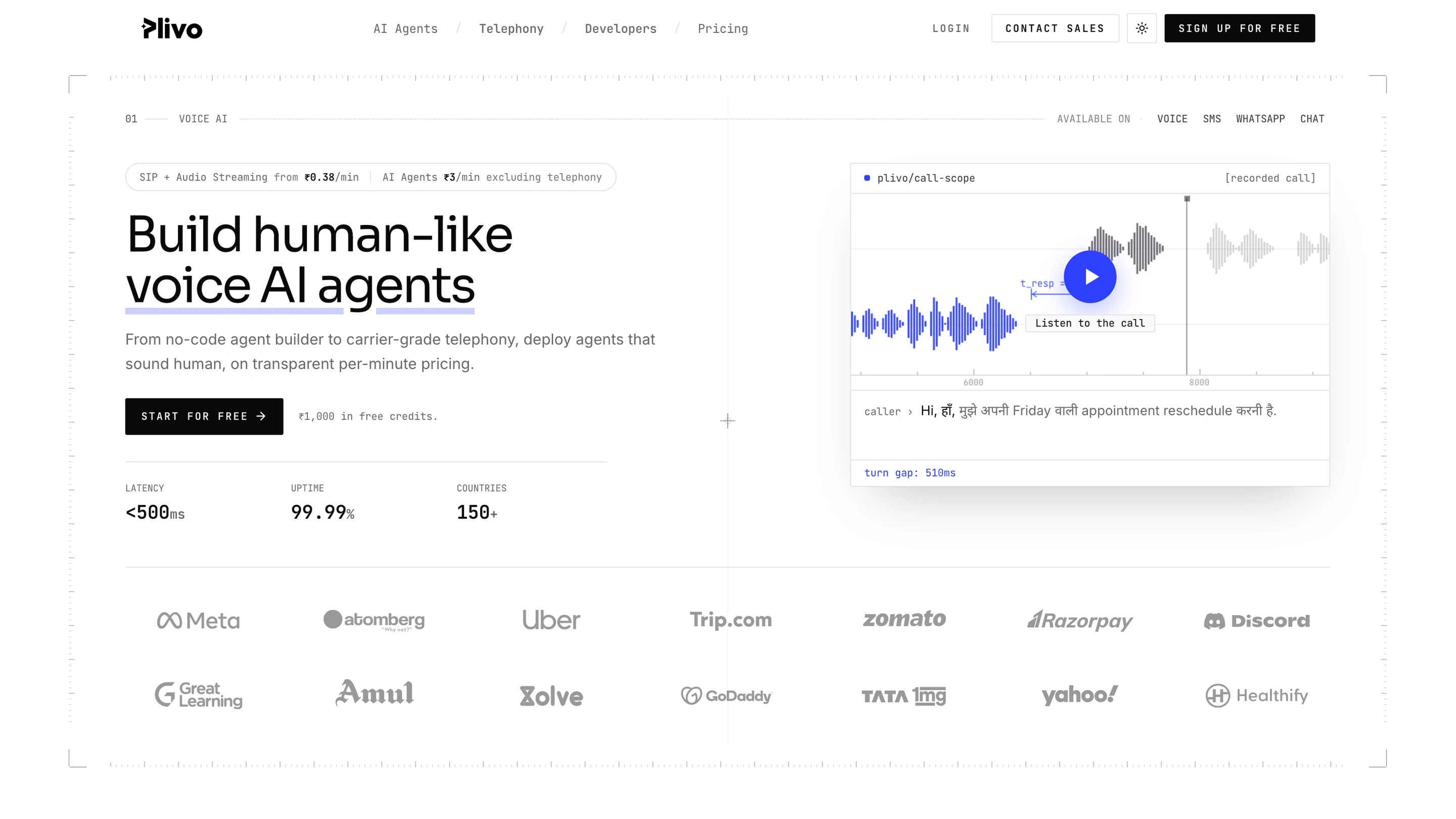
1. Plivo
Plivo is the most direct Twilio replacement for cost-sensitive teams that also send voice. The API patterns are close enough that migration is usually days, not weeks, and the documentation is strong. It is the alternative to reach for when you want a familiar developer experience at a lower rate.
Key features:
- SMS and voice on one platform with a Twilio-like API
- US 10DLC registration handled in-platform
- Global coverage with carrier-grade routing
- SDKs for Node, Python, PHP, Ruby, Java, Go, .NET
- Powerpack for number pooling and throughput management
Pricing: $0.0077 per outbound US SMS segment, plus carrier surcharges that vary by carrier and direction. Pay-as-you-go with no minimum. Plivo US SMS pricing, verified May 2026.
Pros: Familiar API for Twilio teams, SMS and voice together, transparent US pricing.
Cons: Smaller ecosystem and integration library than Twilio, fewer non-messaging products, support depth varies by plan.
Best for: Cost-sensitive teams sending SMS plus outbound voice that want a near drop-in migration.
2. Telnyx
Telnyx is the cheapest carrier-grade option on this list. It runs its own private IP backbone and direct carrier connections, which it uses as the basis for both low cost and low latency. For high-volume, developer-first teams, it is consistently the lowest credible per-segment rate.
Key features:
- Private global IP network with direct carrier interconnects
- US 10DLC registration through the Mission Control portal
- SMS, voice, and wireless (eSIM) on one platform
- Programmable messaging with detailed delivery reporting
- Real-time usage and number management dashboard
Pricing: $0.004 per outbound US SMS segment on local or 10DLC numbers, plus carrier fees. Toll-free is $0.0055 and short codes $0.007 per segment. Telnyx messaging pricing, verified May 2026.
Pros: Lowest per-segment rate, owns its network for latency and reliability, strong developer tooling.
Cons: Smaller brand recognition than Twilio, ecosystem narrower, account verification can be strict for new senders.
Best for: High-volume, developer-first teams optimizing for per-segment cost and latency.
3. Vonage
Vonage (formerly Nexmo) is the closest drop-in Twilio replacement on API design, with a developer-friendly Messages API and a footprint spanning 200+ countries. Teams pick it most often for international SMS, where its routes to Europe, Asia, and Latin America can be cheaper than Twilio's defaults.
Key features:
- Messages API spanning SMS, MMS, WhatsApp, and more
- Global coverage across 200+ countries
- US 10DLC registration support
- SDKs for major languages
- Number Insight API for validation and lookup
Pricing: Usage-based per-segment pricing that varies by destination. US rates are not publicly listed on an open pricing page at the time of writing, so confirm current rates with Vonage directly. Vonage SMS API.
Pros: Closest API analog to Twilio, strong international routing, broad channel coverage.
Cons: US pricing not transparently published, console can feel dated, support tiers vary.
Best for: Teams sending significant international SMS that want a Twilio-style API.
4. Sinch
Sinch is the most enterprise-leaning option here. It owns direct carrier connections across a large number of countries and operates a super-network aimed at high-volume, global senders. It also owns Mailjet (email) and other messaging brands, so it can consolidate channels under one vendor.
Key features:
- Direct carrier connections for global reach
- SMS, voice, WhatsApp, and email under one parent
- US 10DLC support
- Conversation API for omnichannel messaging
- Enterprise-grade SLAs and routing controls
Pricing: Usage-based and typically quoted for volume; standard US per-segment rates are not openly published. Confirm with Sinch sales via their messaging APIs.
Pros: Strong global carrier relationships, omnichannel under one vendor, enterprise routing controls.
Cons: Less self-serve than developer-first competitors, pricing is quote-based, onboarding skews enterprise.
Best for: Enterprises sending high global volume that want direct carrier routing and a single multichannel vendor.
5. Bandwidth
Bandwidth is unusual because it owns and operates its own Tier-1 carrier network in the US rather than reselling another carrier's. That direct ownership is the pitch: fewer intermediaries between your API call and the carrier, which matters for reliability and emergency-services use cases.
Key features:
- Owned Tier-1 US carrier network
- SMS, MMS, and voice APIs
- US 10DLC registration support
- Emergency services (E911) capabilities
- Toll-free and short code messaging
Pricing: Usage-based; US per-segment rates are quoted rather than published on an open page. Confirm with Bandwidth directly. Bandwidth messaging.
Pros: Owns its US network for reliability, strong for voice plus messaging, E911 support.
Cons: Pricing not transparently published, US-centric strength, onboarding skews mid-market and enterprise.
Best for: US-focused teams that want a provider operating its own carrier network.
6. Amazon SNS
Amazon SNS is the pick for teams already deep in AWS that need to fire SMS without adding a new vendor. It is simpler than a full CPaaS: SNS handles fan-out SMS well, but it is not a feature-rich messaging platform with campaign tooling or two-way conversation handling.
Key features:
- Native AWS integration with IAM and CloudWatch
- Transactional and promotional SMS message types
- US 10DLC and toll-free registration support
- Pay-as-you-go with AWS billing consolidation
- Pub/sub fan-out alongside SMS
Pricing: Usage-based and varies by destination; AWS publishes guidance rather than fixed US per-message rates and directs you to usage reports for exact costs. A toll-free origination carrier fee of $0.0025 per message applies for US destinations. Amazon SNS SMS pricing, verified May 2026.
Pros: Zero new vendor if you are on AWS, simple billing, reliable fan-out.
Cons: No campaign tooling, limited two-way messaging, fewer messaging-specific features than a dedicated CPaaS.
Best for: AWS-native teams that need straightforward outbound SMS without a separate platform.
7. Bird (formerly MessageBird)
Bird, formerly MessageBird, is an omnichannel CPaaS that pairs SMS with WhatsApp, email, and a marketing-oriented platform. It suits teams that want messaging plus campaign and customer-engagement tooling in one product rather than a pure developer API.
Key features:
- SMS, WhatsApp, and email in one platform
- Flow Builder for no-code messaging automation
- US 10DLC support
- Global coverage with carrier connections
- Marketing and customer-engagement tooling layered on the API
Pricing: Usage-based per-segment pricing that varies by destination and is largely quote-based post-rebrand. Confirm current US rates with Bird. Bird pricing.
Pros: Omnichannel in one platform, no-code automation, strong WhatsApp support.
Cons: Pricing transparency reduced after the Bird rebrand, product surface broad rather than developer-focused, roadmap shifts.
Best for: Teams that want SMS plus WhatsApp and marketing automation in one omnichannel vendor.
How to Choose a Twilio SMS Alternative
Map the decision to the constraint that made you look.
- Lowest per-segment cost: Telnyx at $0.004, then Plivo at $0.0077.
- Easiest migration from Twilio: Plivo or Vonage, both close on API design.
- Heavy international SMS: Vonage or Sinch for routing and coverage.
- US reliability and owned network: Bandwidth.
- Already on AWS: Amazon SNS for simple sends.
- SMS plus WhatsApp and marketing: Bird.
The Layer Above: Don't Hard-Code One Carrier
Switching from Twilio to a cheaper provider answers how to send a single SMS more cheaply. It does not answer what happens when that provider has a regional outage, when you add email and push next quarter, or when you want to route US traffic through one carrier and international through another. Hard-coding a single CPaaS SDK into your application means redoing the integration every time those needs change.
Notification infrastructure sits one layer above the SMS provider. SuprSend is not an SMS carrier and does not replace Twilio, Plivo, or Telnyx. It integrates with them: you connect Twilio, Plivo, or another vendor as your SMS delivery node, and SuprSend handles templates, routing, retries, and fallback across providers and channels. If your primary SMS vendor fails, vendor fallback reroutes automatically.
On top of SMS, SuprSend adds email, push, WhatsApp, in-app inbox, and Slack as first-class channels through one API, plus a preference center and unified analytics. The CPaaS vs notification infrastructure guide explains where the carrier layer ends and orchestration begins. You still pick a Twilio alternative from this list; SuprSend just keeps that choice swappable.
Frequently Asked Questions
What is the cheapest Twilio alternative for SMS?
Telnyx is the cheapest carrier-grade option at $0.004 per outbound US SMS segment on local or 10DLC numbers, compared with Twilio's $0.0083. Plivo follows at $0.0077. All exclude US carrier surcharges, which apply to every provider. Prices verified May 2026.
Is Plivo a good Twilio replacement?
Yes, especially for teams sending SMS and voice. Plivo's API patterns are close to Twilio's, so migration is usually a matter of days, and its $0.0077 per-segment US rate undercuts Twilio. The main trade-off is a smaller integration ecosystem.
Do Twilio alternatives support US 10DLC?
Yes. All the providers in this list support US Application-to-Person messaging through The Campaign Registry (TCR), which requires brand and campaign registration. The process is the same across providers; onboarding speed and fee transparency vary.
Why do SMS prices exclude carrier fees?
US carriers (AT&T, T-Mobile, Verizon) charge per-message surcharges on top of whatever the SMS provider charges. These apply regardless of which provider you use, so per-segment provider rates are quoted separately from carrier fees. Always add the carrier surcharge when estimating total cost.
Can I use more than one SMS provider at once?
Yes, and high-volume teams often do for redundancy and least-cost routing. The cleanest way is through a notification infrastructure layer that supports vendor fallback, so you avoid hard-coding multiple CPaaS SDKs and routing logic into your application.
Should I switch from Twilio just to save money?
Only if the savings outweigh the migration cost. At low volume the per-segment difference is small. At high volume, moving from $0.0083 to $0.004 per segment can justify the switch on its own. Factor in API migration effort, 10DLC re-registration, and deliverability testing before committing.
TL;DR
Seven credible Twilio SMS alternatives in 2026: Plivo, Telnyx, Vonage, Sinch, Bandwidth, Amazon SNS, and Bird. Twilio's US rate is $0.0083 per segment; Telnyx ($0.004) and Plivo ($0.0077) are the clearest cost wins, with the rest differentiating on international coverage, owned networks, AWS-native simplicity, or omnichannel breadth. All support US 10DLC, and all exclude carrier surcharges. Pick on your real constraint: cost, migration ease, coverage, or channel breadth. Then keep the choice swappable with a notification orchestration layer rather than hard-coding one carrier.
Next Steps
If SMS is one of several channels you send, our guide to implementing an SMS notification system and the best SMS APIs for developers roundup go deeper.
Start building for free or book a demo to see how SuprSend orchestrates SMS across any carrier alongside email, push, and in-app.