Back
Notification Infrastructure
Multi-Channel vs Single-Channel Notifications in 2026

Yashika Mehta
June 25, 2026
•
June 25, 2026
•
Read summary :
Last Updated: May 2026
"Multi-channel is always better" is the default recommendation from every notification vendor on the market, including ours. It is also wrong about a third of the time. A password reset works better as a single-channel email. An OTP works better as a single-channel SMS. An internal incident alert works better as a single Slack message. Sending the same notification across three channels because you can is not multi-channel orchestration. It is notification spam with extra steps.
The honest framing is that multi-channel and single-channel are not competing strategies; they are different tools for different use cases. Multi-channel wins when the notification is important enough to justify the engineering, observability, and user-experience cost of routing across channels. Single-channel wins when one channel is genuinely the best fit and adding others adds noise without adding delivery. The decision should be made per use case, not per company.
This guide covers what each strategy actually means in practice, the five cases where single-channel is the right answer, the five cases where multi-channel pays off, the real cost of going multi-channel, and the smart-routing pattern that most mature teams converge on.
The Real Distinction
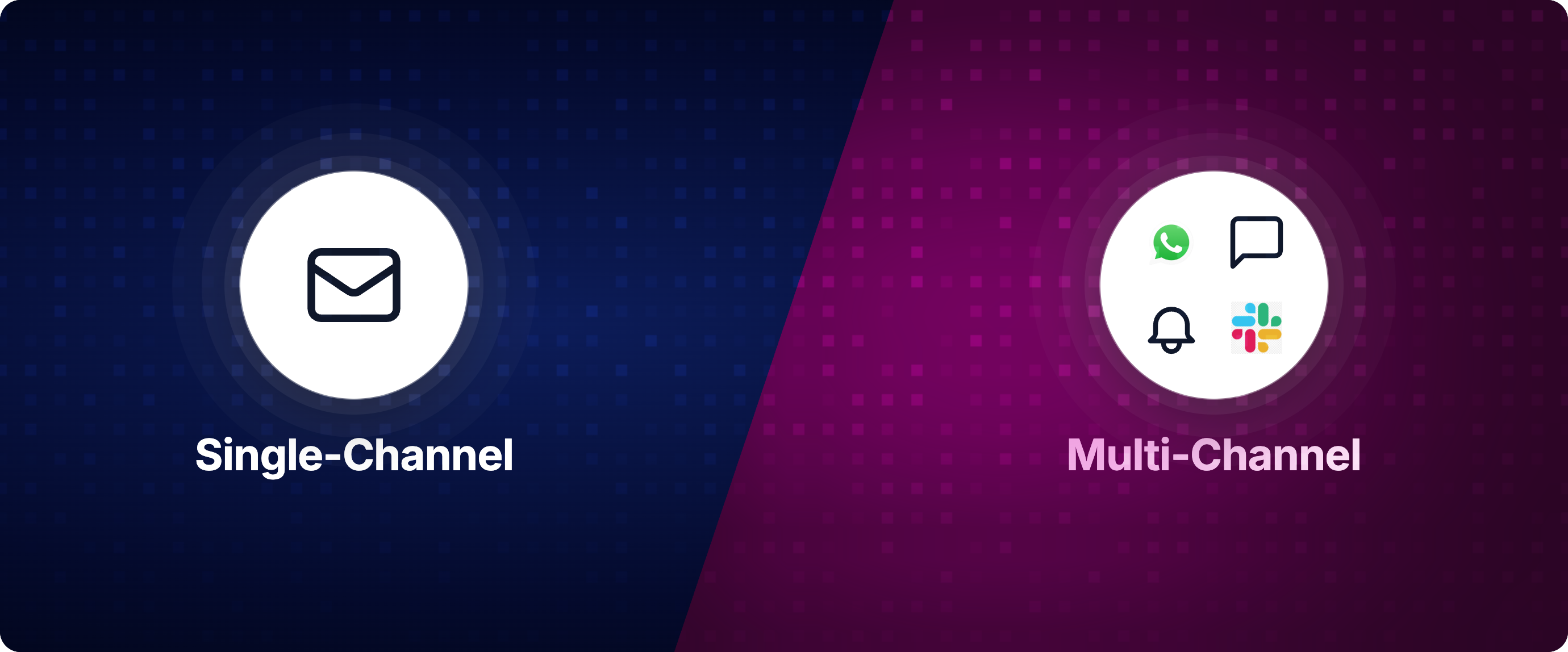
Single-channel notifications send one notification through one channel. Multi-channel notifications can reach a user through any of several channels (email, SMS, push, in-app inbox, WhatsApp, Slack, MS Teams), with the choice of channel made per notification, per user, or per delivery attempt.
There are two separate dimensions people confuse:
- Channel diversity per company. A company that sends email and SMS and push is "multi-channel" in the broad sense, even if each individual notification only uses one channel.
- Channel diversity per notification. An individual notification that can be delivered through any of several channels based on routing logic is "multi-channel" in the strict sense.
The interesting decision is the second one. Most modern SaaS products are multi-channel at the company level (you need email for billing, SMS for OTP, push for engagement). The harder question is whether any specific notification should be routed across multiple channels with fallback and engagement-based stopping, or whether it should go through one channel and stay there.
When Single-Channel Is Actually the Right Answer
Five cases where one channel beats the routing logic.
1. OTP and 2FA codes (SMS only)
One-time passwords work through SMS because SMS has the lowest combined latency, near-universal device coverage, and a long-established user expectation. Sending the same OTP across SMS, email, and push triples the attack surface (compromise any one channel and you have the code) and doubles user confusion. The standard pattern is SMS-only with email as a fallback only if SMS delivery fails, never simultaneously.
2. Password resets (email only)
Password resets work through email because users have a paper trail, they can access reset links from any device, and the security model assumes the user controls their email account. Sending password reset links over SMS or push creates a worse experience (longer URLs, harder to click on the right device) and weakens the audit trail. Email is the right channel and nothing else needs to compete.
3. Internal ops and incident alerts (Slack or MS Teams only)
Engineering teams already live in a chat tool. Alerts going to a separate email or push notification create context-switching cost and get missed. The right pattern for ops notifications is one channel where the on-call engineer is paying attention, not three channels that fragment attention. Add PagerDuty or similar for true incident escalation, but the day-to-day alerts belong in one chat channel.
4. Email marketing and newsletters (email only)
Promotional email at scale is the cheapest reach channel by an order of magnitude. SMS marketing carries a higher per-message cost and a much higher complaint rate. Push notifications require the user to have installed your app, which limits reach. For pure broadcast content (newsletters, product announcements, weekly digests), email-only is the right cost-to-reach pattern unless you have a specific reason to escalate.
5. Low-volume B2B products with one dominant user channel
If your users are sales reps who live in email, or back-office operators who check the dashboard in-app, adding channels they do not use is overhead without lift. Multi-channel architecture pays off when channel mix actually reflects how users prefer to be reached. For products where one channel covers 90 percent of meaningful engagement, the other channels are a distraction.
When Multi-Channel Is Worth the Cost
Five cases where the routing complexity earns its keep.
1. Engagement-critical transactional notifications
If the notification matters enough that the user must see it (order shipped, delivery arriving, payment failed, account suspended), multi-channel with smart routing is the right pattern. The notification fires into the in-app inbox immediately, falls through to push if not seen, then to email if still not engaged, and to SMS if the situation requires it. The user is reached through whichever channel they happen to be active on.
2. Cross-app reach (mobile and web users)
A product with both a mobile app and a web app cannot rely on push alone (web users do not get mobile push by default) or in-app alone (mobile users may not have the app open). Multi-channel becomes necessary just to cover the combined user base, not as an engagement strategy but as a reach strategy.
3. Multi-tenant B2B SaaS with per-tenant policies
Each tenant on a B2B platform may want different channel defaults for its employees. Tenant A wants Slack-first for notifications because its employees live in Slack. Tenant B wants email-first because its employees do not use chat tools. A multi-channel platform with per-tenant channel routing is the only architecture that handles this without forking the product per customer.
4. Compliance and regulatory redundancy
Financial, healthcare, and security notifications often require the sender to demonstrate that the user was reached. Multi-channel delivery with logged attempts across channels provides the audit trail that single-channel cannot. The pattern is not "blast everything"; it is "attempt primary, fall through if unconfirmed, log the entire chain."
5. International reach with channel-mix variation by geography
User behavior by region varies. WhatsApp dominates messaging in Latin America and parts of Asia. SMS is more common in the US for transactional. Email penetration is universal but engagement varies. Products with a global user base need multi-channel because the right channel for a user in São Paulo is not the right channel for a user in Chicago.
The Real Cost of Going Multi-Channel
Multi-channel is not free. Each channel you add brings four kinds of cost.
- Provider integrations and credentials. Each channel needs at least one vendor (often two for failover), API integration, credential rotation, and webhook handling.
- Template work. The same notification needs distinct templates per channel because the content format differs (SMS is short, email is rich, push is push-shaped, in-app inbox has its own UI contract). Multiply your template count by the number of channels you support.
- Routing and engagement logic. Smart routing requires knowing whether a user has engaged with one channel before sending on the next. That requires event tracking, an engagement model, and orchestration logic that survives failures.
- Observability and debugging. A single-channel system has one delivery log to check. A multi-channel system needs per-channel delivery metrics, per-user channel routing history, complaint and bounce handling per channel, and the ability to trace why a specific notification went to one channel and not another.
The first version of multi-channel is roughly 6 to 10 months of focused engineering at a product company that does not already have notification infrastructure. The maintenance load is 0.25 to 0.5 of an engineer ongoing. This is the case for buying a notification infrastructure platform rather than building, but the cost is real either way.
Smart Channel Routing Replaces Channel Blasting
The mistake most teams make on their first multi-channel implementation is blasting every notification across every channel. The user gets the same message four times within seconds, gets annoyed, complains, and the complaint rate damages sender reputation across all channels.
The pattern that mature teams converge on is smart channel routing: deliver to one channel first, wait for engagement, then fall through to the next channel only if the user has not engaged. The in-app inbox receives the notification at T+0. If the user opens the app and sees it, the chain stops. If not, push fires at T+5 minutes. Still no engagement? Email goes out at T+30. SMS only fires if the use case demands it and the email has not been opened within an hour.
This pattern combines multi-channel reach with single-channel hygiene. Users receive each notification through one channel (the one they actually engaged on), but the system has the optionality to escalate when delivery matters. It costs more to build than channel blasting, but the deliverability and complaint-rate consequences are dramatically better.
The orchestration logic for smart routing is what multi-channel notification platforms exist to provide. Building it in-house is possible, but the engagement-tracking and engagement-stopping logic is the part that takes the longest to get right.
A Decision Framework
Apply the table per use case, not per company. Most products end up with a mix.
| Use Case | Right Pattern |
|---|---|
| OTP / 2FA | Single-channel SMS (email fallback only on SMS failure) |
| Password reset | Single-channel email |
| Order confirmation / receipt | Single-channel email (primary record); optional push or in-app for immediate confirmation |
| Delivery / shipping update | Multi-channel with smart routing (in-app → push → email) |
| Account security alert | Multi-channel with redundancy (email + push, logged) |
| Engagement / retention nudge | Single-channel push or in-app, channel matched to user activity |
| Promotional newsletter | Single-channel email |
| Promotional flash campaign | Multi-channel (email + push, both required for reach) |
| Internal ops / incident alert | Single-channel Slack or MS Teams (PagerDuty for true incidents) |
| Compliance notification (KYC, terms update) | Multi-channel with logged delivery |
The pattern that emerges: single-channel for use cases where one channel is structurally the right fit, multi-channel with smart routing where reach and engagement justify the orchestration cost. Channel blasting (sending the same notification to all channels simultaneously) belongs in neither column.
Where SuprSend Fits
SuprSend is notification infrastructure that handles single-channel and multi-channel delivery through the same engine, on the same workflow primitives. There is no separate single-channel product to license; the same platform routes a password reset through email-only and an order shipped notification through in-app → push → email with engagement-based stopping.
The platform covers eight channels out of the box (email, SMS, mobile push, web push, in-app inbox, WhatsApp, Slack, MS Teams) with vendor flexibility per channel. The orchestration primitives that matter for the multi-channel pattern:
- Smart Channel Routing with engagement-based stopping. Channels are attempted in priority order with configurable delays; the chain stops when the user engages, defined by delivery, open, click, or a custom platform event.
- Single-channel delivery nodes for use cases where you want exactly one channel and nothing else (OTP, password reset, ops alerts).
- Vendor Fallback within a single channel for redundancy without escalating to a different channel (primary email vendor fails over to secondary email vendor before email is considered failed).
- Preference center with category-level and channel-level controls, so users can mute promotional channels without affecting transactional delivery.
- Per-tenant routing for multi-tenant SaaS where each tenant configures its own channel priorities and vendors.
The mental model: SuprSend gives you the routing logic, the channel coverage, and the engagement tracking that the multi-channel pattern needs. Whether a specific notification uses one channel or five is a configuration question, not a product question.
Frequently Asked Questions
Is multi-channel always better than single-channel?
No. Multi-channel is better when the notification is important enough to justify the engineering and user-experience cost of routing across channels. For use cases where one channel is structurally the right fit (OTP via SMS, password reset via email, internal alerts via Slack), single-channel is the cleaner answer. The decision should be made per use case, not per company.
What is the difference between multi-channel and channel blasting?
Channel blasting sends the same notification across every channel simultaneously, which annoys users and inflates complaint rates. Multi-channel with smart routing sends through one channel first, then escalates to the next only if the user has not engaged within a defined window. The user receives the notification through one channel; the system retains the optionality to escalate.
How long does it take to build a multi-channel notification system?
The first production-ready version is roughly 6 to 10 months of focused engineering at a product company that does not already have notification infrastructure, plus ongoing maintenance of 0.25 to 0.5 of an engineer. The breakdown includes provider integrations, per-channel templates, routing logic, engagement tracking, observability, and complaint handling per channel.
Should I send OTPs through both SMS and email?
No. Send the OTP through SMS only and treat email as a fallback that fires only if SMS delivery fails, never simultaneously. Sending the same code on both channels doubles the attack surface and confuses the user. The clean pattern is single-channel primary with single-channel fallback on delivery failure.
Which channels should a multi-channel notification system support first?
Start with the channels your users actually use. Most SaaS products land on email, in-app inbox, and mobile push as the first three because email is universally available, in-app is the highest-engagement channel for active users, and push reaches users who have your app installed but are not currently using it. Add SMS, WhatsApp, and chat tools as specific use cases demand them.
Does smart channel routing require a notification platform?
It can be built in-house, but the engagement-tracking and engagement-based-stopping logic is the part that takes the longest to get right. A notification infrastructure platform provides smart channel routing as a configurable feature on top of orchestration primitives, which is usually faster than building it from scratch unless you have specific reasons (data residency, scale, or differentiated routing logic).
The Bottom Line
Multi-channel is the right pattern for use cases where engagement matters enough to justify the orchestration cost. Single-channel is the right pattern when one channel is structurally the best fit and adding others adds noise. Channel blasting belongs in neither column. The companies that get notifications right are the ones that decide channel strategy per use case, build smart routing where it pays off, and resist the impulse to blast every notification across every channel because the platform makes it easy.
If you want to see how a single notification platform handles both single-channel and multi-channel delivery with smart routing built in, start building for free, or book a demo to walk through your stack.
On this page