
The way people work is changing fast. We talk to our tools in natural language, and they get things done. It’s becoming the default for everything. Building and managing notifications should be no different.
Here’s our first set of updates in that direction.
What we shipped at SuprSend
AI Copilot: Smartest SuprSend expert
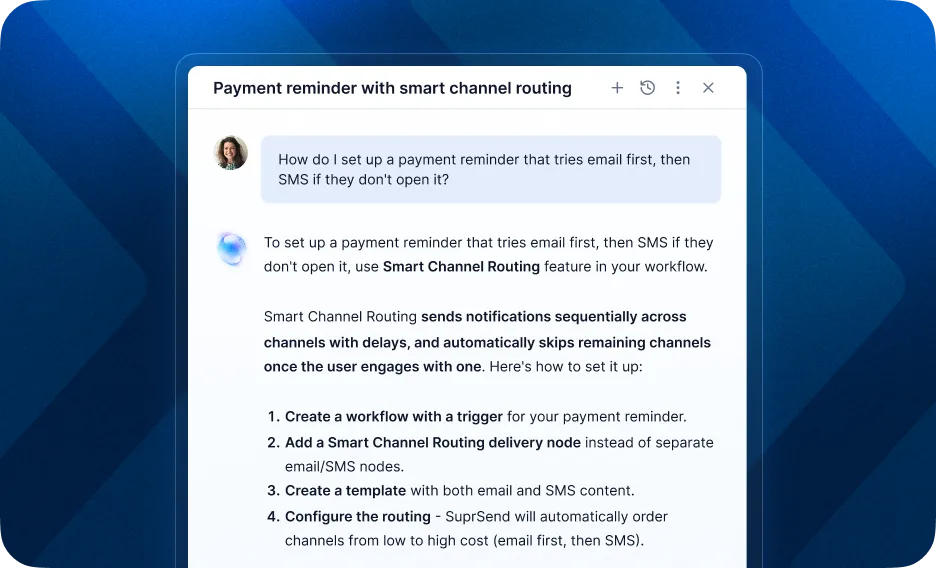
Get instant answers on setup, debugging, APIs, and use-case modeling without digging through docs. The AI Copilot is trained on SuprSend’s full documentation and lives right inside your dashboard.
- Ask questions like “How do preferences work?” or “Which API should I use for bulk notifications?” and get contextual answers instantly.
- Debug faster by describing your issue in plain language instead of searching across multiple doc pages.
- Model use cases by asking the copilot how to set up specific workflows, like “How do I build a multi-step payment reminder with SMS fallback?”
SuprSend CLI: Ship notification changes like code
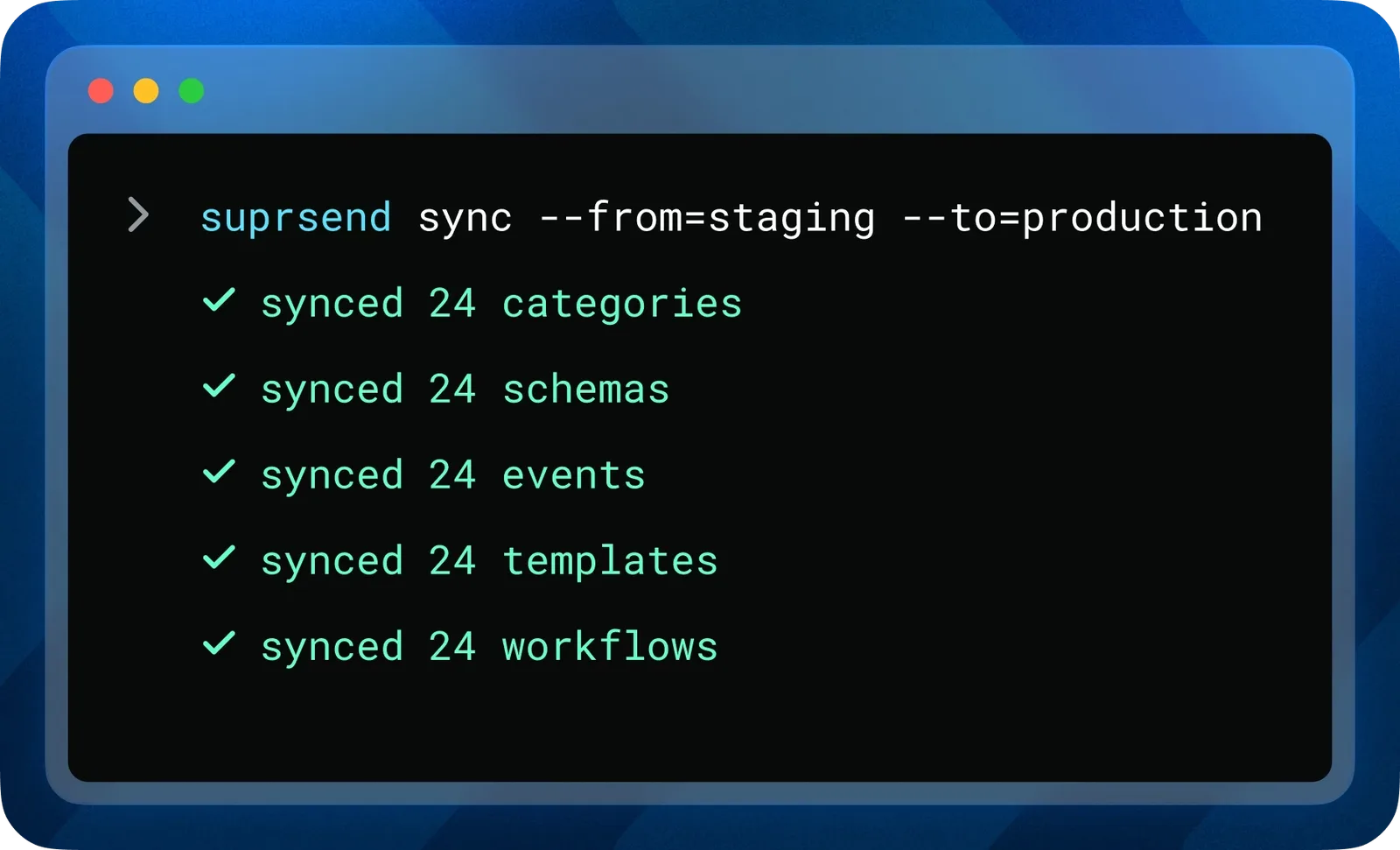
Manage and promote notification assets right from your terminal. The CLI brings version control, environment promotion, and CI/CD integration to your notification infrastructure, so changes go through the same review and deploy process as your application code.
- Pull workflows, schemas, events, and categories locally, version them in Git, and push changes as feature branches or bugfix releases.
- Run
suprsend syncto promote all notification assets from staging to production in one shot, timed exactly with your code release. - Integrate with your CI/CD pipeline so notification changes get the same code reviews, approval gates, and rollback safety as your product code.
Get started with SuprSend CLI →
MCP Server: AI-Powered Notification Management
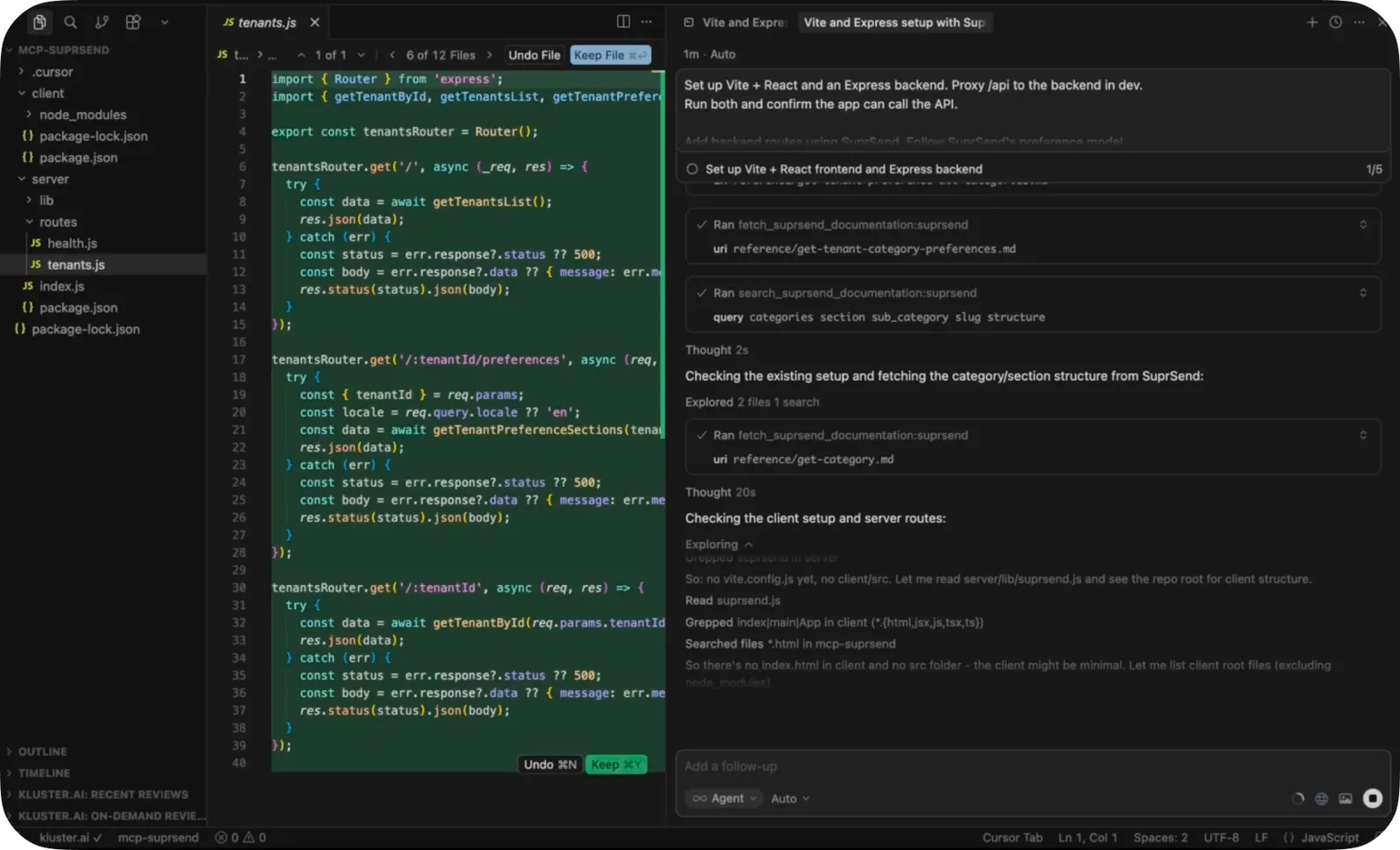
Your AI agents and copilots can now interact with SuprSend through natural language. The MCP Server connects to Claude, Cursor, Windsurf, and any MCP-compatible client, so you can manage notifications without leaving your editor.
- Trigger workflows on demand, like “Run the approval-required workflow for user John Doe to test my setup.”
- Bootstrap test data by asking your AI to create sample users, tenants, and preference configurations in your workspace.
- Manage preferences and branding from your IDE, such as “Enable email for the marketing category” or “Update the logo for the enterprise tenant.”
Setup SuprSend MCP in minutes →
Branch workflows: Based on delivery and engagement signals
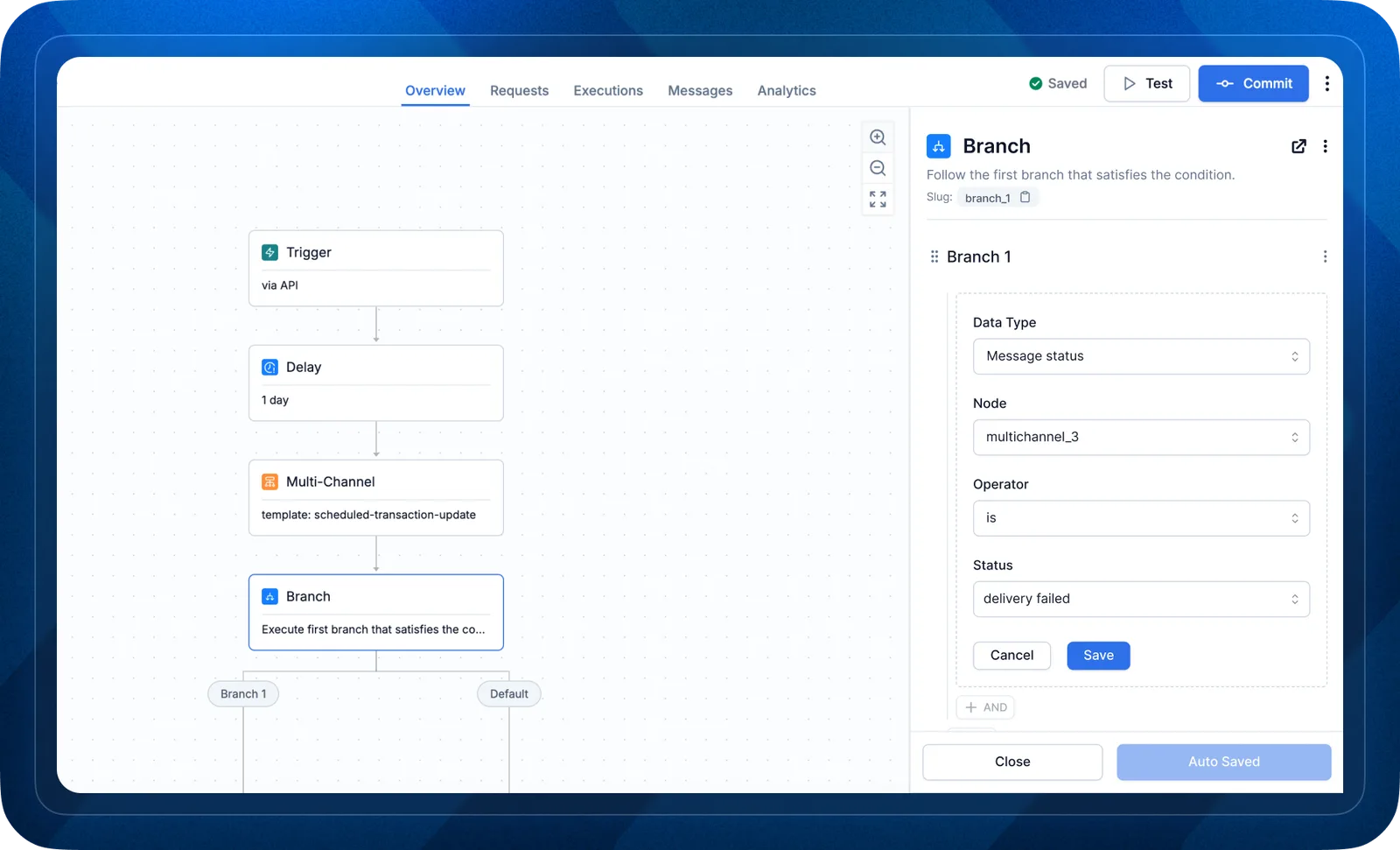
You can now branch workflows based on whether a previous notification was delivered, seen, or clicked. This lets you build intelligent escalation paths directly in the workflow editor, without writing fallback logic in code.
- Send an email, wait 24 hours, and follow up on SMS only if the email wasn’t opened.
- Build multi-step reminder sequences (payment due, approval pending, onboarding nudges) where the next step depends on the user’s action/inaction on last notification.
- Reduce notification fatigue by skipping follow-ups when users have already seen or acted on the original message.
📖 Learn more in our docs
Translations: One template, all languages
If you’ve ever maintained separate notification templates per language, you know how fast that gets out of hand. A new locale means duplicating every template, keeping them in sync across changes, and hoping nothing drifts.
- Drop
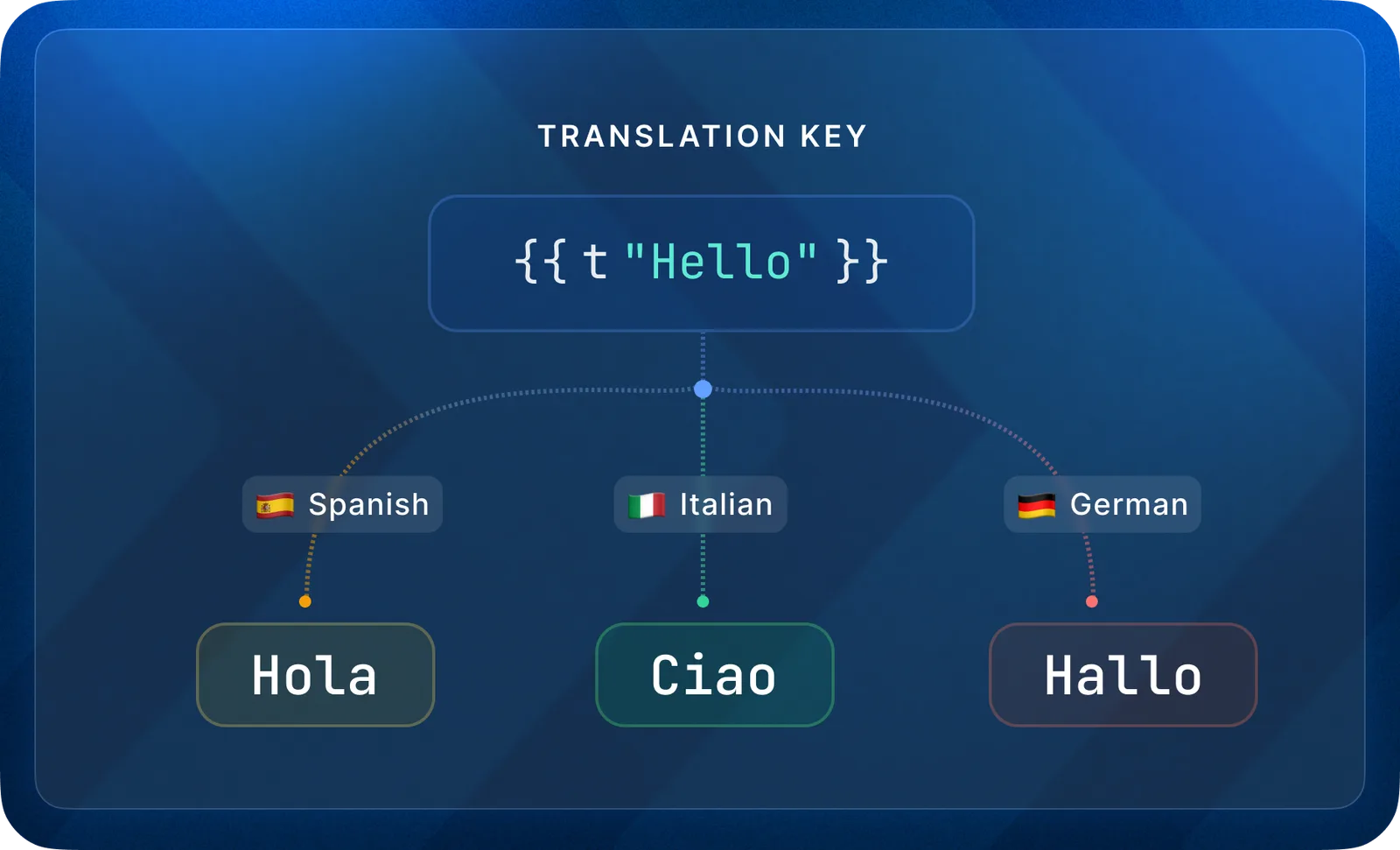
{{t "key"}}into any template, upload translation files via dashboard, API, or CLI, and SuprSend handles the rest. Right language at send time, automatic fallbacks when a locale isn’t available, pluralization support, and version control with one-click rollback. - We didn’t stop at templates. Category Translations for Preference Centers means users see their notification preferences in their own language too - category names, descriptions, fallback logic, all of it. English translations are auto-generated from your existing category names, so there’s zero extra setup to get started.
- The Hosted Preference Page got a full redesign alongside refreshed UI, locale-aware rendering, and automatic translation of all static text across 23 languages out of the box. No configuration needed.
📖 Learn more in our docs
Analytics CSV Export: Your notification data, outside the dashboard
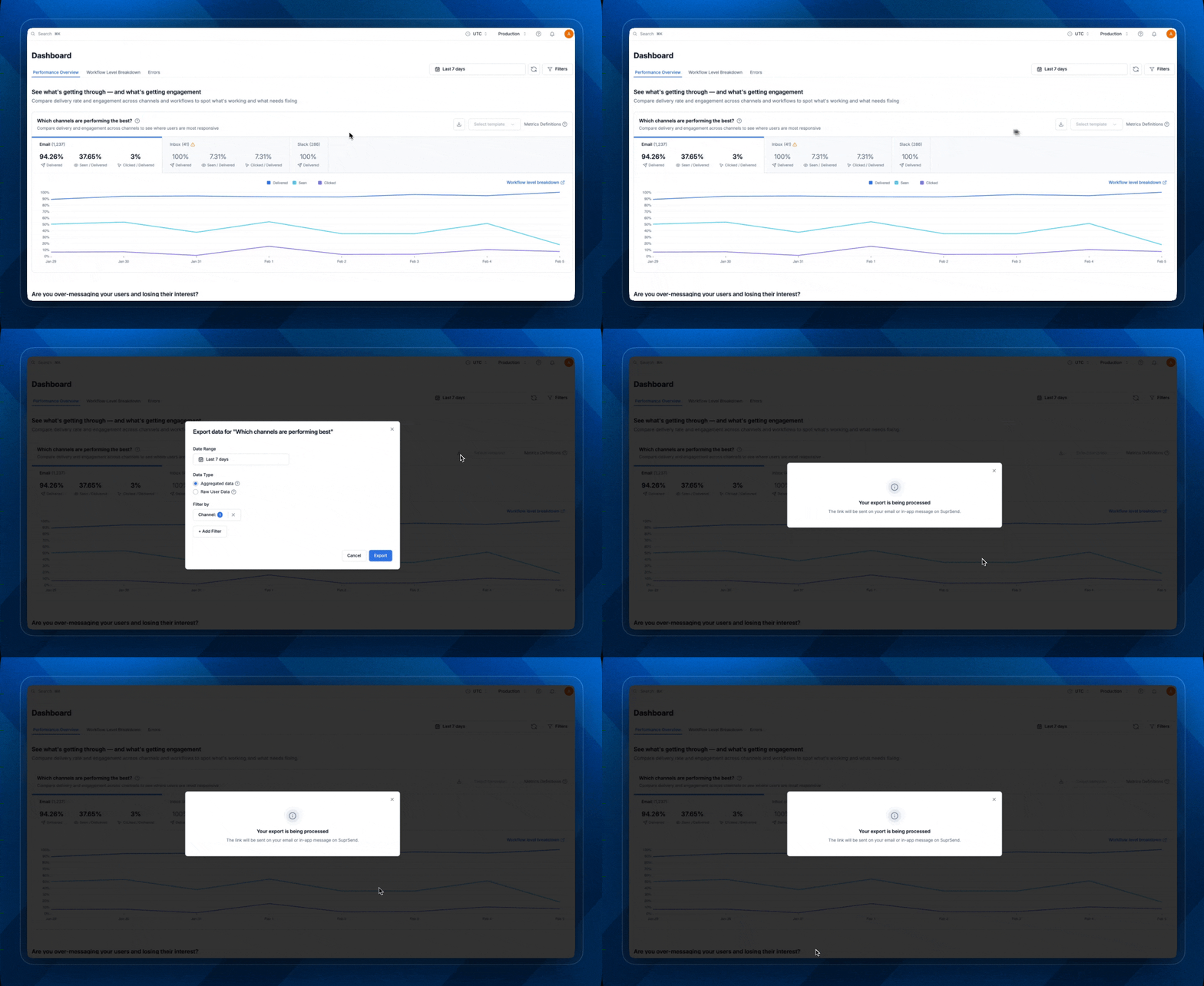
- SuprSend’s analytics gives you a strong overview but sometimes you need to go deeper than what a chart can show. CSV Export lets you pull raw or aggregate notification data out of the dashboard and into whatever tool your team already works in.
- Drop the data into Excel, Google Sheets, or your data warehouse to drill into user-level delivery trends, investigate drop-off patterns, or identify which channels are quietly underperforming.
- Or export aggregate data to build the notification health report your product, ops, or leadership team keeps asking for — without giving everyone dashboard access.
S3 Connector V2.0: Full notification telemetry, straight to your S3 bucket
The v1.0 S3 connector gave you partial data. V2.0 gives you everything — every API request, every workflow execution, every delivery outcome is structured, complete, and in your own storage. If you’re running internal analytics, debugging production issues, or need an audit trail for compliance, this is the data layer that makes it possible.
What’s new in v2.0?
Three new data streams cover the full lifecycle of a notification:
- Requests — API payloads and responses at the trigger level. Useful for debugging what was sent, when, and with what data.
- Workflow Executions — Step-by-step logs of how a workflow ran: which conditions were evaluated, which preferences were applied, where it failed.
- Messages — Final delivery status, engagement metrics, vendor responses, and failure reasons per message.
What you can do with it
- Power internal analytics or surface delivery logs directly on your customer portal. Query the data in Athena or Redshift to investigate drop-off patterns at scale. Use workflow execution logs to debug preference or condition logic without guessing. And maintain a full audit trail for compliance without pulling data manually from the dashboard.
Test Mode: Test the full notification flow without the risk of sending to your real users
Most teams hack around this problem today. Redirecting notifications to qa@company.com or dev@company.com to avoid hitting real users, while still needing to see the full flow end-to-end. Test Mode brings that workflow natively into SuprSend.
- Designate specific channels as test channels that belong to your internal testers and receive notifications normally in test mode, so you can preview the actual message on a real device, not just in a template editor.
- Everything else gets catch-all routing. Non-test notifications redirect to a shared QA inbox, giving you one place to trace and debug every message without anything leaking to real users.
What’s next?
Template variants
Create multiple versions of a template for different audiences. Serve different designs and content per tenant, let customers create their own templates, or run A/B tests to find what drives the most engagement.
OTEL connector (Datadog, New Relic)
Monitor SuprSend’s health alongside the rest of your infrastructure. Track delivery anomalies, error spikes, and custom metrics from a single observability dashboard you already use.
Slack AI Integration
Get answers from the AI Copilot directly in Slack. Ask questions, debug issues, and get recommendations without leaving the conversation.
That’s it for February. As always, we’re just one Slack ping or support ticket away.