




8 best Braze alternativesfor customer engagement (2026)

Eight tools compared on the messages they cover, who on your team can run them, what an agent can do in them, ease of setup and pricing.

By , SuprSendOct 2, 2026

Braze is a customer engagement platform that lifecycle and marketing teams use to run campaigns and journeys across push, email, SMS, WhatsApp and in-app messages.

Teams look elsewhere when they need a published price and a faster start, or when one platform has to run the product’s own notifications alongside campaigns, with engineers, marketers and their agents all able to change them.

Quick guide: Braze alternatives by use case

If you needChoose
An in-app bell and feed inside your product, with preferences your customers control?Every tool here ships some in-app message. SuprSend's in-app inbox adds a real-time feed with read state synced across devices, tabs, toasts and per-tenant feeds, on six client SDKs.SuprSendSuprSendKnock
Transactional, product and marketing messages in one platform?A password reset, a comment alert and a win-back campaign share one user profile, one set of preferences and one log.SuprSendSuprSendKnock
A full orchestration layer under your notifications?Batching and digests, user preferences, per-tenant setups and provider fallback in one engine.SuprSendSuprSend
An agent that builds and debugs notifications, or your own agent over MCP?The agent builds a workflow from a description and traces why a send failed; Claude or Cursor can build, test and send over MCP.SuprSendSuprSend
Workflows kept in your repo and reviewed in a pull request?SuprSendSuprSendKnock
Each of your business customers with its own branding, templates and preferences?See how multi-tenant notifications work.SuprSendSuprSend
Product and growth teams changing messages without an engineer?SuprSendSuprSendOneSignalCustomer.io
Consumer campaigns with experiments across millions of profiles, run from a UI?Iterable leads with email; MoEngage and CleverTap put product analytics next to the campaigns.IterableMoEngageCleverTap
Push and in-app at app scale, for a small team or an enterprise mobile team?OneSignal for a quick start on a free plan; Airship for mobile depth with engineers on the integration.OneSignalAirship
Open source you can self-host for free?None of the tools below is open source; Novu is the usual pick here.Novu
Data kept in your own cloud or data centre, with vendor support?VPC, on-prem or BYOC under an Enterprise licence.SuprSendSuprSend
Braze already runs your lifecycle programme and covers every message you send?Stay; see when to stay on Braze.Braze

What Braze does

Braze began in 2011 as Appboy, a mobile push and in-app messaging tool, and grew into a customer engagement platform. Its journey builder, Canvas, runs campaigns across mobile and web push, email, SMS, WhatsApp, LINE, KakaoTalk, in-app messages, Content Cards and Banners.

Segments are built on profile attributes and events, and SQL Segment Extensions query warehouse data directly. Currents streams message events out to warehouses and partner tools. BrazeAI Operator works inside the dashboard, and Canvas can include agent steps. Braze’s remote MCP server reads analytics and creates templates and content blocks, with no access to user-level data.

Braze sells quoted contracts. On G2, 54.5 percent of its reviewers work at mid-market companies.

Braze's homepage: a customer engagement platform for marketers, with a loyalty push notification on a phone
LicenceProprietary, cloud only.
ChannelsMobile and web push, email, SMS, MMS and RCS, WhatsApp, LINE, KakaoTalk, in-app messages, Content Cards, Banners and webhooks.
BackendREST API.
Frontend SDKsNative iOS, Android and Web SDKs, plus cross-platform SDKs.
ComplianceISO 27001, SOC 2 Type 2 and a HIPAA offering.
Billing unitQuoted contract; data points counted on profile updates, custom events and sessions.
Self-hostingNone; Braze runs in its own cloud.
G24.4 across 1,883 reviews; ease of setup 7.6.

Where Braze is strong

  • Canvas builds journeys with action, audience and experiment paths, decision splits, agent steps and version history.
  • It reaches users on LINE, KakaoTalk and WhatsApp as well as push, email and SMS, and sends email from its own IPs with automated IP warming.
  • Segments can come straight from SQL on your warehouse, and Currents streams every message event back out.
  • One mobile SDK carries push, in-app messages, Content Cards and Banners.
Braze pricingWhat you get
Braze GoEntry edition for early-stage growth teams, price by quote.
Higher editionsFeatures, volume and support set in a quoted contract.
Free planNone listed.
What is countedData points on profile updates, custom events and sessions.

Why teams look elsewhere

  1. 01The budget has to be known before a sales call. Braze publishes no prices. Its entry edition, Braze Go, is sold by quote, and contracts count data points: each profile update, custom event and session draws on the allowance. To forecast cost, a team has to estimate how many events and attribute changes its app records, on top of how many messages it sends. G2 reviewers name opaque and escalating pricing as a recurring frustration.
  2. 02You want to start free and pay as volume grows. Braze lists no free plan, so a trial of a new use case starts with a contract. Several tools on this list let a team ship first and pay later: SuprSend is free up to 10,000 notifications a month, Knock is free for 10,000 messages, and OneSignal is free for mobile push and in-app up to 1,000 monthly active users.
  3. 03The platform has to be live in weeks, run by a small team. Braze puts its own average time to value at six weeks. G2 reviewers rate its ease of setup 7.6 out of 10, and the learning curve is the drawback they cite most, in 159 reviews. Canvas repays a dedicated lifecycle team; a product team without one spends that time on SDK events, data mapping and journey logic.
  4. 04The product's own notifications need a home. Password resets, order updates and comment alerts are triggered by your backend and owned by engineering. In Braze they run as API-triggered campaigns and Canvases, and transactional email is a separate channel. The lasting in-app feed is Content Cards, which your team renders and styles inside your own UI. Preferences are subscription groups with a preference centre; a customer's admin setting defaults for their own users is left to you.
  5. 05Engineers and agents need to change notifications from the repo. Braze's docs list no CLI. Moving a campaign or Canvas to another workspace copies it as a draft, one at a time, and Canvases with WhatsApp, LINE or Content Cards cannot be copied. Braze's MCP server reads analytics and creates templates and content blocks. Building or changing a Canvas happens in the dashboard, by a person.

How we compared these tools

We read each vendor’s documentation, API reference, pricing page, trust or security page and G2 reviews, and the G2 compare pages for ease of setup.

What we compared on: feature depth, use cases covered, billing model, developer experience, AI authoring, and ease of use for technical and non-technical team members.

Three different kinds of product get called “Braze alternatives,” and they solve different problems.

Layer 1: Delivery providers

FCM, APNs, Amazon SES, Twilio and SendGrid move a message to a device, an inbox or a phone. Every tool on this list sends through one of them, either bundled into its price or through your own account. Switching provider changes delivery and cost per message; journeys, segments and preferences still have to live somewhere.

Layer 2: Unified notification platforms

SuprSend and Knock run transactional, product and marketing messages from one system, with a workflow engine, an in-app feed and user preferences built for notifications your product sends. Both can be run from outside the dashboard: each has an MCP server and a CLI. SuprSend’s agent and MCP server build and change workflows, templates and tenants, test and send, and read delivery logs. Knock’s agents run from its dashboard, Slack and MCP clients, and can sit as steps inside a workflow.

Layer 3: Customer engagement platforms

Braze sits here with Iterable, MoEngage, CleverTap, Customer.io, Airship and OneSignal. These platforms run campaigns and journeys at consumer scale for lifecycle and growth marketers. All of them now ship agents or MCP servers. Their agents mostly draft copy, draft journeys for review and read performance inside the campaign canvas, and most of their MCP servers read campaign data or manage users and templates. An embeddable inbox, preferences your customers’ admins control and transactional workflows owned by engineering are usually left to you.

The best Braze alternatives

ToolBuilt aroundStrongest atMeant forBilling unitFree planPaid fromG2
SuprSendSuprSendWorkflows, templates, inbox and preferences shared by every message a product sendsWorkflows with batching, digests and fallback; agent, MCP and CLI that build, test and sendEngineering, product and growth teamsPer notification per channel10,000 notifications a monthEssentials $100 a month for 50,000, then $2 per 1,0004.8 (129 reviews)Ease of setup: 9.4
IterableCross-channel campaigns and journeys, grown from emailWorkflow Studio journeys; Nova Agent builds campaigns and journeys; open-source MCP server, read-only by defaultMid-market lifecycle marketersQuoted contractNone listedQuote4.4 (838 reviews)Ease of setup: 7.8
MoEngageEngagement with product analytics built inMerlin agents draft journeys and in-app templates; MCP server with nine read-only campaign toolsB2C marketing and product teamsQuoted contractNone listedQuote4.5 (523 reviews)Ease of setup: 8.8
Customer.ioMessaging driven by people and object data, grown from emailJourneys on behavioural data; MCP server and CLI act under the signed-in user's roleSaaS and consumer marketing teamsProfiles (people and objects)NoneEssentials $100 a month for 5,000 profiles4.4 (953 reviews)Ease of setup: 7.9
CleverTapEngagement and app analytics in one productAnalytics and segmentation; early-access MCP server for Claude, ChatGPT and CursorMobile app marketersMonthly active usersFree trial onlyEssentials by MAU; higher tiers quoted4.6 (681 reviews)Ease of setup: 8.6
OneSignalPush, in-app and email for apps and websitesQuick setup; AI agent and MCP on every plan manage users, segments, templates and sendsSmall app and web teamsPlatform fee plus mobile MAU, web push subscribers and email sendsMobile push and in-app up to 1,000 MAUGrowth $19 a month plus $0.012 per mobile MAU4.7 (1,237 reviews)Ease of setup: 8.9
AirshipThe mobile app experience: push, in-app and app contentMobile push depth; AI agents for campaigns; developer MCP server for test pushes and channel lookupsEnterprise mobile app teamsQuoted contractFree trial onlyQuote4.0 (83 reviews)Ease of setup: 7.0
KnockProduct notifications with lifecycle messaging and in-app guidesAgents in the dashboard, Slack and MCP clients, agent steps in workflows; CLIProduct engineering teamsPer message10,000 messages a monthStarter $250 a month for 50,000, then $0.005 each4.6 (148 reviews)Ease of setup: 8.7

1.SuprSendSuprSend

Best for running transactional, product and engagement notifications from one platform, changed by engineering, product and growth teams and their agents
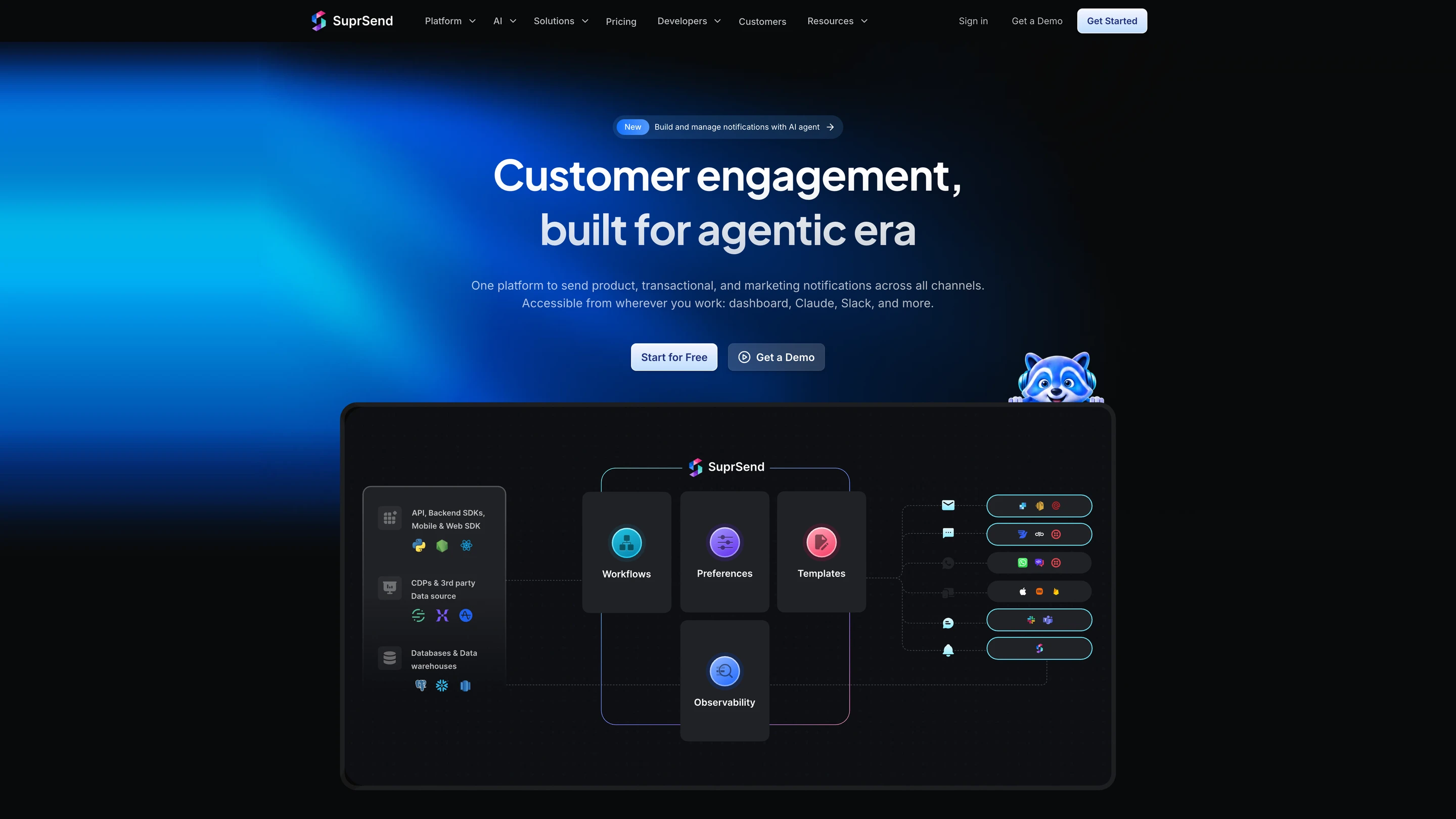
SuprSend's architecture: your API calls, SDKs, CDPs and data warehouses feed workflows, preferences, templates and observability, which send through email, SMS, WhatsApp, push, Slack and Microsoft Teams providers and the in-app inbox

What SuprSend is. SuprSend is a US company, founded in 2022, that runs every notification a product sends from one platform, from transactional alerts to engagement campaigns. Engineering, product and growth teams work in it alongside their agents.

For campaigns, broadcasts go to lists built from segment rules, a scheduled warehouse query, a CSV or the API, and use the same templates, preferences and unsubscribes as your product alerts.

A complete orchestration engine

In-app inboxReal-time bell and feed, read state synced across devices, tabs, toasts, per-tenant feeds, six client SDKs, embedded or headless. Every plan, Free included.
User preferencesOpt in or out per category and channel, in a preference centre you embed or host. Business.
WorkflowsA workflow engine with branches, conditions, delays, throttling, data fetch and webhook steps, and sends in each user's timezone. One send step reaches the user's channels in your order. Built visually, through the CLI or by an agent, with version history and rollback. Builder on every plan; throttling, fetch, webhook and timezone from Essentials.
TemplatingEditors for every channel, variants by tenant, user or language, version history with rollback and translation files. Every plan; translation files on Business.
Batching and digestsCollect events over a window and send one digest at a time the user picks. Business.
Per-tenant setupsEach of your customers gets its own branding, templates, preferences and provider routing. Business add-on, Enterprise.
ObservabilityStep-by-step workflow logs and message logs with the provider's error; 30 days on Free, 90 on paid plans; warehouse sync on Business.
Retries and fallbackBring your own providers; if one does not confirm delivery, the next one sends. Essentials.
DeploymentSuprSend cloud with 99.9% uptime, or your own VPC, on-prem or BYOC with vendor support. SOC 2 Type II, ISO 27001, GDPR, HIPAA, CPRA. Self-hosted and BYOC on Enterprise.

How your team operates it

In the dashboard

The SuprSend agent builds a workflow from a description, drafts the copy for each channel and traces why a send failed. Product and growth work here and in Slack.

In your own agent

Connect the MCP server to Claude, ChatGPT, Cursor or any MCP client and build and change workflows, templates and tenants, test and send, and read the delivery log and analytics from there.

In your IDE or codebase

The CLI pushes and pulls workflows, templates, schemas and translation files, promotes staging to production and generates TypeScript types, so a bulk change is one command reviewed in a pull request.

Pricing. Free up to 10,000 notifications a month; Essentials starts at $100 a month for 50,000, then $2 per 1,000; Business starts at $250 a month for 50,000, then $5 per 1,000; Enterprise is custom.

Verdict. Choose SuprSend when your product's own notifications and its engagement messages should run on one system that engineers, marketers and agents all change. Choose Braze when consumer-scale journeys, experiments and channels such as LINE and KakaoTalk are the core of the job. For the head-to-head, see how SuprSend differs from Braze.

2.Iterable

Best for lifecycle marketing teams that want cross-channel journeys with an email-first builder and a quicker start

Where it goes deep. Iterable started in email and added push, SMS, in-app, web push and embedded messages on the same user profile. Workflow Studio builds journeys that branch on events and attributes, with experiments along the way. Nova Intelligence is its AI layer: Nova Agent builds campaigns and journeys from a goal, audits messages and runs experiments, alongside agents for journeys, experimentation, Handlebars personalisation and monitoring. The open-source MCP server installs locally and starts read-only, with no personal data, writes or sends until you switch each one on. G2 reviewers rate its support 8.8 and its ease of setup 7.8.

Where it stops. Reviewers most often cite missing features, in 68 reviews, and name reporting depth as a limit. The MCP server is labelled beta, and it runs on your machine, so it serves desktop and IDE clients.

Pick it if email leads your lifecycle programme and you want an easier ramp than a full Canvas rollout.

Verdict. Iterable is the like-for-like answer to Braze for teams whose journeys start in email. It asks for the same kind of quoted contract, with setup that G2 reviewers rate slightly easier.

3.MoEngage

Best for B2C marketing and product teams that want analytics and campaigns in one place

MoEngage's homepage: an agentic customer engagement platform, with agent cards for in-app templates and per-user decisioning

Where it goes deep. Funnels, cohorts and segments sit next to push, email, SMS, WhatsApp and in-app campaigns, so a marketer builds an audience and messages it without leaving the product. Merlin AI agents draft multi-stage journeys for review, generate in-app templates from a description and answer questions about campaign performance; custom agents run inside guardrails a marketer sets, with an activity log of every step. The hosted MCP server gives Claude or ChatGPT nine read-only tools to search campaigns and read their metrics.

Where it stops. The MCP server reads campaigns and metrics. Building or changing a flow still happens in the dashboard.

Pick it if your marketers want analytics and engagement in one tool, with setup G2 reviewers rate 8.8.

Verdict. MoEngage covers most of what Braze does for consumer apps, with analytics built in. It suits teams that value an easier start over the widest channel list.

4.Customer.io

Best for marketing teams that message people on behavioural data and want published plans

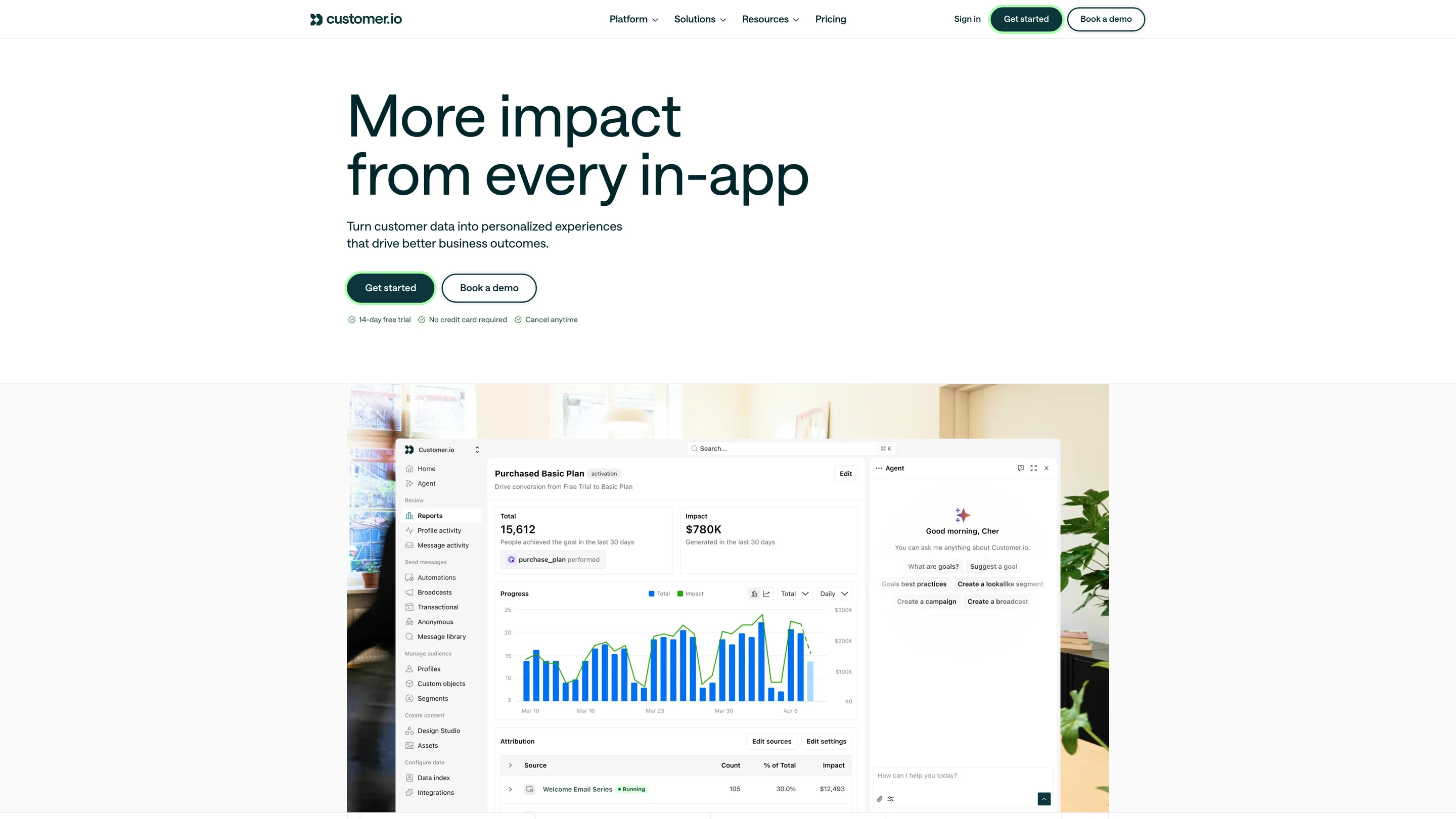
Customer.io's dashboard: a campaign goal report with conversions over time, attribution by message, and the agent panel

Where it goes deep. Customer.io started in email and added push, SMS, in-app and webhooks around one record for people and objects, such as accounts. Journeys trigger on events and attributes, and transactional messages go out through an API on the same profile. Its MCP server and CLI act under the signed-in user’s role, with writes held for approval where the client supports it, and an in-product agent drafts messages.

Where it stops. There is no free plan. Billing counts profiles, and objects count as profiles, so modelling accounts adds to the bill.

Pick it if you want journeys on behavioural data, run by a small marketing team.

Verdict. Customer.io is the lighter step down from Braze for teams that live in events and email. Its profile-based bill rewards careful data modelling.

5.CleverTap

Best for mobile app teams that want engagement and app analytics in one product

CleverTap's homepage: live 1:1 personalization with CleverAI, and cards for events, product launches and case studies

Where it goes deep. CleverTap pairs push, in-app, email, SMS and WhatsApp campaigns with product analytics: funnels, cohorts, uninstall tracking and real-time segments. G2 reviewers cite analytics as its top strength. An early-access MCP server connects Claude, ChatGPT and Cursor to a CleverTap account.

Where it stops. The MCP server supports admin access only, with no role-based access or personal-data handling yet. Reviewers name the learning curve as the most common drawback.

Pick it if your marketers want to see an app’s retention and act on it in the same screen.

Verdict. CleverTap is a strong Braze alternative for app-first businesses that lean on analytics. Teams that want agents to build campaigns will find its MCP server still early.

6.OneSignal

Best for small teams that want push, in-app and email live this week

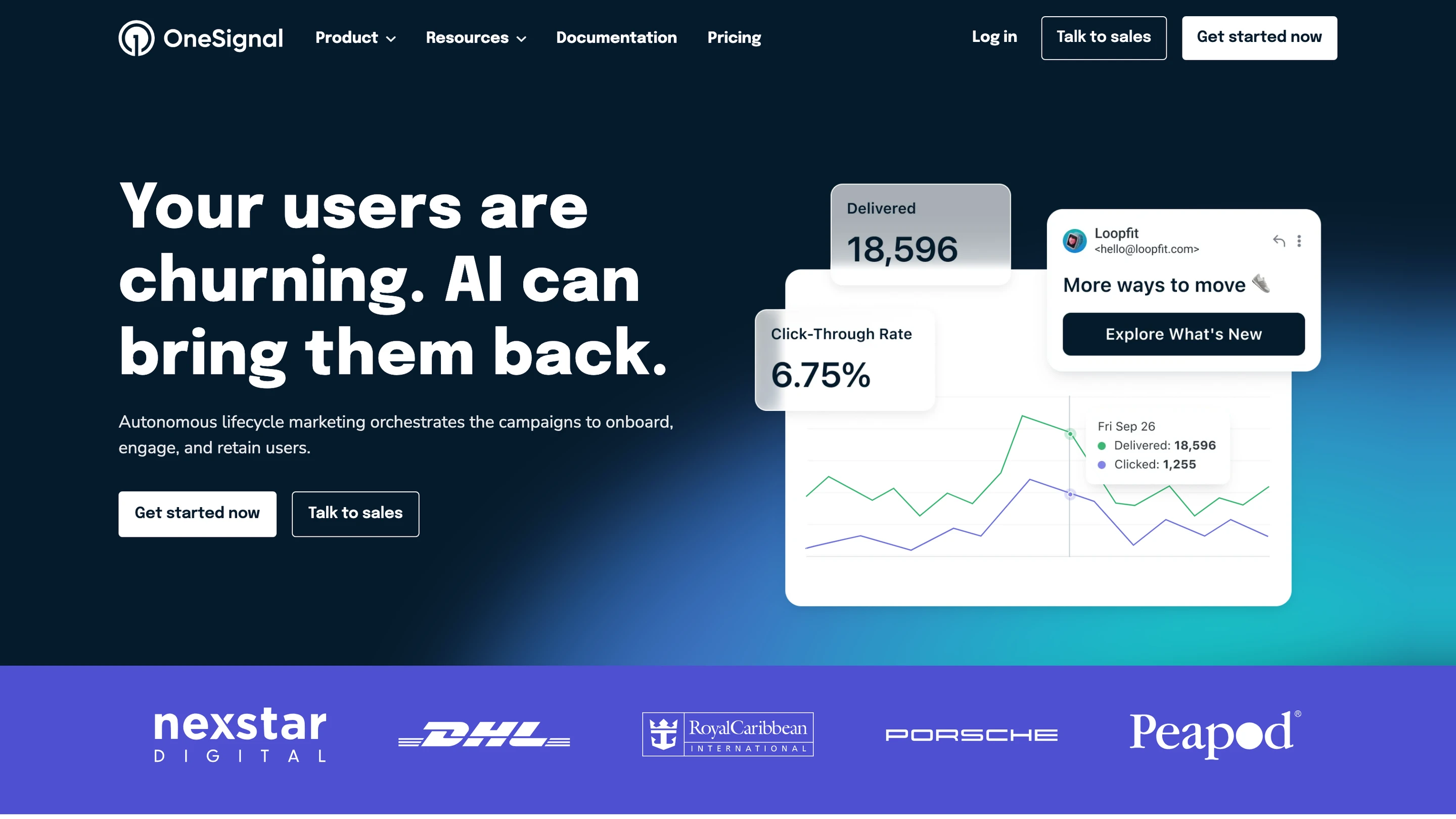
OneSignal's homepage: lifecycle marketing campaigns with a delivered and click-through-rate chart and an email preview

Where it goes deep. OneSignal started as push for apps and websites and added email, SMS and in-app messages. Setup is quick: G2 reviewers rate it 8.9, and 65.5 percent of them are small businesses. Journeys branch across push, email, SMS and in-app, and an AI agent and MCP server on every plan manage users, segments and templates and send messages.

Where it stops. Journeys are capped at 3, 5 or 20 active below Enterprise. Message history is not stored per user, so there is no lasting in-app feed, and WhatsApp is not a channel.

Pick it if push is the main channel and a small team runs it.

Verdict. OneSignal is the fastest way to replace Braze's push and in-app messaging for a small team. Teams that need deep journeys or a lasting feed outgrow its limits.

7.Airship

Best for enterprise mobile app teams whose engagement lives in push and in-app

Where it goes deep. Airship is built around the mobile app: push, in-app experiences and app content, with SMS, email and web alongside. Its AI agents in the dashboard help set up campaigns and audit drafts against brand and accessibility rules. The Airship MCP server is a developer tool: Claude Code or Cursor can send test pushes, look up channels, tags and opt-in status, and help migrate SDKs.

Where it stops. G2 reviewers rate its ease of setup 7.0 across 83 reviews, and say email gets less attention than mobile.

Pick it if mobile push is the heart of your engagement and you have engineers for the integration.

Verdict. Airship replaces the mobile half of Braze with more depth in the app itself. Teams that run email-heavy journeys will find more in Iterable or Customer.io.

8.Knock

Best for product engineering teams that own notifications and want lifecycle messages in the same tool

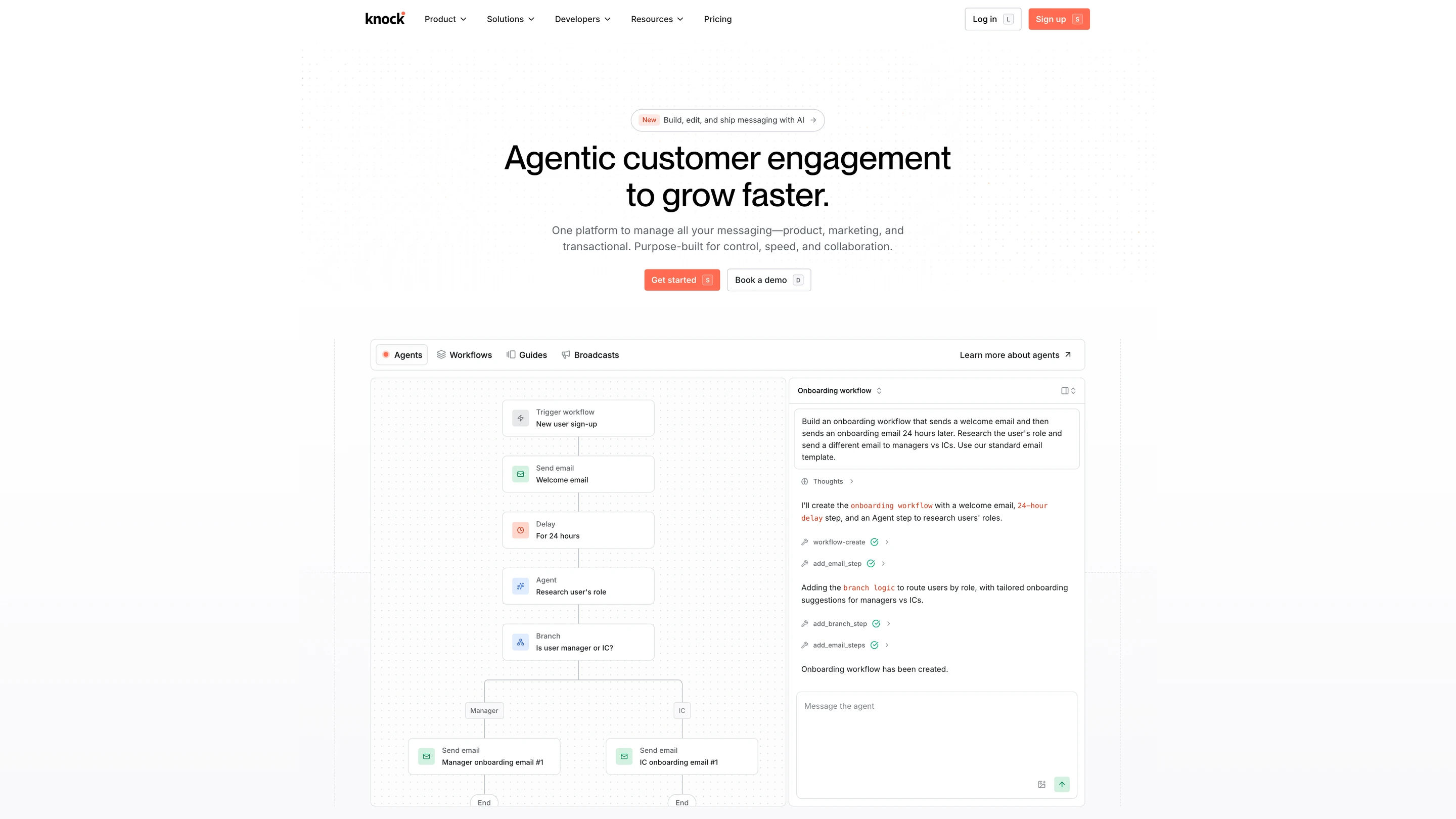
Knock's homepage, with its agent building an onboarding workflow: a trigger, welcome email, 24-hour delay, agent step and a branch for managers and ICs

Where it goes deep. Knock runs product notifications and lifecycle messaging through one workflow engine, with an in-app feed on React, JavaScript, Angular, React Native, Expo, iOS, Android and Flutter. Guides add in-product banners and modals. Agents run from the dashboard, Slack, Claude, Cursor, ChatGPT and Codex, and can sit as steps inside a workflow; an MCP server and CLI cover the rest.

Where it stops. Knock is cloud only. Per-customer branding and preferences, translations, SAML, SCIM and warehouse sync are on Enterprise.

Pick it if engineering owns every message and you want a well-documented API.

Verdict. Knock suits teams moving product messaging off Braze into a developer-run system. Campaign-heavy marketing teams will find its journey tooling lighter than Canvas.

When you should stay on Braze

  • A lifecycle team already runs your growth programme in Braze, and the contract fits your volume.
  • Most of your users are in markets where LINE or KakaoTalk is the main messaging app.
  • Your data team builds audiences in the warehouse and feeds Braze's message events back into its models.
  • An agency runs your campaigns and works in Braze day to day.
  • You need predictive send times and revenue attribution today. SuprSend is behind Braze on both.
  • Your product sends few notifications of its own, and engineering has no plans to own messaging.

Teams that keep Braze for product messaging usually end up writing code around it: a feed UI built on Content Cards, a settings page that maps business-customer defaults onto subscription groups, scripts that copy Canvases between workspaces, and a second system for password resets and alerts. That code is a hidden cost: your team builds it, maintains it, and pays for it in engineering time on top of Braze’s price. A switch usually follows when that work grows, when cost has to be known before the contract, or when agents need to build and change messages end to end.

How to migrate off Braze

  1. 01Record baselines. Export delivery, open and click rates per channel, opt-in counts and volume per campaign for the last 90 days.
  2. 02Rebuild workflows. Map each Canvas and API-triggered campaign to a workflow, then pull them into your repo with the CLI so every later change is reviewed.
  3. 03Move users and tokens. Export profiles by external ID with push tokens, email addresses and phone numbers, and import them through the API.
  4. 04Carry consent state. Map subscription groups and global unsubscribes to preference categories and import them before the first send.
  5. 05Rebuild the inbox. Replace Content Cards with an inbox component and move any cards users still need to see.
  6. 06Dual-send. Run one low-risk flow on both systems for a week and compare it against your baselines.
  7. 07Keep Braze for 30 days. Switch the SDK and traffic over, and keep read access to Braze for reporting and exports.

Conclusion

Braze covers consumer-scale lifecycle marketing: Canvas journeys with experiments, a wide channel list that includes LINE and KakaoTalk, warehouse-driven segments and streaming data out, run by a lifecycle team on a quoted contract.

Move when the product’s own notifications need to sit alongside your campaigns, when engineers and agents need to change them from the repo, or when cost has to be known up front. SuprSend runs every kind of message in one system, gives you a complete orchestration engine, and lets your whole team and its agents operate it, with a free plan for 10,000 notifications a month.

FAQ

Is Braze free?

No. Braze lists no free plan. Its entry edition, Braze Go, and every higher edition are sold by quote, and contracts count data points on profile updates, custom events and sessions.

What is the cheapest Braze alternative?

It depends on the unit each tool bills. At 50,000 notifications a month: SuprSend is free up to 10,000 and Essentials covers 50,000 for $100 a month, with overage at $2 per 1,000 on Essentials and $5 on Business. Knock is free up to 10,000 messages and Starter covers 50,000 for $250, then $0.005 each. OneSignal bills a $19 platform fee plus $0.012 per mobile monthly active user, and Customer.io starts at $100 a month for 5,000 profiles; both count users, so the cost follows your audience size. Iterable, MoEngage and Airship price by quote.

Which Braze alternatives include an in-app inbox?

SuprSend ships an in-app inbox on every plan, with six client SDKs: JavaScript, React, React Native, Flutter, iOS and Android. Knock ships a feed on web and mobile. Braze's lasting feed is Content Cards, which you render in your own UI. OneSignal stores no per-user message history, so it has no lasting feed.

Which Braze alternatives have an MCP server or agent authoring?

All eight have one or both. SuprSend's agent and MCP server build and change workflows, templates and tenants, test and send, and read the delivery log. Knock's agents run in its dashboard, Slack and MCP clients. Iterable's Nova Agent builds campaigns and journeys, and its MCP server starts read-only. MoEngage's Merlin agents draft journeys, and its MCP server reads campaigns. OneSignal's MCP manages users, segments and templates and sends. CleverTap's MCP is in early access, Airship's is a developer tool, and Customer.io's acts under the signed-in user's role.

Can one platform run transactional and marketing notifications?

Yes. SuprSend runs transactional notifications, product alerts and marketing broadcasts through the same workflows, preferences, unsubscribes and logs. Knock also covers both. Braze sends transactional messages through API-triggered campaigns and a separate transactional email channel.

Which channels does SuprSend support compared with Braze?

SuprSend supports nine channels on every plan: email, SMS, WhatsApp, mobile push, web push, Slack, Microsoft Teams, in-app and webhooks. Braze adds LINE, KakaoTalk, MMS, RCS, Content Cards and Banners.

Which compliance certifications do SuprSend and Braze hold?

SuprSend holds SOC 2 Type II and ISO 27001 and complies with GDPR, HIPAA and CPRA, as listed in the SuprSend trust centre. Braze holds ISO 27001 and SOC 2 Type 2 and offers a HIPAA-compliant setup.

Can I self-host a Braze alternative?

SuprSend runs in your own VPC, on-prem or as BYOC under an Enterprise licence, with vendor support, and the self-hosted edition is the same product as the cloud. Braze is cloud only, and so is Knock. Novu is open source if your team wants to run it for free and own the operations.

Do I still pay delivery providers with a Braze alternative?

With SuprSend, yes: you connect your own email, SMS, WhatsApp and push providers and pay them directly, and SuprSend's fallback moves to the next provider if one fails. Engagement platforms bundle some delivery into the contract and bill other channels separately, so check each quote for what it includes.

Related Resources

How does SuprSend compare with Braze feature by feature?SuprSend vs Braze
What does SuprSend cost at my volume?SuprSend pricing
How do journeys and product alerts run in one workflow engine?SuprSend workflows
What can an agent build and change in SuprSend?SuprSend for AI agents

There’s no better place for you
to build notifications

Join thousands of product & engineering teams using SuprSend to build and ship better notifications—faster.