
Last Updated: May 2026
Engineering teams routinely put marketing automation tools and notification infrastructure on the same shortlist. They both ship messages. That's where the similarity ends. They solve different jobs, are bought by different people, and fail in different ways when applied to the wrong use case.
This guide draws the line clearly: what marketing automation does, what notification infrastructure does, where they overlap, and how production teams use both side by side.
Quick Definitions
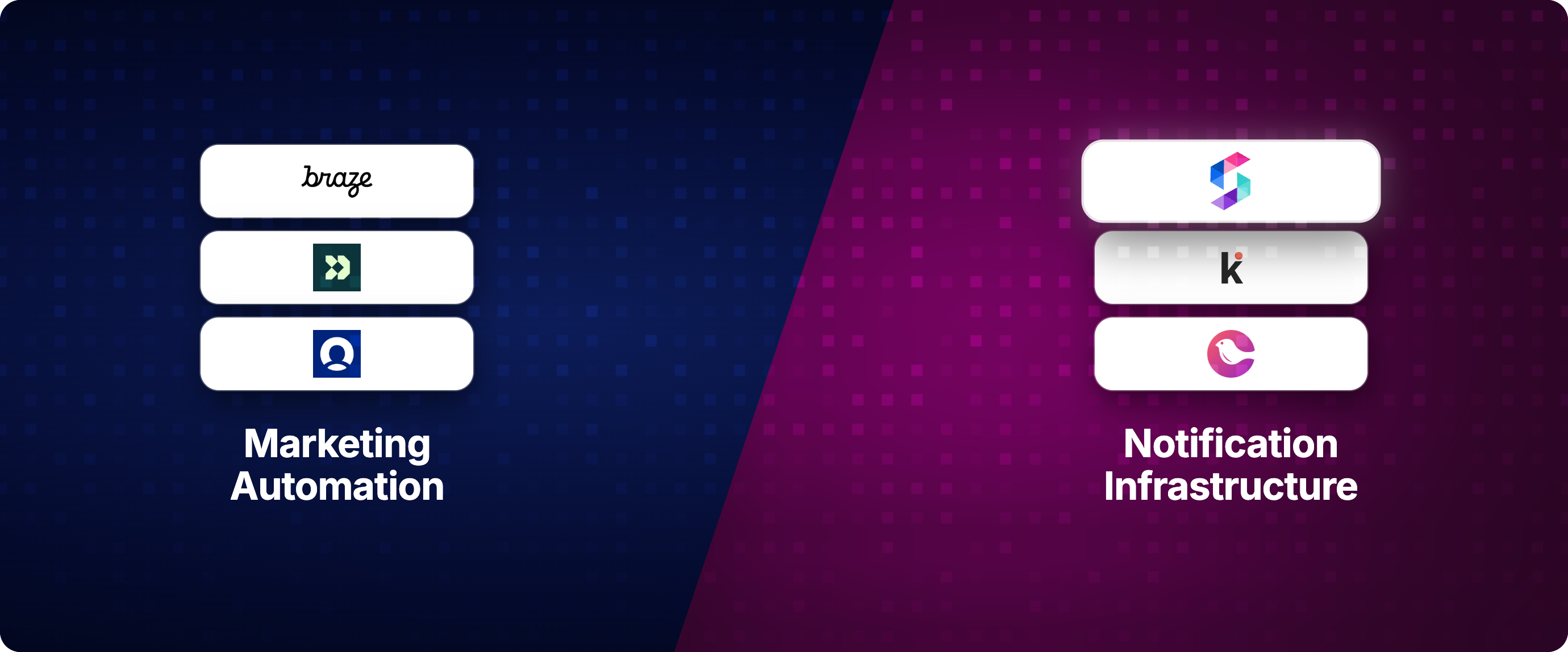
Marketing automation tools (MATs) are platforms built for marketing and growth teams to run lifecycle and promotional campaigns on top of a customer data platform (CDP). They include behavioral segmentation, journey orchestration across email, SMS, push, and in-app, plus reporting on campaign performance. Examples: Braze, Customer.io, Iterable, MoEngage, CleverTap, Salesforce Marketing Cloud.
Notification infrastructure is platforms built for engineering and product teams to send transactional, product, and collaboration notifications triggered by application events. Workflow engine, multi-channel routing, in-app inbox, preferences, vendor abstraction, and per-step logs. Examples: SuprSend, Knock, Courier, Novu, MagicBell, Engagespot.
Both ship messages. The difference is who pulls the trigger and what for.
Side-by-Side: How the Categories Differ
| Dimension | Marketing Automation | Notification Infrastructure |
|---|---|---|
| Primary buyer | VP Marketing, Growth lead | VP Engineering, CTO, Product lead |
| Daily user | Marketer, lifecycle manager | Backend engineer, product manager |
| Job to be done | Run campaigns; grow revenue and retention | Send transactional and product notifications reliably |
| Trigger source | CDP segments, marketer-defined journeys, scheduled sends | Application code, system events, webhooks |
| Examples of messages | Cart abandonment, weekly digest, win-back, promo | Password reset, order confirmation, mention, status change |
| Workflow logic | Lives with marketer in the campaign tool | Lives in code or in a workflow engine triggered by code |
| Multi-tenancy | Limited; rarely first-class | First-class on platforms built for B2B SaaS |
| Templates | Marketer-edits with rich content | Engineer-defined with WYSIWYG support, versioned |
| Pricing | Custom annual contracts; sales-led | Usage-based, often self-serve, public pricing common |
| Channels | Push, email, SMS, in-app, content cards | Push, email, SMS, in-app inbox, WhatsApp, Slack, Teams |
| Compliance focus | Marketing consent (GDPR, CAN-SPAM) | Transactional reliability, audit logs, SOC 2, HIPAA |
5 Differences That Decide Which Category You Need
1. Who Triggers the Message
Marketing automation: a marketer builds a journey on a behavioral segment ("users who viewed product X but didn't buy in 7 days"). The platform fires messages on schedule or on event matches.
Notification infrastructure: application code fires an API call when something happens ("user.password.reset.requested"). The notification platform's workflow engine runs the workflow.
If your "what should I send" question lives with a marketer, you need MAT. If it lives with engineering, you need NI.
2. What Lives Where
Marketing automation: campaign logic, segmentation, journeys, and templates all live inside the platform. Application code's job is to send user attributes and events to the platform's CDP layer.
Notification infrastructure: application code triggers events. The platform's workflow engine handles routing, batching, fallback, preferences, templates, and delivery. The "what should be sent" lives in the workflow; the "when to send" lives in your code.
The wrong fit shows up fast. Engineers using MATs end up with brittle business logic in marketing tools they can't deploy. Marketers using NI end up unable to ship campaigns because every change needs an engineering deploy.
3. Multi-Tenancy
If you sell to other businesses (B2B SaaS), each customer expects their own branding, their own SMTP, their own preference categories. MATs were built for one brand sending to one consumer base. Multi-tenancy is rarely a first-class concept.
Notification infrastructure built for B2B SaaS treats per-tenant branding, vendors, templates, and preferences as first-class objects. SuprSend, Engagespot, and to a lesser extent Knock and Courier all support this. MATs typically require workarounds.
4. Pricing Model and Contract Length
MATs sell annual contracts with custom pricing tied to MAUs, contacts, or message volume tiers. Public pricing is rare. Evaluation cycles are sales-led.
NI platforms commonly publish usage-based pricing tiers and offer self-serve free tiers. SuprSend (free 10k/mo, then $110/mo for 50k), Knock (free 10k, then $250/mo), Novu (free 10k workflow runs, then $30/mo), MagicBell (free 1k deliveries, then $249/mo) all post pricing publicly.
For startups and mid-market teams, this matters. The MAT sales cycle can take months; an NI free tier can be live the same afternoon.
5. Compliance and Reliability Posture
MATs focus on marketing consent (CAN-SPAM, GDPR opt-in, suppression lists). Reliability matters but per-message audit trails are rarely the strongest part of the product.
NI focuses on transactional reliability: retries, vendor failover, idempotency, per-step logs filterable by recipient, tenant, workflow. SOC 2 Type 2, HIPAA, GDPR, CCPA are table stakes for the category.
If your messages can't fail (OTPs, password resets, security alerts, payment receipts), the reliability posture of NI is structurally a better fit.
When to Use Which (and When to Use Both)
Use marketing automation when
- Your buyer is a marketer or growth lead
- You're running lifecycle and promotional campaigns
- You need a CDP layer with behavioral segmentation
- You want experimentation, holdout groups, and attribution
- The "what to send" decision sits outside engineering
Use notification infrastructure when
- Your buyer is an engineer or product lead
- You're sending transactional, product, or collaboration notifications
- You need multi-tenancy, multi-channel routing, and per-step logs
- Application events trigger most of your messages
- You want public, usage-based pricing and a self-serve free tier
Use both when
- You're past Series A with separate marketing and product engineering teams
- You have transactional volume that warrants NI plus lifecycle programs that warrant MAT
- You need clear separation between marketing-led and engineering-led messages
The dual-stack pattern is common above 100 employees: MAT for marketing, NI for transactional and product. Both run preference centers; the smart pattern is to designate one as the source of truth for opt-in state and have the other consume it.
The Overlap Trap: Where Teams Pick Wrong
The most common bad outcomes:
- Engineering team uses a MAT for transactional. They picked it because the company already had it. Now they have brittle business logic in a marketing tool, no per-step logs, and no multi-tenancy. Migration to NI is the eventual path; the cost is the months spent fighting the wrong tool.
- Marketing team uses NI for lifecycle. They picked it because engineering had it. Now marketers can't build campaigns without an engineering deploy, segmentation is weak, and there's no attribution. Migration to MAT is the eventual path.
- Picking one to "save costs" when both are needed. Below ~50 people this can work. Above ~100 with both marketing and product engineering teams, the unified-tool fantasy almost always cracks.
For a longer breakdown of the categories, see comparing notification infrastructure and marketing automation tools.
Where SuprSend Fits
SuprSend is squarely in the notification infrastructure category. It's built for engineering and product teams sending transactional and product notifications across push, email, SMS, in-app, WhatsApp, Slack, and MS Teams.
SuprSend is not a marketing automation tool. It doesn't include a CDP, behavioral segmentation, or attribution. Marketing-led teams running large lifecycle programs typically pair it with Braze, Customer.io, MoEngage, or Iterable rather than picking SuprSend instead of one.
For the engineering-led job (transactional reliability, multi-channel routing, multi-tenant SaaS, per-step logs, public usage pricing), SuprSend is the right category and one of the leading options inside it.
Frequently Asked Questions
What's the difference between marketing automation and notification infrastructure?
Marketing automation tools are built for marketers to run lifecycle and promotional campaigns on top of a CDP. Notification infrastructure is built for engineers to send transactional, product, and collaboration notifications triggered by application events. The categories ship messages but solve different jobs, are bought by different people, and use different trigger models.
Is SuprSend a marketing automation tool?
No. SuprSend is notification infrastructure. It doesn't include a CDP, behavioral segmentation, or marketing attribution. Teams running marketing lifecycle programs typically pair SuprSend with a marketing automation tool rather than substituting one for the other.
Can I replace my marketing automation tool with notification infrastructure?
Only if you weren't really using the marketing automation features (segmentation, journeys, attribution). For teams sending mostly transactional and product notifications, NI is a complete replacement and usually cheaper. For teams running real lifecycle programs, NI doesn't replace MAT; the two coexist.
Can I use Braze for transactional notifications?
Technically yes; practically no. Braze is built for promotional and lifecycle campaigns. Transactional reliability, per-step logs, multi-tenancy, and engineering-friendly APIs aren't its strongest dimensions. Most teams that try this end up with brittle business logic in a marketing tool and migrate to notification infrastructure for the transactional layer.
Should I use the same preference center for marketing and transactional?
Some opt-out preferences should apply to both (a user who unsubscribes globally shouldn't get marketing email). Others should be channel-specific and category-specific. The right pattern is to designate one preference center as source of truth and have the other consume it. Both MATs and NI platforms support preference centers; integration patterns vary.
Are there platforms that do both?
Some claim to. In practice, leading platforms in each category are deeply specialized, and the platforms that try to span both end up underwhelming on at least one side. The dual-stack pattern (MAT plus NI) is the production-grade approach for teams above ~100 people.
Which costs more: marketing automation or notification infrastructure?
Marketing automation, generally. MATs sell annual contracts with custom pricing in the tens of thousands. NI platforms commonly publish usage-based pricing starting under $300/month for production tiers, with free tiers covering 10,000 messages per month.
TL;DR
Marketing automation tools are built for marketers running lifecycle campaigns on top of a CDP. Notification infrastructure is built for engineers sending transactional and product notifications triggered by application events. They ship messages but solve different jobs. Use marketing automation when the buyer is a marketer; use notification infrastructure when the buyer is an engineer. Above ~100 people, most teams use both, with one preference center as source of truth. The most expensive mistake is picking the wrong category and trying to make it fit the other job.
Next Steps
If your job is engineering-led notifications and you want to evaluate notification infrastructure, the SuprSend free tier includes 10,000 notifications per month across every channel. Or book a 30-minute call to walk through where SuprSend does and doesn't fit alongside your existing stack.


