
Most engineering teams treat notifications as an afterthought. They ship the core product, then scramble to bolt on emails and push alerts six months later - usually right after a customer complains they never received a critical update. That scramble costs more than you think. Building and maintaining notification infrastructure in-house eats up an average of 4–6 weeks of engineering time per year, per team. That’s time you’ll never get back.
If you’re deciding which API to integrate first when building a new product or scaling an existing one, notification infrastructure deserves a serious look at the top of that list. Here’s why.
What Is Notification Infrastructure and Why Does It Matter?
Notification infrastructure is the backbone that powers every message your product sends - transactional emails, SMS alerts, push notifications, in-app messages, Slack messages, and more. It’s not just about sending a message. It’s about routing the right message to the right channel at the right time, with full visibility into delivery and engagement.
Without a solid foundation here, you end up with a patchwork of integrations: one vendor for email, another for SMS, a custom-built in-app notification system, and zero unified visibility across all of them. Debugging becomes a nightmare. Scaling becomes expensive. And your users feel the inconsistency.
The Hidden Cost of Building Notifications In-House
Let’s be honest about what it actually takes to build notification infrastructure from scratch.
Engineering Time Adds Up Fast
It starts simple - a welcome email, a password reset. Then product requests a weekly digest. Then sales wants in-app alerts. Then compliance needs an audit trail. Before you know it, you have three engineers maintaining a system that was never designed to scale.
- Building a basic email + SMS system from scratch: 2–4 weeks
- Adding in-app notifications with read/unread state: 1–2 more weeks
- Adding user preferences and opt-outs: another week
- Handling retries, failures, and delivery tracking: ongoing maintenance
That’s a conservative estimate. And it doesn’t account for the refactoring you’ll inevitably do when requirements change.
Technical Debt Compounds Over Time
Homegrown notification systems are notorious for becoming unmaintainable. They’re usually built by someone who’s no longer on the team, lack documentation, and break in unpredictable ways during high-traffic periods. Every new channel or feature request means touching fragile code.
User Experience Suffers
When your notification system is cobbled together, users pay the price. Duplicate messages, missing alerts, no preference controls, and inconsistent formatting erode trust. In SaaS, trust is everything.
Why Notifications Are Core to Product Experience, Not Just A Side Feature
Here’s the mindset shift that changes everything: notifications aren’t a utility, they’re a product feature. They directly impact activation, retention, and revenue.
Notifications Drive Activation
Onboarding sequences, welcome emails, feature tips - these are often the difference between a user who activates and one who churns in the first week. A well-timed push notification or in-app message at the right moment in the user journey can dramatically improve time-to-value.
Notifications Reduce Churn
Proactive alerts keep users engaged. Payment failures, usage limit warnings, inactivity nudges - these aren’t just nice-to-haves. They’re retention mechanisms. Products that nail proactive communication consistently outperform those that don’t.
Notifications Build Trust
When something goes wrong - a failed transaction, a security alert, a service outage - users expect to be notified immediately and clearly. The companies that communicate well in these moments earn loyalty. The ones that go silent lose customers.
The Case for Making Notification Infrastructure Your First API Integration
If you integrate a notification infrastructure API early, you build on a solid foundation from day one. Here’s what that unlocks.
You Ship Faster on Every Feature That Follows
Once your notification layer is in place, triggering a message from any new feature is a single API call. New payment flow? Trigger a confirmation. New collaboration feature? Trigger an invite. The marginal cost of adding notifications to each new feature drops to near zero.
You Gain Multi-Channel Flexibility Without Extra Work
A good notification infrastructure API handles the routing logic for you. You define what to send and to whom - the platform figures out the best channel based on user preferences, availability, and priority. That’s incredibly hard to build yourself, and incredibly valuable once it works.
You Get Reliability Built In
Vendor-managed notification infrastructure comes with SLAs, built-in retry logic, delivery tracking, and failover routing. If your primary email provider goes down, the system automatically falls back to a secondary. Try building that yourself in a weekend sprint.
You Can Iterate on Messaging Without Engineer Involvement
One of the most underrated benefits: when your notification infrastructure is decoupled from your codebase via an API, your product and marketing teams can update notification templates, copy, and logic without a deployment. That’s a massive operational win.
Real-World Use Cases Where Early Integration Pays Off
This isn’t theoretical. Here are scenarios where early notification infrastructure investment creates compounding returns.
B2B SaaS Onboarding
You’re building a project management tool. From week one, you need welcome emails, setup reminders, feature discovery nudges, and team invite notifications. If your notification layer is already in place, each of these is a quick configuration, not a sprint. If it’s not, your onboarding experience launches broken or delayed.
Fintech and Transactional Products
A payments or banking app has strict requirements around notification delivery - transaction confirmations, fraud alerts, balance updates. These need to be real-time, reliable, and auditable. Building that from scratch while also building the core financial product is a recipe for burnout and bugs.
Marketplace Platforms
Buyers and sellers both need timely, channel-appropriate updates. Order placed, item shipped, message received, review requested. The notification volume and complexity in a marketplace context makes in-house infrastructure impractical without significant investment.
Developer Tools and APIs
Even developer-focused products need strong notification flows - webhook delivery alerts, API quota warnings, build success or failure notifications. Early integration means these flows are consistent and maintainable as the product scales.
What to Look for in a Notification Infrastructure API
Not all notification platforms are equal. When evaluating options, focus on these criteria.
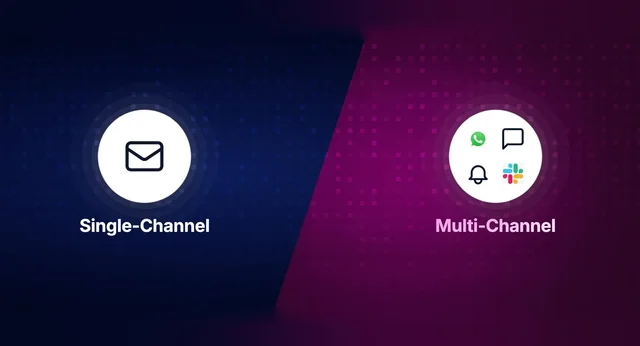
- Multi-channel support: Email, SMS, push, in-app, WhatsApp, Slack - ideally managed from a single API
- User preference management: Built-in opt-in/opt-out handling across channels and notification types
- Template management: A visual editor that lets non-engineers update content without deployments
- Delivery analytics: Real-time visibility into sent, delivered, opened, and failed notifications
- Workflow engine: The ability to define multi-step, conditional notification sequences without custom code
- Vendor abstraction: Support for multiple underlying providers (SendGrid, Twilio, FCM) with automatic failover
Platforms like SuprSend are purpose-built for this - providing a single API that orchestrates notifications across channels, manages user preferences, and gives full delivery visibility without requiring you to stitch together multiple point solutions.
Common Objections - Addressed
“We Can Just Use a Single Email Provider for Now”
You can. But when you need SMS in three months, or in-app notifications in six, you’ll be integrating again from scratch. Starting with infrastructure that’s channel-agnostic from day one avoids that rework entirely.
“It’s Too Early to Think About This”
It’s never too early. Notification infrastructure is one of the few things that gets exponentially harder to retrofit as your product grows. User preference data, delivery history, template management - these are foundational. The sooner you structure them properly, the cleaner your architecture stays.
“Our Engineers Can Build This Faster”
They can build a version of it. But can they build one with retry logic, failover routing, preference management, analytics dashboards, and multi-channel support - all while shipping your core product features? Almost certainly not. This is a solved problem. Use the solution.
How to Make the Integration Decision
Here’s a simple framework for evaluating whether notification infrastructure should be your first API integration.
- Do you need to send any kind of transactional or product notification within the first three months? (Almost every product does.)
- Will your notification needs grow beyond a single channel in the next six months?
- Do you want non-engineers to be able to update notification content?
- Do you need delivery tracking or analytics tied to user behavior?
- Is reliable, scalable delivery important to your product’s core promise?
If you answered yes to two or more of these, integrating notification infrastructure early isn’t just smart - it’s essential.
Conclusion: Build the Foundation Before You Need It
The products that scale well are the ones that make smart architectural decisions early. Notification infrastructure isn’t glamorous, but it’s foundational. It touches every user, every day, across every channel. Getting it right from the start means faster feature development, better user experiences, and one less fire to put out at scale.
Don’t wait until a customer complains about a missing alert, or until your engineers are drowning in a homegrown system held together with duct tape. Integrate notification infrastructure first -treat it like the product-critical layer it actually is - and everything else you build will be better for it.
The best time to set up your notification infrastructure was at the start of your project. The second best time is right now.