








Last Updated: May 2026
MagicBell is the in-app notification inbox most product teams default to first. It is well-designed, easy to ship, and good at the narrow thing it does. The reason teams start shopping for alternatives is rarely about quality. It is about scope (in-app inbox alone is not enough once you need email plus push plus SMS), pricing (per-delivery costs spike at growth-stage volume), or architecture (multi-tenant SaaS needs per-tenant configuration that MagicBell does not natively expose).
This guide covers 8 MagicBell alternatives ranked by how cleanly each one replaces MagicBell for the most common reasons teams switch. Pricing is verified directly from each vendor's public pricing page as of May 2026. Where a vendor does not publish prices, the entry says so honestly instead of guessing.
How We Ranked the Alternatives
The ranking prioritizes how complete a replacement each tool is for the specific use cases teams leave MagicBell to solve:
- In-app inbox depth. Native real-time inbox with SDK coverage across web and mobile frameworks. This is the MagicBell core capability.
- Multi-channel coverage. Email, SMS, push, WhatsApp, Slack alongside in-app. Most teams realize they need more than inbox.
- Multi-tenancy. Per-tenant branding, templates, vendor configuration. Critical for B2B SaaS.
- Workflow orchestration. Visual workflow builder, smart routing, batching, digest.
- Pricing predictability. Flat tiers versus per-MAU versus per-delivery models.
- Time to first notification. SDK ergonomics and onboarding effort.
The top tools split into two clear lanes: pure in-app inbox products (Knock, Engagespot, Beamer) that replace MagicBell narrowly, and notification infrastructure platforms (SuprSend, Novu, Courier, OneSignal, Customer.io) that subsume MagicBell as one piece of a broader stack.
1. SuprSend
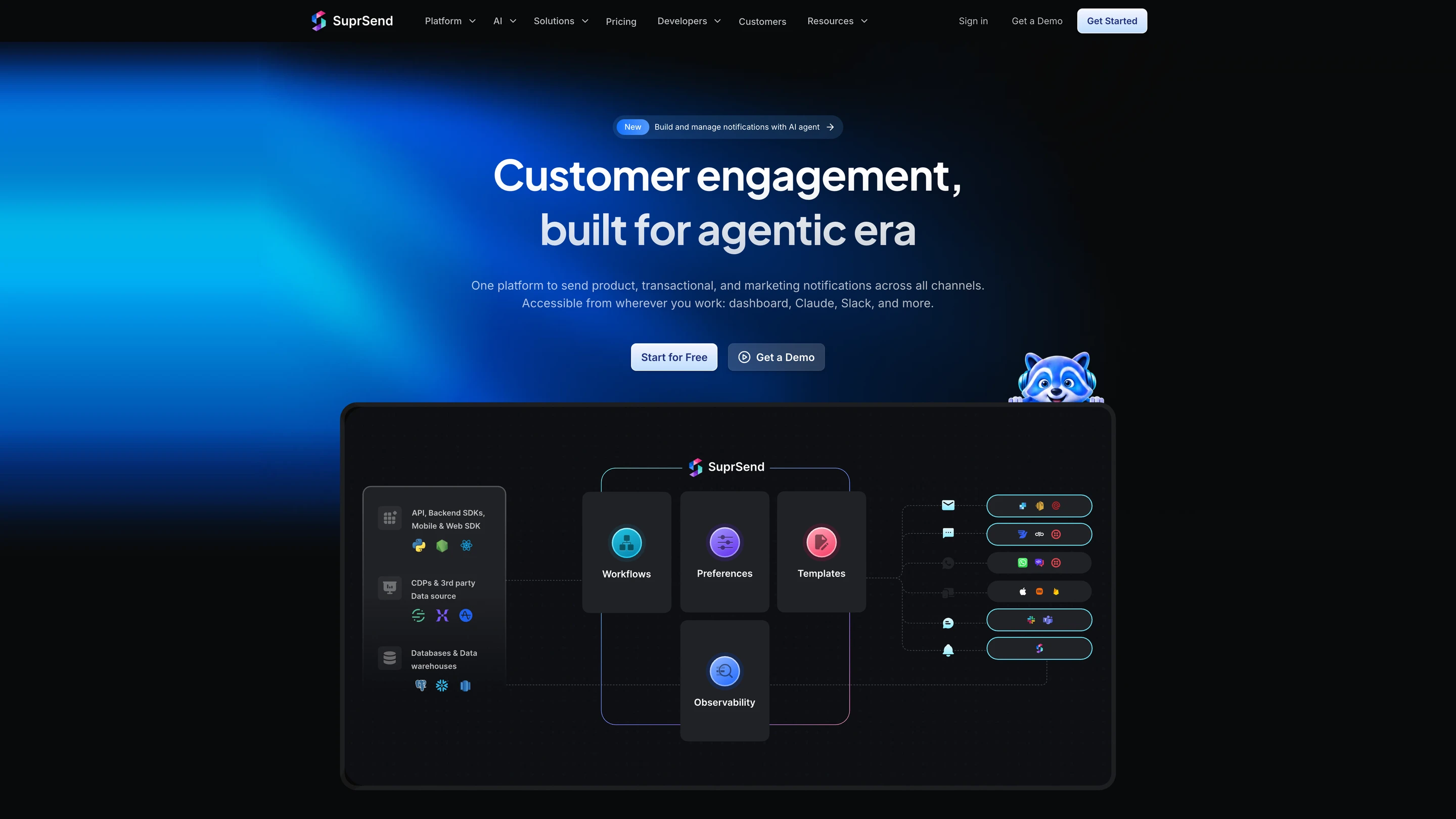
SuprSend leads this list because it solves the broader problem teams actually have when they outgrow MagicBell: in-app inbox plus full multi-channel orchestration plus first-class multi-tenancy, all from one engine. Most MagicBell users are migrating because in-app inbox alone is not enough anymore. SuprSend covers that day-one need and the next two years of scope expansion.
Key features: In-app inbox with SDKs across React, Vue, Angular, Next.js, React Native, Flutter, Android, iOS. Eight channels (email, SMS, mobile push, web push, in-app, WhatsApp, Slack, MS Teams). Per-tenant templates, branding, vendor configuration, preference center. Visual workflow builder. Smart Channel Routing with engagement-based stopping. Vendor Fallback. Broadcast feature for scheduled campaigns.
Pros: Broadest in-app inbox SDK coverage in the category, first-class multi-tenancy (per-tenant overrides on templates, vendors, preferences that MagicBell does not natively expose), 8-channel orchestration from one platform, native web push, transparent pay-as-you-go pricing that starts cheaper than MagicBell's paid tier, SOC 2 Type 2 + HIPAA + GDPR compliant.
Cons: Newer brand than MagicBell in some buyer circles, the workflow editor has more concepts to learn than MagicBell's narrower drop-in inbox, deeper feature set means onboarding is longer than the "ship an inbox in 30 minutes" experience MagicBell offers.
Pricing (verified May 2026): Free 10K notifications, Essentials $110/month (50K notifications), Business $275/month, Enterprise custom. Pay-as-you-go on usage above tier.
Best for: Multi-tenant B2B SaaS teams that need in-app inbox plus full multi-channel orchestration from one platform.
2. Knock
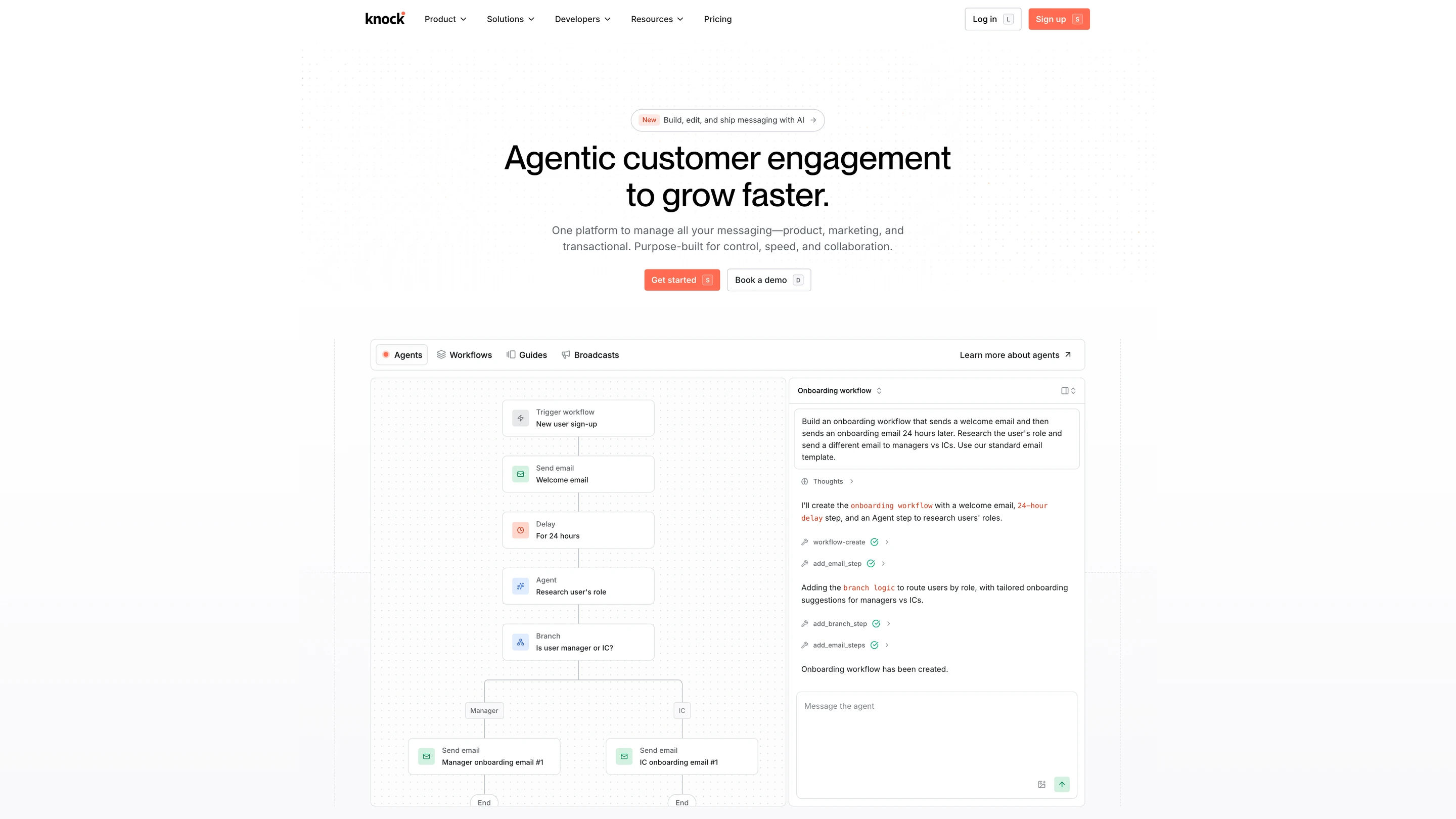
Knock is the closest direct competitor to MagicBell in product positioning: in-app inbox with cross-channel workflows, strong developer brand, well-known customer logos. Knock places second because it replaces MagicBell most directly for teams that wanted exactly what MagicBell offered but with better workflow orchestration.
Key features: Real-time in-app inbox, cross-channel workflows, multi-tenancy (called "tenants"), preference center, SDKs (React, Vue, iOS, Android), batching and delay primitives.
Pros: Mature workflow builder, clean SDK ergonomics, flat-fee pricing that does not spike with MAU growth, mature enterprise features (SCIM, SAML, HIPAA on Enterprise).
Cons: Pricing jumps from free to $250/month with little in between, no native web push, in-app inbox SDKs less broad than SuprSend (no Flutter or Angular natively), higher entry price than most alternatives.
Pricing (verified May 2026): Developer $0 (10K messages); Starter $250/month (50K messages, $0.005 per additional); Enterprise custom.
Best for: Teams that want a direct MagicBell replacement with stronger workflow logic and predictable pricing.
3. Novu
Novu is the open-source option in this category, with both self-hosted Community Edition and a managed Novu Cloud. Useful when data sovereignty or budget makes a SaaS-only option untenable.
Key features: In-app inbox component, multi-channel workflows, integrations with 14+ email providers and 16+ SMS providers, FCM/APNs push, chat (Slack/Discord/MS Teams), Open Core licensing (MIT plus commercial EE).
Pros: Self-host option for full data control, MIT-licensed core, active community (~39K GitHub stars), no per-MAU pricing on self-host.
Cons: Self-hosting requires DevOps investment (Kubernetes, Postgres, Redis), Novu Cloud is cheaper at low volume but scales similarly to managed competitors, in-app inbox SDKs less polished than dedicated inbox products.
Pricing (verified May 2026): Free $0 (10K workflow runs); Pro from $30/month (30K runs, $1.20 per 1K additional); Team from $250/month (250K runs); Enterprise custom. Self-hosted: free software, you pay infrastructure.
Best for: Teams with strict data sovereignty requirements or strong DevOps capacity that want to self-host.
4. Engagespot
Engagespot is a cheaper alternative in the same product category as MagicBell and Knock. In-app inbox plus basic multi-channel, priced aggressively for teams under $250/month budget.
Key features: In-app inbox with React/Angular/Vue SDKs, multi-channel (email, SMS, push, chat), workflows, multi-tenancy, multi-lingual templates on paid tier.
Pros: Lowest sticker price among feature-comparable alternatives, multi-tenancy on all plans, EU/US region options on free tier.
Cons: Smaller team and brand recognition than Knock or MagicBell, fewer integrations and SDK platforms, less mature enterprise features.
Pricing (verified May 2026): Launch free $0 (10K event triggers/month); Growth $250/month (250K triggers, $1.50 per 1K additional); Enterprise from $2,500/month.
Best for: Cost-sensitive teams that want a MagicBell-class product at lower entry price.
5. Courier
Courier is a multi-channel notification orchestration platform with in-app inbox as one piece. Strong brand in the developer-tool category, well-funded, mature workflow builder.
Key features: Multi-channel notifications (email, SMS, push, in-app, Slack, MS Teams), visual workflow builder ("Automations"), template editor, integrations with most major channel vendors.
Pros: Mature platform with strong brand recognition, well-developed visual workflow builder, broad channel coverage.
Cons: Pricing is higher than most alternatives at scale, in-app inbox is one feature among many rather than the product focus, complex setup compared to MagicBell's drop-in simplicity.
Pricing (verified May 2026): Pricing page requires sales contact for current rates; historically a free tier exists plus usage-based paid tiers starting in the low hundreds per month.
Best for: Teams that want a mature multi-channel orchestration platform with strong brand backing and broad channel coverage.
6. OneSignal
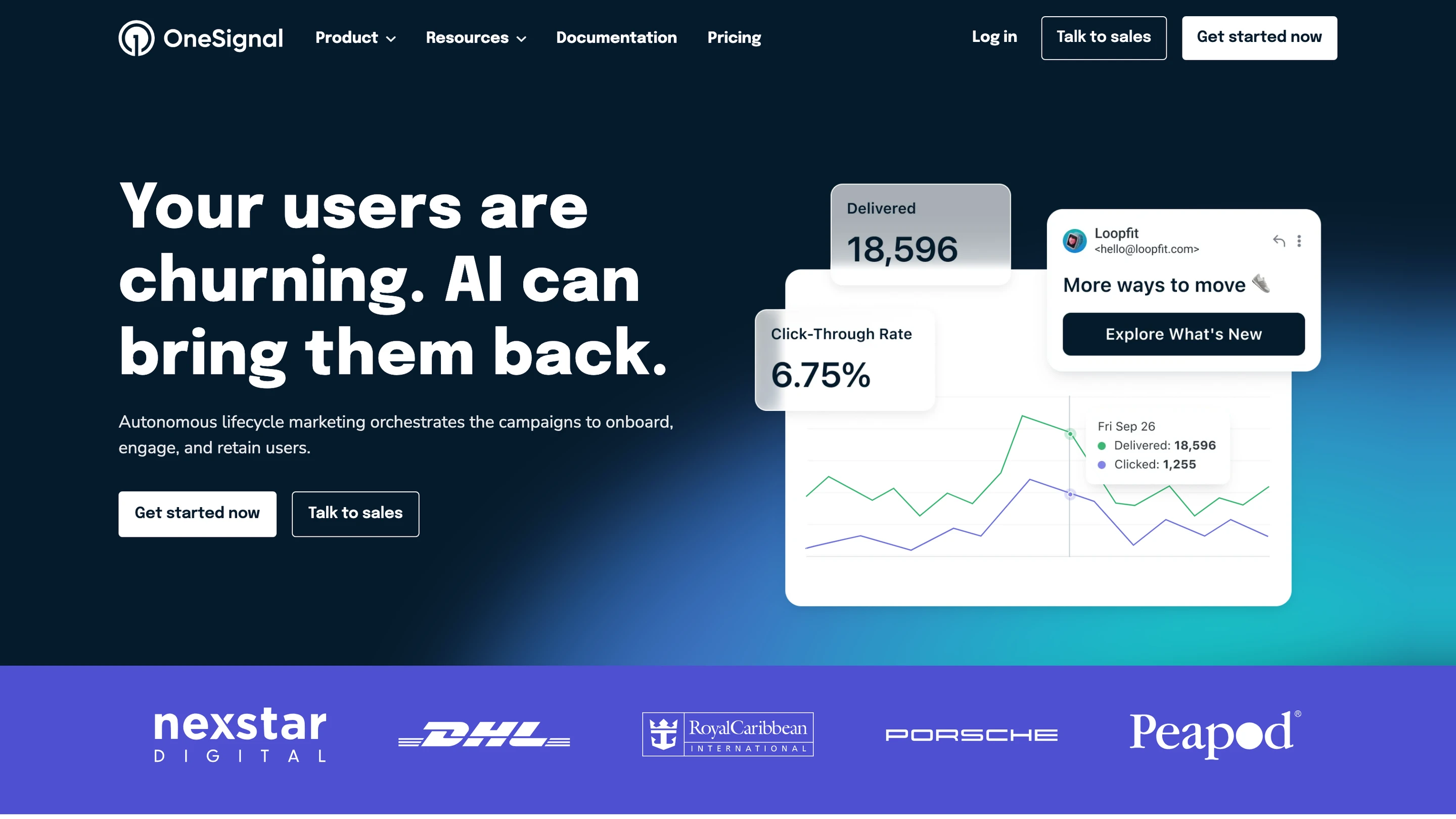
OneSignal is push-first but has grown into a broader notification platform including in-app messaging, email, SMS, and journeys. Strong for mobile-heavy products.
Key features: Mobile push (FCM/APNs), web push, in-app messaging, email, SMS, journeys with branching, A/B testing, intelligent delivery timing.
Pros: Generous free tier (unlimited mobile push, 10K free email), strong push focus and infrastructure, large existing customer base.
Cons: In-app inbox is less central to the product than at MagicBell or Knock, marketing-heavy positioning (less developer-first), pricing scales by MAU which can be unpredictable.
Pricing (verified May 2026): Free $0 (10K email/month, unlimited mobile push); Growth from $19/month plus usage costs (mobile push $0.012/MAU, email $1.50/1K above 20K); Professional and Enterprise custom annual contracts only.
Best for: Mobile-first product teams where push is the dominant channel and in-app inbox is supplementary.
7. Customer.io
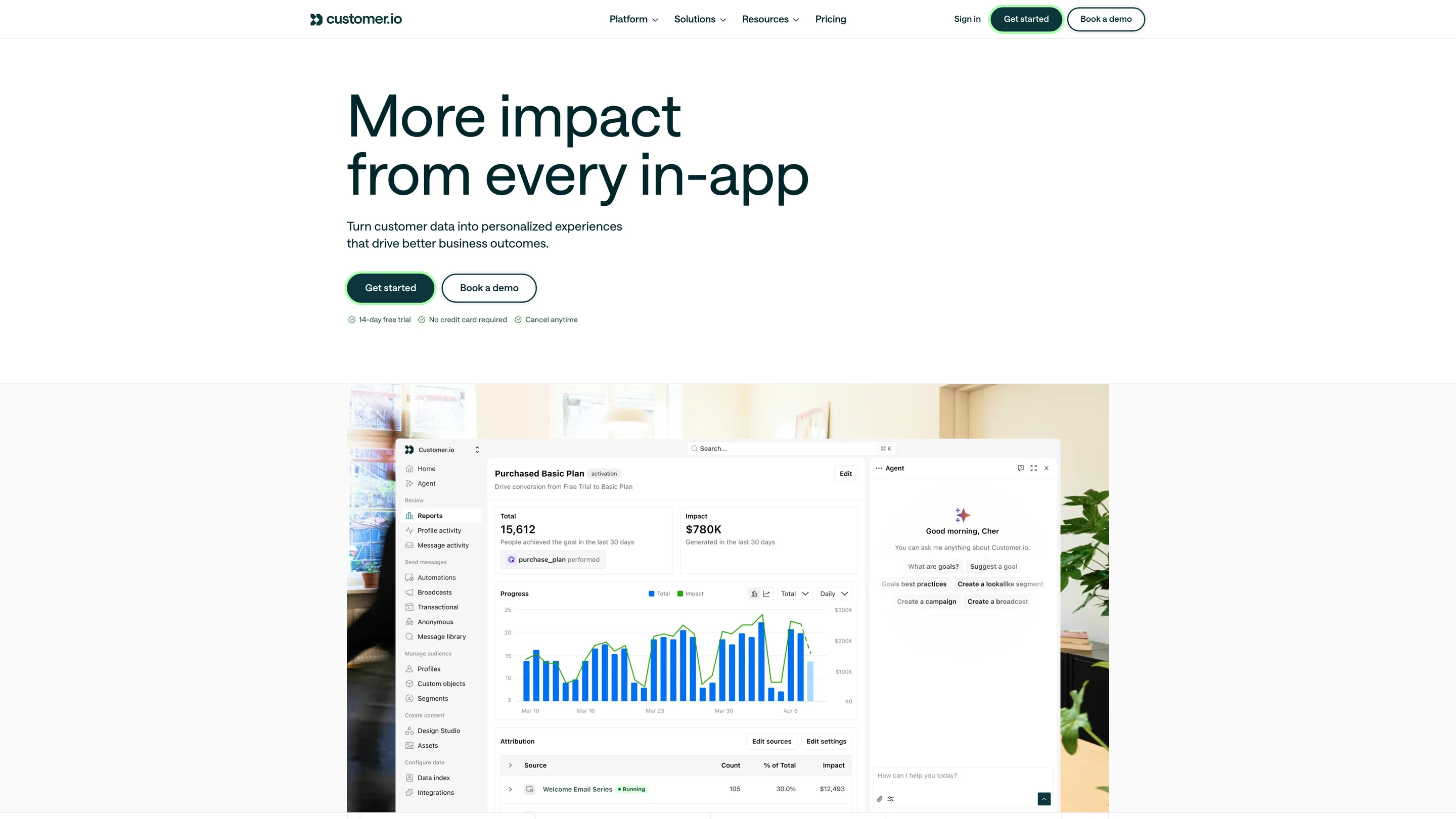
Customer.io is primarily a marketing automation tool with in-app messages as one channel among many. The in-app capability is real but the product orientation is lifecycle marketing, not notification infrastructure.
Key features: Lifecycle journey builder, segmentation, email, SMS, push, in-app messages, webhooks, attribute and event tracking.
Pros: Mature marketing automation features, strong journey builder, deep behavioral segmentation.
Cons: In-app messages are not the same shape as MagicBell's notification inbox (more campaign-style than feed-style), marketing positioning rather than developer/infrastructure, no native multi-tenancy for B2B SaaS.
Pricing (verified May 2026): Essentials from $100/month for marketers; Premium custom. Plans scale by attributable user and message volume.
Best for: Marketing-led teams that want in-app messaging as part of broader lifecycle marketing rather than as a notification inbox.
8. Beamer
Beamer is a light alternative focused on product announcements and changelogs rather than transactional notifications. Worth listing because some teams use MagicBell for what Beamer does better.
Key features: In-product announcement feed, changelog widget, NPS surveys, basic segmentation.
Pros: Purpose-built for changelog and announcements, lightest setup, content team can manage without engineering.
Cons: Not a notification infrastructure (no API-triggered transactional notifications), no multi-channel, narrower use case.
Pricing (verified May 2026): Free tier and paid plans starting in the low double digits per month; check the current pricing page for exact tiers.
Best for: Teams whose "in-app inbox" need is actually a changelog and announcements feed, not transactional notifications.
All 8 MagicBell Alternatives Compared
Pricing verified from each vendor's public pricing page as of May 2026. Vendors marked "Contact sales" do not publish current prices publicly.
How to Choose
- In-app inbox plus full multi-channel from one platform, multi-tenant B2B SaaS: SuprSend
- Pure in-app inbox replacement with stronger workflow logic: Knock
- Self-hosting or open-source requirement: Novu
- Lowest sticker price for comparable feature set: Engagespot
- Mature multi-channel orchestration platform: Courier
- Mobile-first with push as primary channel: OneSignal
- In-app messaging as part of lifecycle marketing stack: Customer.io
- Changelog and product announcement feed, not transactional notifications: Beamer
Frequently Asked Questions
Why do teams switch from MagicBell?
The three most common reasons are scope (in-app inbox alone is not enough once multi-channel is needed), pricing (per-delivery costs spike at growth-stage volume), and multi-tenancy (B2B SaaS needs per-tenant configuration that MagicBell does not natively expose).
What is the closest direct alternative to MagicBell?
SuprSend is the broadest replacement: same in-app inbox use case plus full multi-channel orchestration and first-class multi-tenancy from one engine. Knock is the closest direct product-shape replacement (same in-app inbox positioning). Engagespot is the closest budget alternative.
How does MagicBell pricing compare with alternatives?
MagicBell charges $249/month for 50,000 deliveries on its Startup plan, with deliveries counted per channel reached. Knock charges $250/month for 50,000 messages with predictable overage. SuprSend starts at $99/month. Engagespot's $250/month tier includes 250,000 event triggers. Pricing model differences matter as much as the sticker price: per-delivery, per-MAU, and per-trigger pricing scale differently with growth.
Can I self-host an alternative to MagicBell?
Yes, Novu's Community Edition is the open-source self-hosted option in this category. SuprSend offers an enterprise self-hosted deployment for organizations with strict data residency requirements, available under the Enterprise plan.
Which alternative has the best multi-tenancy support?
SuprSend has the most developed multi-tenancy with per-tenant overrides on templates, branding, vendor configuration, and preference center. Knock and Engagespot have multi-tenancy as a first-class feature with slightly less granular controls.
Do MagicBell alternatives support web push and mobile push?
Most do. SuprSend, Knock, Novu, Engagespot, OneSignal, Customer.io, and Courier all support both web and mobile push. OneSignal is the most push-focused. Beamer does not support push at all.
The Bottom Line
MagicBell is good at the narrow thing it does, and the teams that outgrow it are looking for either broader scope (multi-channel beyond in-app inbox), better pricing predictability, or stronger multi-tenancy for B2B SaaS. SuprSend covers all three from one platform. Knock is the closest direct product-shape replacement if you want a narrow in-app inbox tool. Novu is the open-source option. The rest of the list fits specific edges (cost-sensitive, mobile-first, marketing-led, changelog-focused). Match the alternative to the reason you are switching, not to brand recognition.
If you want to see how SuprSend handles in-app inbox plus 7 other channels from one platform, start building for free, or book a demo to walk through your stack.