
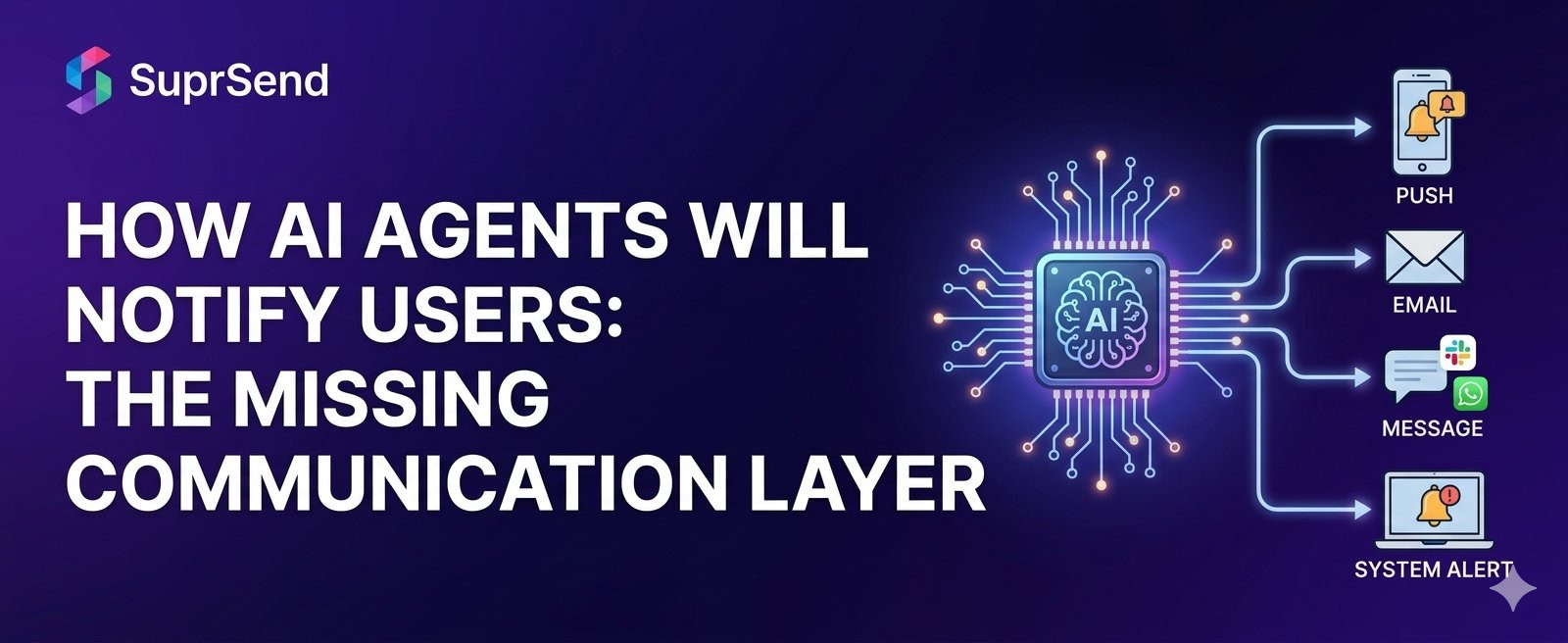
AI agents can now book meetings, analyze data, write code, process invoices, and manage entire workflows autonomously. They can reason, plan multi-step tasks, and even coordinate with other agents to get complex work done.
But here's the problem nobody is talking about: most AI agents have no reliable way to communicate with users.
They can think. They can act. But they can't notify.
An AI agent can detect a fraud attempt in milliseconds — but how does it tell the user? An agent can finish a three-hour research task while you sleep — but how does it report back? An agent monitoring your cloud infrastructure can catch a critical error at 3 AM — but how does it reach the right person, on the right channel, with the right urgency?
The answer, for most agent implementations in 2026, is: it doesn't. Or it uses whatever fragile, one-off messaging hack the developer could wire up in an afternoon.
This is the missing communication layer. And it's becoming the bottleneck that separates agents that demo well from agents that work in production.
The Agent Explosion Is Real — But Communication Isn't Keeping Up
The numbers tell a clear story. Gartner projects that 40% of enterprise applications will embed task-specific AI agents by the end of 2026. The AI agent market is projected to grow from $7.84 billion in 2025 to over $52 billion by 2030. Organizations that were running 5 agents as a proof of concept in 2024 are now operating fleets of 50 to 200+ agents across departments.
The infrastructure to build agents has matured rapidly. Frameworks like LangChain, CrewAI, and AutoGen handle orchestration. Protocols like MCP (Model Context Protocol) and A2A (Agent-to-Agent) standardize how agents connect to tools and to each other. Platforms like n8n, Zapier, and Workato make agent-powered automation accessible even to non-technical teams.
But here's what got left behind: the notification layer.
Every agent framework solves for reasoning, tool use, memory, and planning. Almost none of them solve for how an agent communicates the outcome of its work back to a human — reliably, across channels, with context-aware routing.
The result is a predictable mess:
- Agents dump results into Slack channels that nobody reads.
- Critical alerts get buried in email threads alongside marketing newsletters.
- Time-sensitive outputs from overnight agent runs sit unnoticed until someone happens to check a dashboard.
- Different agents use different messaging mechanisms — one sends email, another posts to Slack, a third writes to a database — with no unified system managing delivery.
The agent infrastructure stack has six layers: models, memory, tools, orchestration, observability, and governance. Communication — the act of reliably reaching a human with the right message at the right time — cuts across all of them but belongs to none.
It's an orphan layer. And it's costing organizations real value.
Why Agents Need a Notification Infrastructure (Not Just a Messaging API)
The instinct for most engineering teams is to solve agent communication with a simple API call. Agent finishes a task → send an email. Alert detected → post to Slack. Job done.
This works for a prototype. It fails catastrophically in production. Here's why.
The Channel Problem
Users don't live on a single channel. Some people read Slack religiously. Others live in email. Some teams use WhatsApp for urgent communications. In-app notifications matter when users are actively inside the product. Push notifications reach users on mobile.
An agent that can only communicate through one channel is an agent that will be ignored by a significant portion of its users. And an agent that sends every message through every channel simultaneously is an agent that trains users to tune it out entirely.
What agents need is intelligent channel routing — the ability to determine the right channel for the right message based on urgency, user preference, and delivery context. If a critical security alert goes unread on Slack after 5 minutes, escalate to SMS. If a routine report is generated overnight, queue it for email delivery at 9 AM. If a user has explicitly said "don't send me push notifications," respect that preference.
This isn't a feature you build into each individual agent. It's an infrastructure layer that sits between agents and users.
The Orchestration Problem
In a single-agent system, communication is straightforward. But organizations are rapidly moving to multi-agent architectures. A content agent drafts a blog post, a review agent checks it for quality, an SEO agent optimizes it, and a publishing agent pushes it live. Each agent in this chain may need to notify different people at different stages — the content team when a draft is ready, the editor when review is needed, the marketing lead when the post goes live.
Without orchestrated communication, each agent independently fires off notifications. The result: notification fatigue. Users get five messages about one workflow instead of one well-timed, contextualized update.
Notification orchestration — with support for batching, digests, delays, conditional logic, and workflow-aware sequencing — is what turns agent noise into agent signal.
The Preference Problem
As agents proliferate, so does the volume of agent-generated communication. Users need control over what reaches them and how. Notification preferences — the ability for end users to configure which categories of agent communication they receive, on which channels, at what frequency — become essential infrastructure.
Without it, the agent era risks becoming the notification spam era. And user trust erodes fast when AI-generated messages feel intrusive, irrelevant, or uncontrollable.
The Reliability Problem
When a human sends a Slack message and it fails, the human retries. When an AI agent's notification fails silently at 2 AM, nobody knows until the damage is done.
Agent communication requires delivery guarantees: automatic retries, provider failover (if SendGrid is down, route through SES), delivery confirmation, and real-time observability into what was sent, what was delivered, and what failed. This is not application logic. This is infrastructure.
What the Communication Layer Actually Looks Like
The notification infrastructure that AI agents need isn't a new concept. It's the same infrastructure that product teams have been building for transactional notifications — order confirmations, OTP delivery, payment alerts, user onboarding sequences — for years.
The difference is the trigger source. Instead of a user action (someone places an order) or a system event (a payment is processed), the trigger is an agent completing a task, detecting an anomaly, or reaching a decision point that requires human input.
The infrastructure requirements are identical:
Event ingestion — Accept notification triggers from any source via API. An agent finishes a task → fires an event → the notification system takes over.
Workflow orchestration — Define multi-step communication flows with conditional logic. If urgent → send immediately via push + SMS. If routine → batch into a daily digest. If the user hasn't engaged in 5 minutes → escalate to the next channel.
Multi-channel delivery — Email, SMS, push, in-app inbox, WhatsApp, Slack, MS Teams, webhooks. All channels through one API, not separate integrations per channel.
Template management — Agents generate raw data. The notification layer transforms that data into well-formatted, branded, human-readable messages — without requiring the agent to know anything about HTML email templates or push notification formatting.
User preferences — A centralized preference center where users control their notification experience. Per-category opt-in/out. Channel preferences. Frequency controls. Quiet hours.
Delivery reliability — Retries, fallbacks, provider failover, delivery tracking, and end-to-end observability. Every notification traceable from trigger to delivery.
Multi-tenancy — For B2B platforms where agents serve multiple customers, the notification layer must support per-tenant branding, templates, and preferences.
Platforms like SuprSend already provide this entire stack as a managed infrastructure layer. A single API call from an agent triggers the notification system, which handles channel selection, template rendering, user preference checks, delivery, retries, and logging — automatically. The agent doesn't need to know about email deliverability or SMS provider failover. It just fires an event, and the infrastructure handles the rest.
This separation of concerns — agent logic stays in the agent, communication logic stays in the notification infrastructure — is what makes agent communication scalable, reliable, and maintainable.
The Architecture: Agent → Event → Notification Infrastructure → User
Here's how the stack works in practice:
- Step 1: AI Agent completes task, detects event, or needs human input
- Step 2: Fires a notification event via API (e.g., "fraud_detected", "report_ready", "approval_needed")
- Step 3: Notification infrastructure receives the event
- Step 4: Checks user preferences (channel, frequency, opt-in status)
- Step 5: Selects the right channel(s) based on urgency + user config
- Step 6: Renders the message using a pre-defined template + dynamic data
- Step 7: Delivers via the selected provider (SendGrid, Twilio, FCM, etc.)
- Step 8: Tracks delivery → If failed, retries or escalates to fallback channel
- Step 9: User receives a well-formatted, timely, relevant notification
The agent stays focused on its job — reasoning, planning, executing. The notification infrastructure stays focused on its job — reaching the right human, on the right channel, at the right time, with the right message.
Neither system needs to understand the other's internals. The API contract between them is simple: an event name, a recipient, and a data payload.
Real-World Agent Notification Use Cases
DevOps agents that monitor infrastructure, detect anomalies, and auto-remediate issues need to notify the on-call engineer when human intervention is required — via PagerDuty, SMS, or Slack, depending on severity and time of day.
Customer support agents that resolve tickets autonomously need to notify the customer when their issue is fixed — via the channel the customer originally used (email, WhatsApp, in-app chat).
Sales agents that qualify leads and enrich prospect data need to alert the sales rep when a high-intent lead is identified — instantly, via Slack or push, not via a daily email report that arrives six hours too late.
Content agents that research, draft, and optimize blog posts need to notify the content manager when a draft is ready for review — with a link to the draft and a summary of what was written.
Finance agents that process invoices, detect anomalies, and flag compliance issues need to alert the finance team with the right context — invoice number, anomaly type, suggested action — in a branded, well-structured notification.
HR agents that screen resumes and schedule interviews need to notify candidates with personalized, professional communication — not a robotic "Your application has been processed by an AI system."
In every case, the agent's value is diminished — sometimes destroyed — if the communication fails or feels broken.
Why This Matters Now
The agentic era is not coming. It's here. Enterprises are deploying agent fleets at scale. Multi-agent systems are coordinating complex workflows across departments. AI is moving from "assistant that answers questions" to "coworker that completes tasks."
But a coworker that does great work and never tells you about it is a coworker you stop trusting. A coworker that floods your inbox with irrelevant updates is a coworker you start ignoring. The communication layer is what determines whether agents feel like trusted team members or unreliable black boxes.
The infrastructure exists. Multi-channel notification orchestration platforms — with workflow engines, preference management, intelligent routing, and delivery observability — have been solving this exact problem for transactional product notifications for years. The agent era doesn't need a new notification paradigm. It needs the existing one, properly connected.
The companies that wire up this communication layer early — treating agent-to-human notification as a first-class infrastructure concern, not an afterthought — will be the ones whose agents actually deliver value in production.
The ones that don't will have very smart agents that nobody listens to.


