

How CrazyGames Boosted Player Engagement and Developer Retention with SuprSend


Challenge
CrazyGames’ in-house notification system was rigid and engineering-heavy. Every template or workflow change took weeks, personalization hit limits, and a marketing tool they tried couldn’t handle real-time data, advanced segmentation, or true omnichannel journeys.
Solution
CrazyGames integrated SuprSend's multi-channel notification system along with Lists via database connector, enabling real-time cohorts built directly on their full customer 360° data. This allowed the product team to create, personalize, and iterate on campaigns quickly without engineering or data-sync overhead.
Outcome
CrazyGames can now launch new notifications and experiments within hours, not weeks. Product teams operate independently without waiting on engineering, and overall player reactivation and engagement improved.


For a platform like CrazyGames with 45M+ monthly active users and 3,000 games live, keeping players engaged and developers informed is the real game.
That’s where notifications come in. The right nudge at the right moment can mean the difference between a player drifting away or sticking around.
SuprSend spoke with Jonas Boonen, VP of Product at CrazyGames, to understand how they are leveraging SuprSend to power their notifications.
Engaging both players and developers with the right notifications
CrazyGames runs a two-sided ecosystem: players looking for fun games to play, and developers looking for reach.
Players
- Teens (13–20) are the biggest segment, mostly on mobile
- Casual vs. hardcore players with very different play patterns
- Logged-in vs. anonymous players
Game Developers
- From solo hobbyists to global studios
- Need timely updates on revenue, platform changes, and marketing opportunities
Keeping both sides engaged requires a steady stream of relevant, well-timed notifications.
Here’s a quick snapshot of how CrazyGames uses notifications today:
Breaking free from code-heavy systems
Before SuprSend,CrazyGames relied on an in-house built notification system. Every notification change required developer time.
"If you wanted it [template] slightly different, it took two weeks to get it live,” Jonas explained. “Templates stayed ugly for years, and new experiments rarely made the priority list."
Jonas Boonen, VP of Product at CrazyGames
Looking for more flexibility, the team tested a popular marketing automation tool. But it quickly ran into limitations:
- Database integration limits: All user activity, play history, and game recommendations had to be synced into the tool as user properties. Every new use case meant engineers sending new events, which made the setup too slow.
- Attribute restrictions: Game recommendations could only be passed as user properties — but there was a hard cap on the number of attributes they could sync. That meant personalization hit a ceiling.
- Omnichannel gaps: Email and push notifications were bolted together, not unified. Non-unified APIs created multiple profiles for the same user, leading to fragmented multi-channel experiences.
Why SuprSend?
Direct database sync = flexibility + speed
With SuprSend, CrazyGames connected their database directly to the platform to create dynamic lists. This surpassed limitations like exporting limited datasets or consistently syncing event pipelines. With SuprSend’s database connector, the teams could write SQL that queried their database in real time and generate user lists. No data duplication, no waiting on engineers to sync new properties, no silent pipeline failures.
Their database remains the single source of truth—and whatever is needed on demand is fetched. This unlocked hyper-personalized templates, and experimentation without engineering bottlenecks.
“We could plug our database directly into SuprSend. That meant we could make changes, add dynamic content, and set up new flows ourselves without waiting on engineering. In the past, even a small tweak took two weeks of dev time and a lot of back-and-forth. Now we can move fast and experiment freely.”
Jonas Boonen, VP of Product at CrazyGames
Built for omnichannel from day one
Unlike competitors, SuprSend wasn’t all channels patched together as an after thought. It was omni-channel by design.
“Truly omnichannel templates meant one unified workflow across email, on-site, or push. Anywhere in the workflow, you can test across channels. It’s all well thought through and works seamlessly.”
Jonas Boonen, VP of Product at CrazyGames
Personalization in action: Re-activation flows
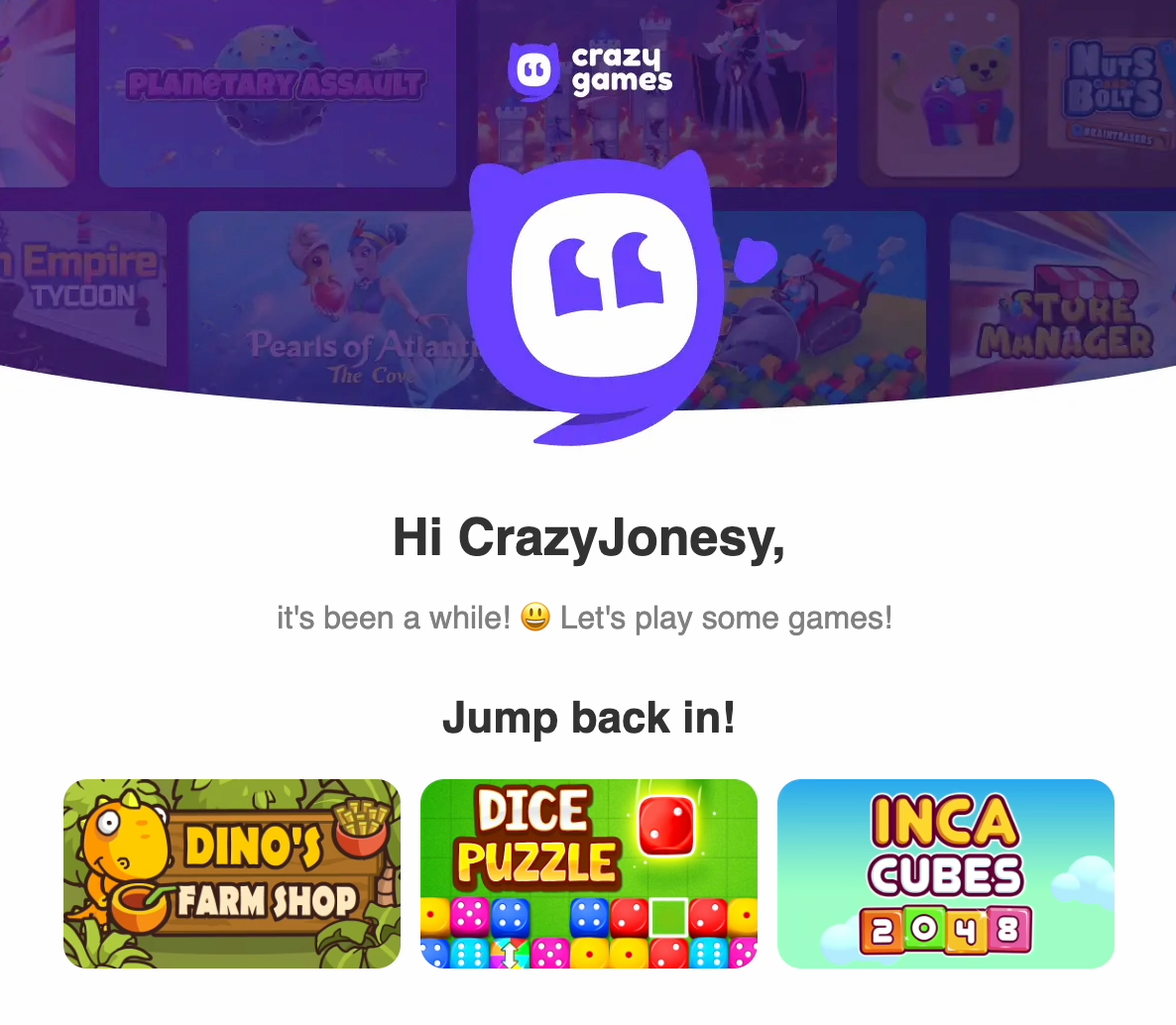
CrazyGames runs personalized re-activation campaigns that bring players back with game recommendations tailored to their history and preferences. The product team can directly tap into the freshest data and generate dynamic player lists on demand.
If the product team wants to add a new property or run queries on a different field tomorrow, they don’t need to sync anything into SuprSend. The data continues to live in their own warehouse; SuprSend only fetches the final query output at send time. That’s the superpower — complex logic and new fields can be added instantly, without moving data.
“Now, we can handle pretty advanced use cases with ease. For example, in our reactivation flows, we’ve been able to test different templates for churned users: some get personalized game recommendations, some get a survey, and some even get a direct question from the CEO. Setting this up and running experiments is straightforward, and we can evaluate how each variation performs without involving engineers. It just takes a bit of creativity from the product team — but it’s completely doable, and that’s a huge plus.”
Jonas Boonen, VP of Product at CrazyGames
Here’s how the flow works:
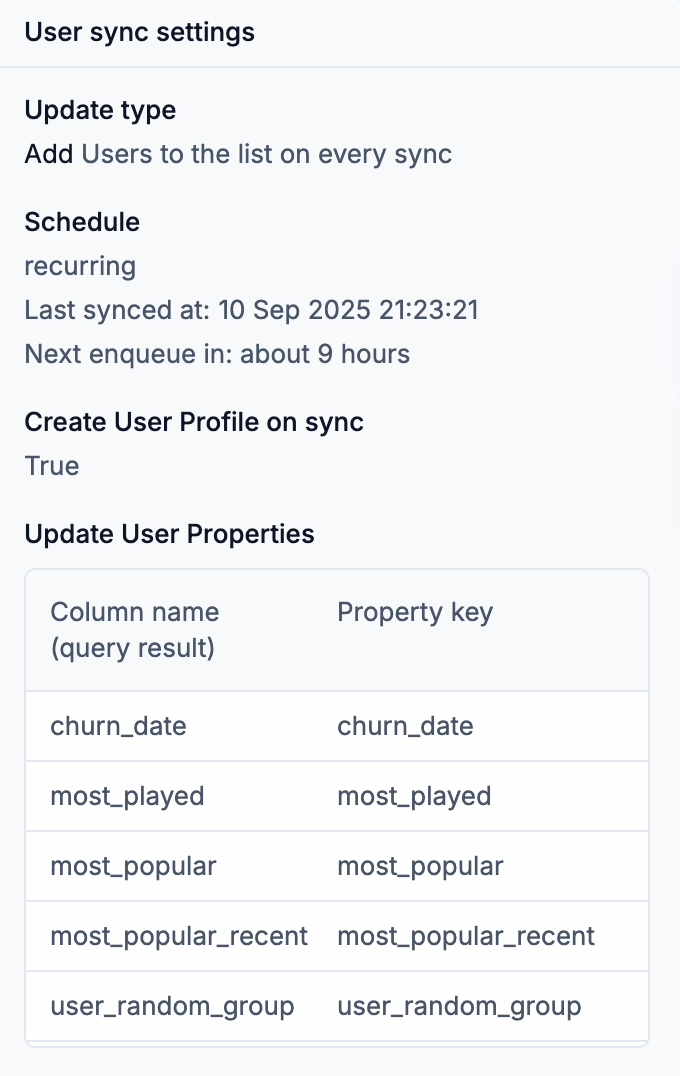
Data Sync
The data team maintains a simple database containing:
- User IDs
- Recommended games
- Extra profile details (like playtime history).
Smart Segmentation Rules
The product team defined selectors to identify eligible users:
- Played at least 60 minutes in the last 90 days.
- Haven’t visited the site for the past 15 days.
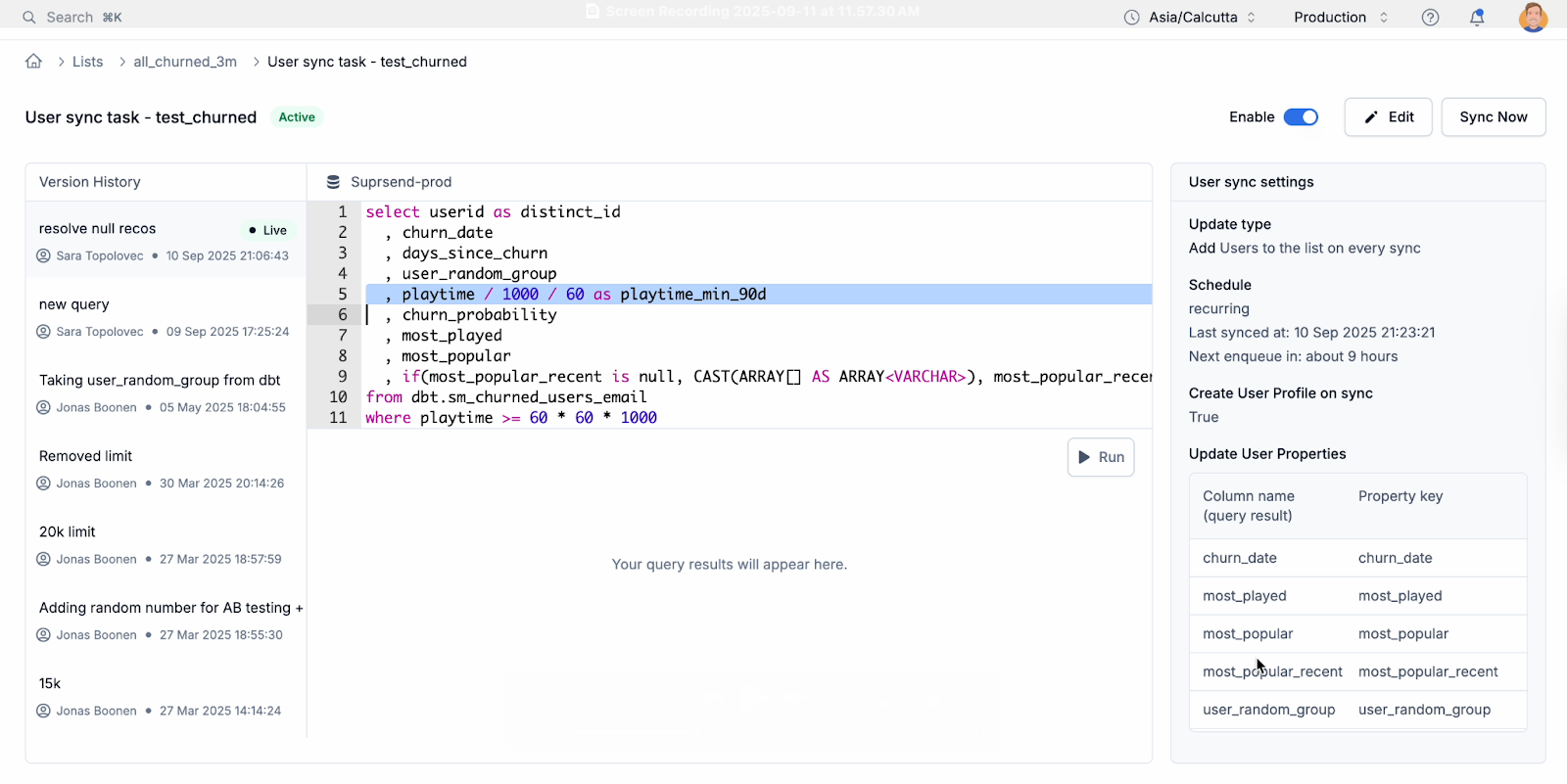
These rules are easy to tweak anytime without engineering support.
Personalized Recommendations
Once users qualify, they are added to a “reactivation list.”
Each profile is enriched with three recommendation lanes:
- Most Played Games
- Most Popular Games
- Recently Popular Games
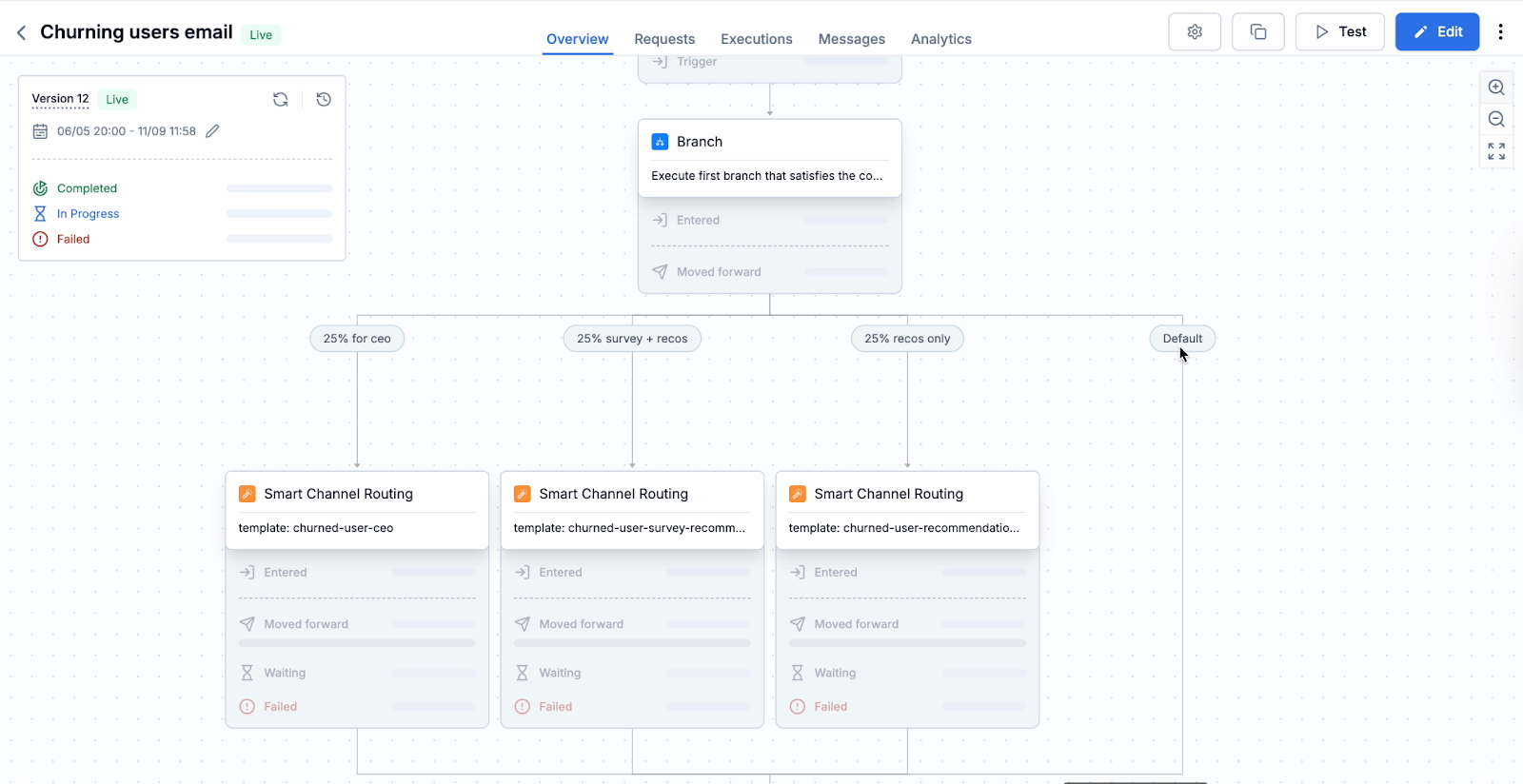
A/B Testing via Random Groups
To test different strategies, users are randomly split into four groups:
- No message sent (to set base case)
- CEO Mail – a personal note asking why they left
- Survey + Recommendations – request for feedback plus game suggestions
- Recommendations Only – three recommended games
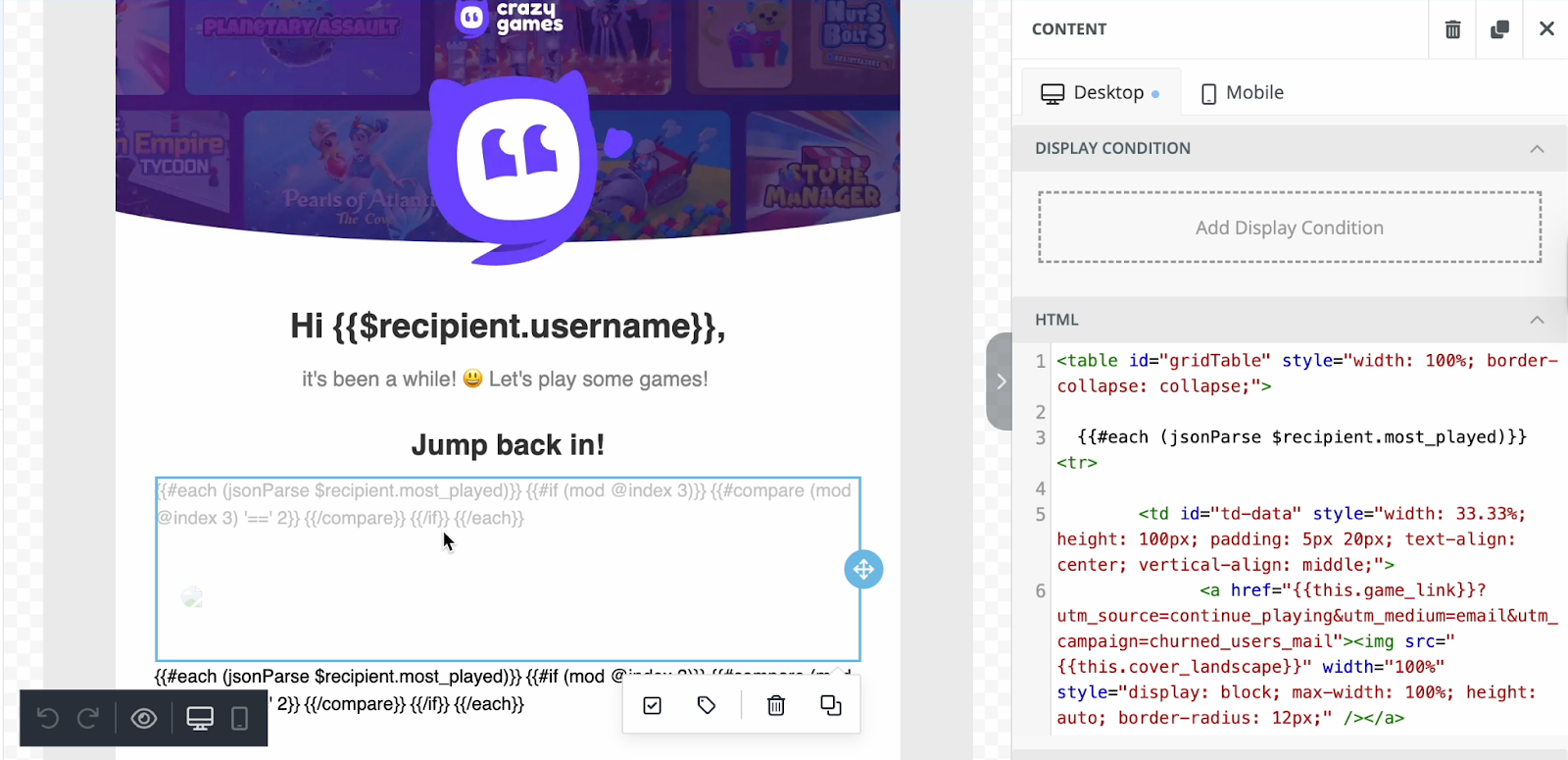
Dynamic Templates
Each variant is powered by SuprSend’s WYSIWYG template editors. Example: The survey version includes a Typeform link + three personalized game suggestions pulled directly from the user’s database record with SQL.
Monitoring & Analytics
Inside SuprSend, the team tracks delivery and engagement at the notification level. Impact analysis, reactivation rates, and A/B performance are then measured in CrazyGames’ own analytics system, using the tagged user groups. The data is synced back into CrazyGames database with S3 sync.
Smooth integration and faster iteration
Implementation with SuprSend was quick and straightforward.
“It took just a few weeks to switch over our first flows. No confusion, no blockers. SuprSend even built an Athena connector for us during the process so we could use the database sync.”
Jonas Boonen, VP of Product at CrazyGames
Today, even non-technical teams at CrazyGames run campaigns independently.
Business Impact
- Higher reactivation: players receiving nudges return more often.
- Smoother engagement: notifications feel natural, timely, and personal.
- Massive developer participation: monthly Game Jams now attract thousands of submissions — something engineering bandwidth couldn’t support before.
For CrazyGames, SuprSend made notifications:
- Faster to launch (weeks → hours)
- More flexible (dynamic content, personalization)
- Truly omnichannel (email, on-site, push-ready)
- Business-friendly (non-technical teams self-serve)
Adding Notifications shouldn’t take four weeks and two engineers. Notifications should be simple and with SuprSend, they are. Start now!
Other success stories

How a Reporting Service Provider Launched a Complete Notification System in Just Two Weeks