
Last Updated: May 2026
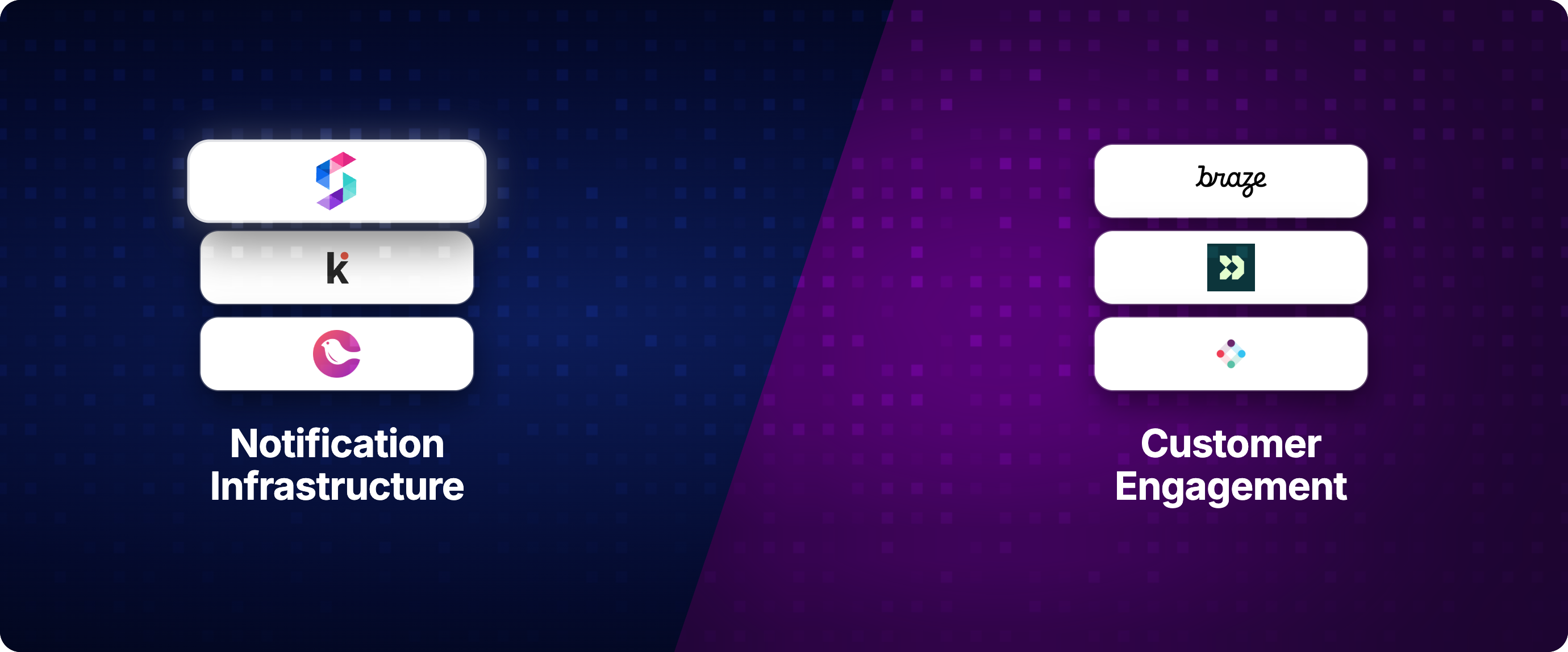
Customer engagement platforms (CEPs) like Braze, CleverTap, MoEngage, and Iterable were built around a question marketers ask: "How do I keep users engaged across email, push, in-app, SMS, and WhatsApp?" Notification infrastructure Platforms (NIPs) like SuprSend, Knock, Courier, and Novu was built around a different question engineers ask: "How do I send a transactional notification reliably across all channels without re-inventing the workflow engine?"
The categories solve different problems with different architectures. Treating them as alternatives is the most common buying mistake we see. This guide explains what each category does, where they overlap, where they don't, and how production teams actually use both.
What is a Customer Engagement Platform?
A CEP is a marketing-led platform that combines a customer data layer (CDP), behavioral segmentation, journey orchestration, multi-channel messaging, and engagement analytics. The core unit is a campaign or a journey, defined by a marketer.
The shape of the work: a marketer ingests user data and events, defines segments ("users who completed onboarding but haven't returned in 14 days"), builds a journey with branches and triggers, picks channels (push, email, in-app, SMS, WhatsApp), schedules sends, and watches conversion dashboards.
Examples: Braze, CleverTap, MoEngage, Iterable, Customer.io, Airship, Salesforce Marketing Cloud.
What is Notification Infrastructure?
NI is an engineering-led platform that handles the workflow logic, multi-channel routing, vendor abstraction, in-app inbox, preferences, templates, and observability for application-triggered notifications. The core unit is a workflow, triggered by code on an event.
The shape of the work: an engineer integrates the API, defines a workflow ("on user.password.reset.requested, send email, fall back to SMS if not delivered in 5 minutes, log every step"), and the platform handles routing, retries, vendor failover, preferences, and rendering. Templates can be edited by product or marketing without engineering.
Examples: SuprSend, Knock, Courier, Novu, MagicBell, Engagespot.
Customer Engagement Platforms vs Notification Infrastructure Platforms
| Dimension | Customer Engagement Platform | Notification Infrastructure |
|---|---|---|
| Core unit of work | Campaign / journey | Workflow / event |
| Primary buyer | VP Marketing, Growth lead | VP Engineering, CTO, Product lead |
| Daily user | Marketer, lifecycle manager | Backend engineer, product manager |
| Trigger source | Marketer-defined; behavioral segments; schedules | Application code; system events; webhooks |
| Data model | CDP with rich behavioral profile | Lean user object plus event payloads |
| Strongest at | Lifecycle, retention, promo, experimentation | Transactional, product, collaboration; multi-tenant SaaS |
| Multi-tenancy | Limited; rarely first-class | First-class on platforms built for B2B SaaS |
| Logs | Campaign-level; less per-step granularity | Per-notification, per-step, per-vendor-call |
| Templates | Marketer-edited with rich content tools | WYSIWYG with versioning and i18n |
| Pricing | Custom annual contracts | Usage-based, often public, free tier common |
| Compliance | Marketing consent, suppression lists | SOC 2, HIPAA, audit logs, RBAC |
The Engagement Playbook vs the Infrastructure Playbook
The two categories aren't just different products; they reflect different operating playbooks.
The engagement playbook
- Marketer ingests user data and events into the CDP.
- Marketer defines a behavioral segment.
- Marketer builds a journey: send X, wait Y, branch on Z.
- Marketer ships, watches conversion, iterates on copy and timing.
- Engineering's role: keep the data pipe healthy.
The infrastructure playbook
- Engineer integrates the notification platform's API.
- Engineer (or product manager) defines workflows for system events.
- Engineer triggers workflows from application code on events.
- Platform handles routing, retries, vendor failover, preferences, logs.
- Marketing's role: edit templates, consume logs and analytics.
Picking a CEP for the infrastructure playbook (or NI for the engagement playbook) creates a shape mismatch that grinds teams down within months.
When to Pick Each
Pick a CEP when
- The core question is "how do we keep users engaged across the lifecycle?"
- Marketing or growth owns the messaging strategy
- You need behavioral segmentation, journey orchestration, holdout groups, and attribution
- You have a marketing team that can own the platform day-to-day
- Your messages are mostly promotional, lifecycle, or retention-focused
Pick notification infrastructure when
- The core question is "how do we send transactional and product notifications reliably across channels?"
- Engineering owns the messaging surface
- You need multi-tenancy, per-step logs, vendor abstraction, and an in-app inbox
- Your messages are mostly triggered by application events
- You sell to other businesses (B2B SaaS) and need per-tenant control
Pick both when
- You're past Series A with separate marketing and product engineering teams
- You have transactional and product notification volume that warrants NI
- You also have lifecycle and promotional programs that warrant a CEP
- You can invest in clear preference center boundaries between the two stacks
The Hybrid Stack: How Production Teams Run Both
Above ~100 employees, the dual-stack is the norm. The pattern that works:
- NIPs handle transactional and product notifications. Password resets, mentions, comments, status changes, security alerts, OTPs. Triggered by application code.
- CEPs handle lifecycle and promotional campaigns. Onboarding flows, re-engagement, win-back, weekly digests, sales. Triggered by behavioral segments.
- One source of truth for opt-in state. Either the NI preference center or the CEP's preferences holds the master record. The other consumes it via API or webhook. Without this, users get conflicting messages or unsubscribe state diverges.
- Shared user identifier. The same user_id flows through both systems so logs and analytics can join.
- Clear category boundaries. Define what "transactional" means and what "marketing" means. Edge cases (re-engagement, abandoned cart) get assigned to one stack consistently.
For more on architecting the boundary, see comparing notification infrastructure and marketing automation and the multi-channel notifications guide.
A Note on Cost
CEPs are sales-led with custom annual contracts that frequently land in the tens of thousands per year. Public pricing is rare. Evaluation cycles take months and require procurement signoff.
NI platforms typically publish usage-based pricing. SuprSend's free tier covers 10,000 notifications per month; production paid tiers start at $110/mo. Knock, Novu, MagicBell, and Engagespot all post tiers publicly. Free tiers are live the same day you sign up.
For startups and mid-market teams shipping a transactional layer, this is the most under-appreciated practical difference. NI gets you to a working integration in days. CEP evaluation takes a quarter.
Where SuprSend Fits
SuprSend is in the notification infrastructure category. It's built for engineering and product teams sending transactional, product, and collaboration notifications across push, email, SMS, in-app inbox, WhatsApp, Slack, and MS Teams.
SuprSend isn't a customer engagement platform. We don't include a CDP, behavioral segmentation, holdout groups, or marketing attribution. Teams running real lifecycle programs typically pair SuprSend with a CEP, with one preference center as source of truth.
For the infrastructure playbook (transactional reliability, multi-channel routing, multi-tenant SaaS, per-step logs, public usage pricing), SuprSend is one of the leading options.
Frequently Asked Questions
What's the difference between notification infrastructure and a customer engagement platform?
Notification infrastructure is engineering-led, triggered by application events, optimized for transactional reliability, per-step logs, multi-tenancy, and vendor abstraction. A CEP is marketing-led, triggered by behavioral segments on top of a CDP, optimized for lifecycle journeys, segmentation, and engagement analytics. They solve different jobs.
Can I use a CEP for transactional notifications?
Technically yes; practically no. CEPs are built for promotional and lifecycle campaigns. Per-step logs, multi-tenancy, transactional reliability, and engineering-friendly APIs aren't their strongest dimensions. Most teams that try this end up with brittle business logic in a marketing tool and migrate to notification infrastructure for the transactional layer.
Can notification infrastructure replace my CEP?
Only if you weren't really using the CEP capabilities (segmentation, journeys, attribution). For teams sending mostly transactional and product notifications, NI is a complete replacement. For teams running real lifecycle programs, NI doesn't replace a CEP; the two coexist.
Should I use both a CEP and notification infrastructure?
Above ~100 people with separate marketing and product engineering teams, almost always yes. NI handles transactional and product notifications. The CEP handles lifecycle and promotional. One preference center holds the source of truth for opt-in state.
How do I split which messages go where?
Apply this rule: if application code triggers it on a system event (password reset, order confirmation, mention, status change), it belongs in NI. If a marketer triggers it from a behavioral segment (cart abandonment, weekly digest, re-engagement, sale), it belongs in the CEP. Edge cases get assigned consistently and documented.
Is notification infrastructure cheaper than a CEP?
Generally yes. NI commonly publishes usage-based pricing starting under $300/month for production tiers, with free tiers covering 10,000 notifications. CEPs sell custom annual contracts starting in the tens of thousands. For startups, the cost gap is significant.
What if my team is too small for both stacks?
Below ~50 people with a single product team, picking one is fine. Pick based on the dominant playbook: if you're sending mostly transactional, pick NI. If you're sending mostly marketing, pick a CEP. The dual-stack pattern emerges as marketing and product engineering teams diverge.
TL;DR
Notification infrastructure is engineering-led platforms built for transactional and product notifications triggered by application events. Customer engagement platforms are marketing-led platforms built for lifecycle and promotional campaigns triggered by behavioral segments on top of a CDP. They solve different jobs with different architectures, different buyers, and different pricing models. Pick NI when engineering owns the messaging surface and most messages are application-triggered. Pick a CEP when marketing owns the strategy and journeys are segment-triggered. Above ~100 people, run both with one preference center as source of truth.
Next Steps
If you need notification infrastructure for transactional and product notifications, the SuprSend free tier includes 10,000 notifications per month across every channel. Or book a 30-minute call to walk through where SuprSend fits alongside your existing CEP.


